









Good evening. This is JNN, bringing you the major stories of Tuesday, August 25, 2026.
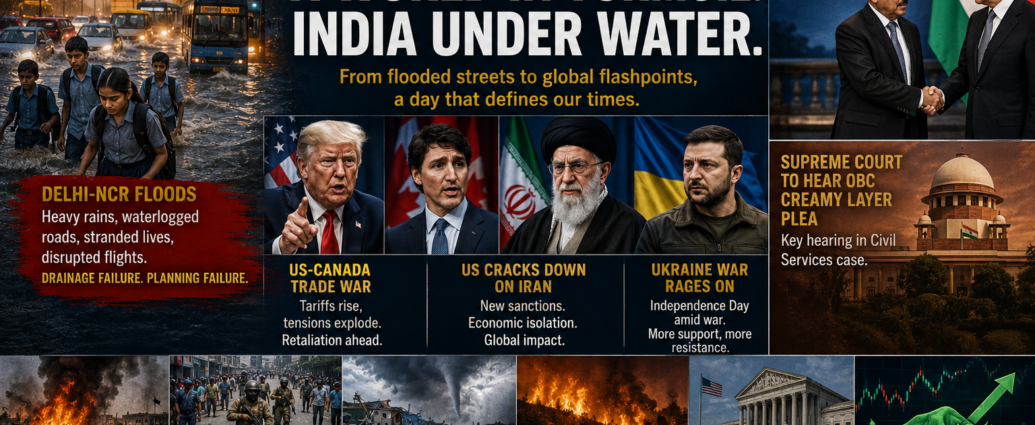
Tonight, India is battling another punishing day of monsoon rain, with Delhi-NCR once again resembling a city that has temporarily misplaced its drainage system. Roads have disappeared beneath floodwater, traffic has crawled to a standstill, schoolchildren have been stranded for hours and the question being asked with increasing frustration is no longer whether it will rain, but whether our cities are capable of surviving it.
Delhi was placed under a red alert as heavy rain returned on Tuesday, flooding stretches around Connaught Place, AIIMS, ITO and other major parts of the capital. Gurugram has been hit particularly hard, with authorities advising offices and educational institutions to shift to work-from-home and remote-learning arrangements. At least 12 school buses were reportedly stranded near Subhash Chowk, while children and parents were forced to wade through knee-deep water.
The scenes are becoming painfully familiar. Waterlogged roads, submerged vehicles, stranded commuters and emergency crews pumping water out of places that presumably were not designed to become swimming pools.
The IMD has warned of further heavy rain, thunderstorms, lightning and gusty winds. The crisis has also exposed the chronic weakness of urban drainage and planning, with the same roads and neighbourhoods repeatedly flooding whenever the skies decide to test India’s infrastructure.
But while the rain dominates the domestic picture, India’s strategic landscape is moving in a very different direction.
National Security Adviser Ajit Doval held the 25th round of India-China Special Representatives’ talks in Beijing with Chinese Foreign Minister Wang Yi. The discussions focused on the boundary question and the broader effort to stabilise relations after years of military tensions. Both sides are attempting to sustain the fragile thaw, with wider India-China engagement expected to remain significant ahead of possible high-level meetings.
From flooded streets to high diplomacy, India is dealing with two very different kinds of turbulence.
On the political front, the Supreme Court has agreed to consider the Centre’s plea concerning the applicability of OBC creamy-layer criteria to candidates appearing for the Civil Services Examination 2025. Meanwhile, student protests and political tensions continue in several states, adding another layer to an already restless domestic landscape.
The Indian markets, however, offered some relief. The Sensex gained roughly 287 points, while the Nifty closed around 24,335, with healthcare and pharmaceutical stocks among the stronger performers.
And now to the world, where diplomacy is increasingly being conducted with tariffs, sanctions and threats.
The United States and Canada are heading towards another major trade confrontation. President Donald Trump has threatened to raise tariffs on Canadian automobiles and auto parts to 50 per cent from January 2027, after Washington imposed 50 per cent tariffs on around $20 billion worth of other Canadian goods. Canada has indicated that retaliatory measures could follow. The dispute threatens to disrupt one of the world’s most deeply integrated trading relationships and could ultimately raise costs for consumers on both sides of the border.
Washington is simultaneously turning the economic screws on Iran.
Treasury Secretary Scott Bessent has announced “Operation Economic Outcast”, a sweeping sanctions campaign intended to sever Iran’s remaining international economic lifelines. The measures target entities and networks connected with Iran across sectors including digital assets, technology, gold, aviation and shipping, while Washington has warned countries and companies doing business with Tehran that they too could face consequences. Iran has threatened retaliation, while China has urged Washington to act rationally. The danger is not merely diplomatic.
Iran’s currency has plunged to record lows, while markets are watching closely for any disruption to energy supplies and shipping through the strategically vital Strait of Hormuz. What begins as an economic offensive can very quickly become an energy crisis, and what becomes an energy crisis rarely remains somebody else’s problem for very long.
The Russia-Ukraine war continues with no clear end in sight. Ukraine marked its 35th Independence Day amid the continuing Russian invasion, with European leaders gathering in Kyiv to reaffirm support for President Volodymyr Zelenskyy. British Prime Minister Andy Burnham announced that Britain would provide access to classified technology related to Storm Shadow missiles, potentially helping Ukraine develop domestic production capability. The UK and Ukraine have also signed a new artificial-intelligence defence partnership.
Russia, meanwhile, continues its attacks on Ukrainian infrastructure, while Ukraine continues its campaign of drone strikes against targets inside Russia.
In Gaza, the humanitarian crisis remains grim. Israeli strikes have reportedly hit a mosque, a water desalination facility and tents housing displaced Palestinians, with civilians, including children, among those killed. The violence continues despite repeated diplomatic efforts to secure a lasting ceasefire.
And in Haiti, the security situation has deteriorated further. A gang raid in the Kenscoff area near Port-au-Prince reportedly killed at least 47 people and injured around 22, with homes set ablaze.
The United States is also confronting a fresh domestic political and legal battle after the Supreme Court allowed parts of President Trump’s executive order concerning mail-in voting and election rules to proceed, at least temporarily.
Across the Atlantic, a tornado has struck parts of southern France, damaging homes and causing injuries and power outages, while wildfires and extreme weather continue to challenge communities in several regions.
And so, as JNN closes tonight’s bulletin, the picture is striking.
India is fighting water at home while navigating power politics abroad.
Our cities are struggling with rain that should be manageable with competent drainage and planning. Our diplomats are working to stabilise relations with a powerful neighbour. Our markets are watching trade wars and sanctions thousands of kilometres away. And the global economy is increasingly vulnerable to conflicts that can turn from political disputes into energy, food and financial crises almost overnight.
The world is becoming more interconnected, but it is not necessarily becoming more cooperative.
Tonight, the message from Delhi’s flooded streets to the diplomatic rooms of Beijing, Washington and Kyiv is remarkably similar:
The cost of poor planning is eventually paid by ordinary people.
This is JNN.
Good night, stay safe, and stay informed.
JANPATH NEWS NETWORK (JNN)
Independent. Fearless. On the People’s Path.