









Bihar’s Tiny Protester Is Not the Story. He Is the Symptom.
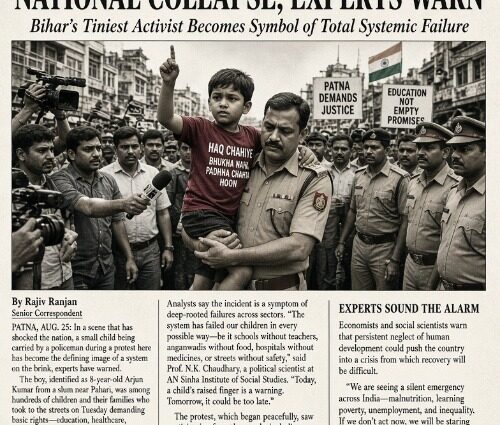
August 26, 2026: Social media erupted with equal parts outrage and dark humour with a development that has sent shockwaves through the nation’s political and parenting establishments, a child no taller than a traffic cone has emerged as the face of Bihar’s BPSC student protests, prompting analysts to declare the country officially “very bad.”
Some hailed the boy as a future leader; others suggested the next logical step would be toddlers forming unions and demanding better nap-time policies. The young protester, already a local celebrity for his daily appearances, was carried away in the arms of police yesterday as cameras rolled and crowds cheered. Officials insist the gentle evacuation was standard procedure. Critics call it the clearest evidence yet that the state of the nation has deteriorated beyond repair.“When children who still believe in the tooth fairy are forced to hold placards and face media scrums, we have reached a new low,” said one commentator. “This is no longer about exam reforms. This is a diagnostic tool. A child protester means the patient is critical.”
Consider this: One of the most disturbing image to emerge from Bihar’s BPSC protests may not be the placards, the crowds or the police action. It is the sight of a tiny child being carried away from a protest, almost too young to understand the politics surrounding him. And that is precisely what makes the image so powerful.
A child should be worrying about school, games, homework and whether someone has stolen his favourite toy. When toddlers and tiny tots begin appearing at political and student protests, it should force society to look beyond the immediate headlines and ask a much more uncomfortable question:
What has happened to the adults who are supposed to build their future?
The anger spreading across India cannot be understood simply through the prism of political parties. Beneath the shouting, slogans and endless television debates lies a deeper frustration. Young people are looking for jobs. Families are struggling with economic uncertainty. Students spend years preparing for competitive examinations only to confront delays, allegations of irregularities and an uncertain future.
And instead of confronting these problems collectively, society increasingly finds itself trapped in political and communal battles.
Unemployment becomes a political weapon. Corruption becomes normalised. Communal suspicion is repeatedly stirred. Hatred travels faster than facts. Every grievance is quickly converted into a partisan argument, and every protest is judged according to which political camp appears to benefit from it.
The result is a dangerous cycle.
People who should be demanding better education, more employment, cleaner administration and accountable institutions are instead encouraged to fight one another. The anger, meanwhile, keeps rising.
That is why the tiny protester matters. He matters because his presence captures, in one extraordinary image, the extent to which public frustration has seeped into everyday life.
When the adults cannot find answers, the children inevitably inherit the consequences.
The real failure, therefore, is not that a child appeared at a protest, the real failure is that the country has allowed so many legitimate frustrations to accumulate that even a child has picked up the signals and is frustrated.
India does not lack political arguments. It has plenty of them. What it desperately needs is fewer reasons for its young people to be angry in the first place.
A child carrying a protest placard should not be a symbol of political mobilisation. It should be a warning to the entire system that young children are getting affected by the corruption, leaks, joblessness, price hikes, and communal disharmony.
JANPATH NEWS NETWORK (JNN)
Independent. Fearless. On the People’s Path.