










India 2047: The Superpower India Must Become
India’s journey towards 2047 is usually described in the language of economic growth, military strength, technological ambition, infrastructure and global influence. We speak of becoming a manufacturing powerhouse, a leader in artificial intelligence, space and semiconductors, and of acquiring the strategic weight that comes with being one of the world’s most powerful nations.
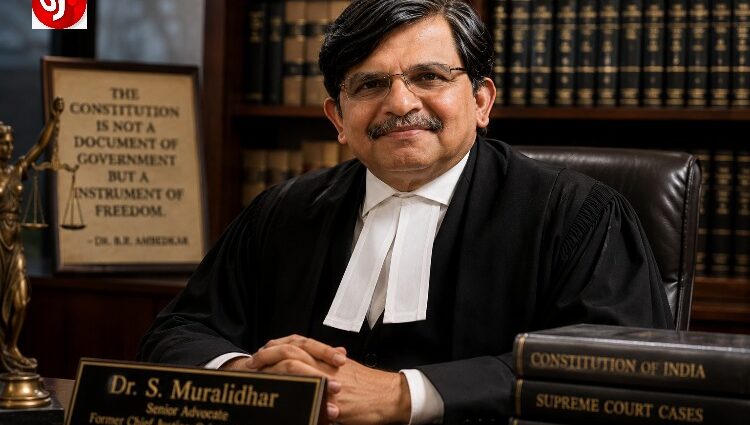
But Dr. S. Muralidhar, Senior Advocate and former Chief Justice of the Orissa High Court, offered a very different way of looking at India’s destiny when he delivered the 28th D.S. Borker Memorial Lecture on My Vision of India.
At the heart of his vision was something far less glamorous than missiles, satellites or stock-market valuations: the rule of law.
His argument, taken as a whole, points towards a profound proposition. India cannot become a genuine superpower merely by accumulating wealth and military power. It must also build institutions strong enough to protect the citizen from the misuse of that power.
A country can have the world’s largest corporations, sophisticated digital infrastructure and an increasingly formidable military. But if an ordinary citizen is afraid to criticise the government, if peaceful protest is treated as conspiracy, if criminal law is used to silence dissent, and if constitutional questions take years to resolve, then something fundamental remains unfinished.
Muralidhar’s vision of India in 2047 is therefore not simply about how powerful India will become. It is about what kind of country will possess that power.
One of his strongest arguments concerned freedom of expression. He said that the India of 2047 would be better served if honest criticism of the government and those running it was not criminalised, including through cartoons and jokes by stand-up comedians. He also argued against using the law against people peacefully protesting the denial of basic rights.
It is here that his vision becomes larger than a legal reform agenda. It becomes a statement about the confidence of the Indian state.
A weak government fears criticism. A confident government can withstand it.
A mature democracy understands that criticism is not necessarily an attack upon the nation. Sometimes it is precisely how a nation discovers where it is going wrong.
And Muralidhar put the larger democratic challenge in particularly direct terms when he said:
“India of 2047 would be better served if the law doesn’t permit criminalising honest criticism of the government.”
That sentence deserves to sit at the centre of any serious discussion about India’s future.
The India of 2047 will be younger, more connected and more assertive than the India of today. Its citizens will ask questions. They will challenge authority. They will mock politicians. They will protest. They will disagree, often loudly, because apparently humanity has decided that agreement is too boring to be sustainable.
The answer cannot be to criminalise every uncomfortable voice.
Muralidhar’s observations about Gen Z were particularly revealing. He saw the recent protests by young people as evidence that democracy in India would not simply be allowed to die. He described the generation as willing to turn towards the Constitution to safeguard the country’s future, question those in power and resist political rhetoric and propaganda.
His assessment of the young generation was unusually hopeful.
“The irreverence of Gen Z is a sure sign of democratic progress.”
That is more than a comment about a particular generation. It is a statement about the relationship between democracy and dissent.
The young Indians who will inherit the country cannot merely be treated as an economic resource. They will also be the custodians of the Republic.
They will become its judges, soldiers, scientists, entrepreneurs, civil servants, teachers, journalists and political leaders. Their relationship with democracy will help determine whether India’s rise is merely economic or truly civilisational.
A powerful India must therefore create citizens who are confident enough to question the state and a state confident enough to answer them.
That confidence must extend to the judiciary.
Muralidhar argued that the judiciary of 2047 should not take years to decide questions of enormous constitutional importance. He pointed to the extraordinary delays involved in cases concerning the reduction of a State to a Union Territory, demonetisation and electoral bonds.
Justice is not simply about eventually reaching the correct conclusion. Timing matters A judgment delivered after the moment requiring it has passed can become an exercise in historical documentation rather than effective justice.
If India wants to operate one of the world’s largest economies, attract enormous investment and compete globally in technology and manufacturing, it will need a legal system capable of functioning at comparable speed.
India cannot have a twenty-first-century economy operating alongside a legal system where important cases spend years waiting for their turn.
That is why Muralidhar’s criticism of the country’s so-called fast-track courts is important. Simply redesignating existing judges and asking them to handle additional specialised responsibilities does not magically create judicial capacity. It merely gives an already overloaded system another label.
Real reform requires judges, courtrooms, staff, technology and administrative capacity.
It also requires digitisation. Muralidhar pointed to delays caused when judges and lawyers cannot access physical case files. In an India that can conduct banking transactions from a mobile phone, launch satellites into orbit and deliver digital public services to hundreds of millions of people, it is difficult to defend a judicial system in which a hearing can be affected because a physical file has failed to appear.
By 2047, the courts should be fully digital, with secure and searchable records, efficient case management, transparent scheduling and easy access to documents.
Technology should not merely make courts look modern. It should make justice faster.
Muralidhar also raised a deeper problem: laws are often passed without adequately considering the burden they will place upon the judiciary.
He referred to the 1988 amendment to the Negotiable Instruments Act that criminalised cheque bouncing and argued that the resulting litigation has placed an enormous burden on Magistrate Courts.
His conclusion was blunt:
“Decriminalising the offence of cheque bouncing and restoring status quo is a no-brainer.”
The larger principle is crucial.
Whenever Parliament creates a new offence, there should be a serious assessment of its consequences.
How many cases will it generate, police investigations, prosecutions, trials, how many judges will be required, how many years will the additional workload add to the existing backlog, because law cannot be designed in isolation from the institutions that must implement it.
If Parliament creates an offence without considering judicial capacity, it may solve one perceived problem while creating another.
India in 2047 will need legislation that is not merely politically attractive but institutionally sustainable.
The same principle applies to criminal law.
Muralidhar called for the repeal of preventive detention laws and criticised stringent provisions under laws such as the UAPA and PMLA, particularly provisions that make bail exceptionally difficult.
The question is not whether the state should possess powers to protect national security. Every serious nation needs such powers.
The question is whether extraordinary powers remain genuinely extraordinary as a democracy becomes vulnerable when the criminal law begins to treat disagreement itself as evidence of criminality.
A peaceful protest demanding basic rights is not automatically a conspiracy; a journalist asking uncomfortable questions is not automatically an enemy of the state; a comedian making an offensive joke is not necessarily threatening national security; and a citizen criticising the government is not necessarily working against the country.
A confident India should be capable of making those distinctions.
Muralidhar’s criticism of judicial culture also deserves attention because it exposes a different kind of institutional weakness.
He questioned feudal and patriarchal practices within the legal system, including elaborate forms of address such as “Your Lordship”, the practice of lower-court judges and staff lining up to greet visiting senior judges, and even the existence of an “entertainment fund”.
The symbolism is more important than the ceremony. A democratic judiciary should not resemble a feudal court.
Judges should command respect because of their constitutional authority, independence, integrity and intellectual strength, not because the institution surrounding them reproduces rituals inherited from another era.
The centre of the justice system should ultimately be the citizen who walks into a courtroom seeking justice, not protocol, hierarchy, institutional vanity, the litigant.
Muralidhar’s call for an independent Bar is equally significant. He argued for a reformed and democratic Bar Council of India free from executive and judicial interference.
An independent judiciary cannot function properly without an independent legal profession.
Lawyers must be able to represent unpopular individuals, challenge governments and defend constitutional rights without fearing that their professional independence can itself be compromised.
That is not a luxury of liberal democracy but rather one of its foundations. Taken together, these arguments suggest a much broader definition of what India must accomplish by 2047.
The first requirement is obviously economic strength. India must continue expanding manufacturing, infrastructure, innovation, technology, energy security and employment. A country cannot become a global superpower while leaving large sections of its population without meaningful economic opportunity.
The second is human capital.
India’s greatest resource is not buried underground. It is sitting in its classrooms, laboratories, factories, farms, offices and start-ups. The young population must receive world-class education, skills, healthcare and opportunities to innovate.
But human capital is not merely about producing workers. It is about producing citizens who think, question, create and who understand that patriotism does not require intellectual obedience.
The third requirement is institutional strength.
India’s institutions must become strong enough to survive political changes. Ultimately, governments, leaders, come and go, but the courts, Parliament, constitutional bodies, investigative institutions and regulatory systems must retain credibility and independence.
A superpower cannot depend upon the personality of whoever happens to occupy an office, it requires institutions that remain reliable regardless of who occupies that office.
The fourth requirement is social cohesion.
India’s diversity is not a weakness. It is one of its greatest strategic advantages, but diversity becomes a source of strength only when citizens believe that they have an equal stake in the nation.
A country that constantly divides its population into political enemies, ideological camps and permanent antagonists wastes enormous energy fighting itself.
India’s rise will require something more difficult than uniformity. It will require coexistence.
The India of 2047 must be able to disagree without treating disagreement as treason.
And finally, there is constitutional confidence.
Perhaps this is the deepest thread running through Muralidhar’s vision.
India does not have to choose between national strength and civil liberty, the two can reinforce each other. A citizen who can criticise the government without fear does not weaken the nation, a protester demanding basic rights does not automatically threaten the state, a cartoonist making fun of a minister does not bring down the Republic, a judge delivering an inconvenient judgment does not betray the government.
A democracy that can tolerate these things is not weak.
India’s ambition to become a superpower by 2047 will therefore be judged by much more than its GDP, military capability, technological achievements or diplomatic influence.
The real test will be whether India can combine power with restraint, speed with justice, technological sophistication with institutional wisdom, and economic ambition with social fairness.
The ultimate measure of a powerful nation is not simply how much power it possesses, it is how confidently it can afford to restrain that power.
And perhaps that is the India that deserves to lead the world in 2047: not merely a country powerful enough to command respect, but a country confident enough not to fear its own people.
JANPATH NEWS NETWORK (JNN)
Independent. Fearless. On the People’s Path.