










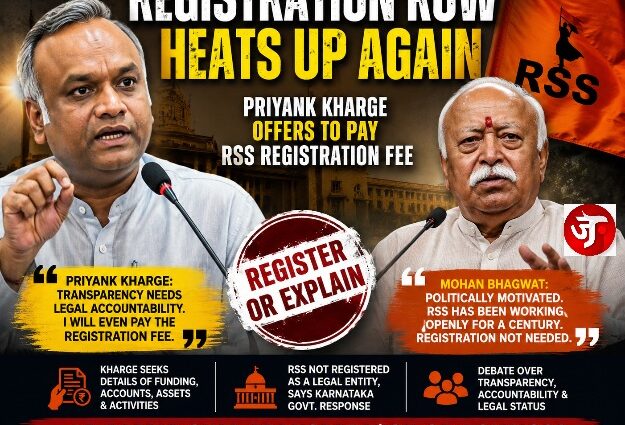
Karnataka Home Minister Priyank Kharge has once again challenged the Rashtriya Swayamsevak Sangh (RSS) to formally register itself, taking his campaign for greater transparency a step further by offering to personally pay the registration fee.
Kharge said the issue was not whether the RSS exists, but under what legal framework it operates. He has repeatedly questioned the organisation’s legal status, financial structure, ownership of assets, donations, accounts and tax compliance.
Taking a sharper line this week, Kharge said he was even prepared to pay for the registration of RSS units across Karnataka from his MLA funds or salary, and offered to extend the arrangement to RSS units elsewhere in the country.
The minister’s argument is straightforward: an organisation with a century-long history and a vast nationwide presence should not, in his view, remain outside a clearly defined legal identity and public accountability framework.
Kharge has previously asked the RSS to disclose its office-bearers, sources of donations and other income, expenditure, assets and tax compliance, as well as the legal basis on which it conducts large public events and route marches without formal registration.
The controversy intensified after BJP leaders questioned Kharge over an official Karnataka government response stating that there were no criminal cases registered against the RSS. Kharge’s answer was that because the RSS itself is not a registered legal entity, cases are registered against individuals rather than against the organisation.
The RSS and its supporters reject Kharge’s premise.
RSS chief Mohan Bhagwat has described the registration demand as politically motivated, arguing that the organisation has functioned openly for a century and does not require formal registration simply to establish its existence. Bhagwat has also maintained that registration is generally relevant for organisations seeking government funding, which the RSS does not, and has rejected suggestions that the organisation operates secretly.
An RSS functionary in Karnataka has separately said that the organisation would comply if the government enacted a law making registration mandatory for all organisations, while asserting that its existing financial arrangements are properly accounted for.
The political confrontation therefore goes beyond a registration fee.
At its heart is a larger question: how much legal and financial transparency should be expected from an organisation of the RSS’s size, influence and national reach?
Kharge argues that historical longevity and public visibility cannot substitute for legal accountability. The RSS, meanwhile, maintains that its open functioning and existing legal arrangements make compulsory registration unnecessary.
For the moment, neither side appears inclined to back down.
And Kharge’s offer to pay the registration fee has given the dispute a distinctly provocative new twist: the minister is now effectively telling the RSS, register first and argue about the politics later
JANPATH NEWS NETWORK (JNN)
Independent. Fearless. On the People’s Path.