





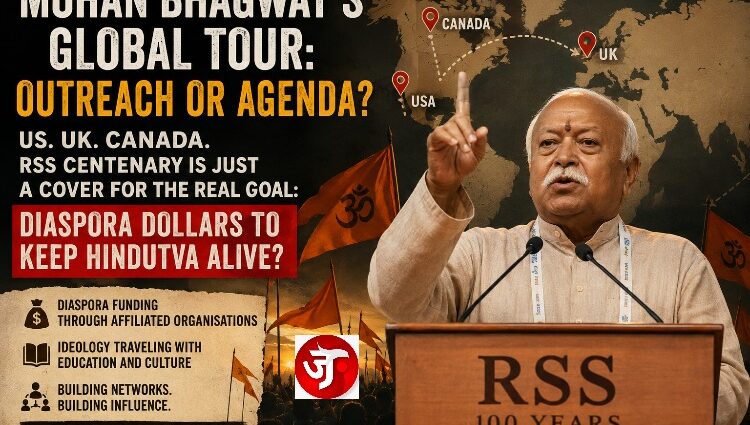
Why is Mohan Bhagwat rushing through the US, UK and Canada at a moment when the RSS is celebrating 100 years?
The official explanation is perfectly respectable: centenary-year outreach, engagement with the Indian diaspora, correcting what the RSS calls misconceptions about Hinduism and India, and spreading the message of “Vasudhaiva Kutumbakam.”
But not everyone believes it is only to spread Vasudhaiva Kutumbakam, which is contrary to the RSS ideology, so it is somewhat of a paradox.
In the video below, Muralidharan Gopal, former World Bank consultant writes
Why is Mohan Bhagwat rushing through the US, UK, and Canada?
It’s about ‘Diaspora dollars”.
The RSS centenary is just a cover for the real agenda:
Securing overseas cash flow for keeping Hindutva alive.
As she discerns, politics is rarely just about the words printed on the invitation card. If Bhagwat is going for the Diaspora Dollars, how does it fit in the bigger picture of their agenda?
The more uncomfortable question is this: what does the RSS gain from building an increasingly powerful relationship with the Indian diaspora? Because there is a long and documented history here.
The RSS itself is not a conventional registered charity collecting foreign donations. But the wider Sangh Parivar ecosystem contains numerous organisations and charities operating in the United States, Britain, Canada and elsewhere, and these organisations have raised substantial sums for activities in India.
It would be misleading to say that every dollar donated to a Sangh-linked organisation is secretly funding Hindutva. Much of the money goes toward schools, rural development, disaster relief and other charitable activities. But it would be equally naïve to pretend that ideology and social work have always existed in completely separate compartments.
The history of organisations such as the India Development and Relief Fund and Ekal Vidyalaya has generated precisely this controversy. Critics have argued that some ostensibly developmental programmes have also served a broader project of Hindu cultural and ideological consolidation. Supporters reject that characterization and describe the programmes as genuine grassroots development.
So the issue isn’t simply “Where is the money going?”
It is also:
What networks are being built? What institutions are being strengthened? What worldview travels with the money? And who ultimately gains influence from that ecosystem?
And what is the definition of Hindutva? In its most radical form, Hindutva can be understood as an ethno-nationalist vision of India as fundamentally a Hindu nation, where Hindu identity is treated as the central criterion of national belonging. In this conception: Muslims and Christians can be portrayed as communities whose historical or religious loyalties lie partly outside India, making their national belonging subject to suspicion. Secularism can be portrayed as appeasement of minorities, rather than equal citizenship.
In the Hindutva ideology, India is regarded primarily as the homeland of Hindus, rather than as a religiously neutral nation belonging equally to all faiths.
That is why Bhagwat’s North American and British tour deserves scrutiny.
The RSS can legitimately say that this is a centenary outreach programme. It can point to community meetings, cultural events, religious visits and its message of global Hindu unity.
But critics are equally entitled to ask whether diaspora mobilisation has become an important pillar of the Sangh’s international influence.
And there is another uncomfortable contradiction.
Bhagwat has publicly emphasised that the Sangh operates through volunteer contributions and has rejected the idea that the RSS itself depends on foreign money. Technically, that is an important distinction. The RSS itself cannot simply receive FCRA donations in the manner of a registered Indian NGO.
But ideology does not need to travel through one bank account. It travels through networks, charities, educational institutions, cultural organisations, volunteers, donors and affiliated bodies.
That is the bigger story.
So, is there proof that Bhagwat’s 2026 tour is specifically a fundraising operation designed to “keep Hindutva alive” through diaspora dollars?
No. That claim has not been independently established.
But does the Sangh ecosystem have a long history of engaging the Indian diaspora, raising money abroad and using that international network to support organisations and activities in India?
Yes. That is documented.
And that makes the question legitimate. The centenary may genuinely be about outreach. It may genuinely be about explaining the RSS to a global audience.
But 100 years of an organisation does not automatically make the organisation innocent, nor does putting the words “Vasudhaiva Kutumbakam” on a banner make questions about power, money and ideology disappear.
The real issue is therefore not whether Bhagwat is travelling merely to collect cheques. The real issue is how the RSS and its wider network are building political, cultural and financial influence across the global Indian diaspora – and what that influence ultimately does in India.
A centenary celebration can be both an anniversary and an opportunity for expansion. The two are not mutually exclusive.
And perhaps that is the question worth asking:
Is Bhagwat touring the diaspora simply to celebrate 100 years of the RSS or to build the next 100 years of its global influence? That question is harder to dismiss than the simplistic claim that the entire tour is merely a hunt for “diaspora dollars.”
JANPATH NEWS NETWORK (JNN)
Independent. Fearless. On the People’s Path.