





NDA Ally Chirag Paswan Backs Kharge Over Haldwani Purification Controversy
There are moments in politics when the argument is not really about what happened on the ground. It is about what a society believes certain people are allowed to be. The controversy over the “shuddhikaran” of Haldwani’s Ramlila Maidan after Congress president Mallikarjun Kharge addressed a rally is one of those moments. And it deserves to be examined carefully, because there are two competing explanations for what happened.
One says a religious-cultural venue was allegedly defiled by political activity and objectionable slogans, and a local organisation subsequently performed a havan to restore its sanctity.
The other says something far more disturbing happened: a public space was declared “polluted” after a Dalit national political leader stood on its stage.
The facts surrounding the ritual are not really in dispute. The meaning of the ritual is. And that is where this story becomes much bigger than Mallikarjun Kharge.
What actually happened?
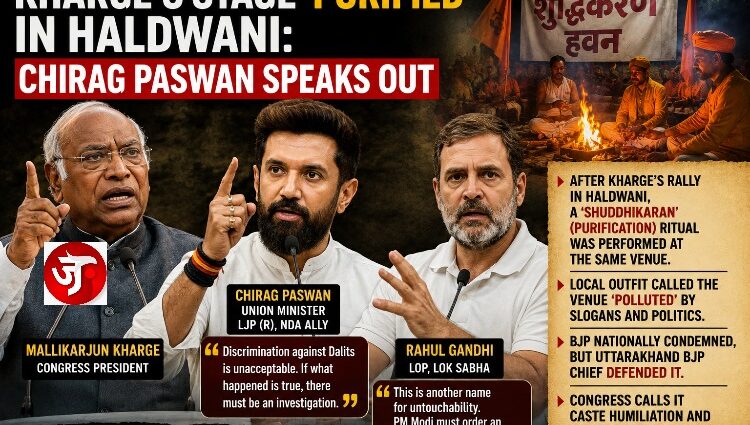
On August 8, Kharge addressed the Congress’s “Vijay Shankhnaad” rally at Ramlila Maidan in Haldwani, part of the party’s preparations for the 2027 Uttarakhand Assembly election. Two days later, on August 10, members of the Shri Ram Sena Dharmarth Seva Nyas Sangathan performed a havan and described it as shuddhikaran, or purification, of the venue.
The organisation said the ground had religious and cultural significance and should not be used for political programmes. It also alleged that objectionable slogans were raised during the Congress rally. Some reports specifically referred to slogans that the group described as Islamic.
That context should not simply be erased.
If objectionable slogans were indeed raised, they should be identified, investigated and condemned. But there is still a profound problem with what happened next.
Because the chosen response was not simply to condemn a slogan. It was purification.
And then came the word that changed everything: “polluted.”
When Kharge raised the issue in the Rajya Sabha on August 13, he said he had not mentioned any community or religion in his speech and had simply spoken about government issues.
He said the subsequent ritual made him feel the “sting of untouchability.” That reaction cannot simply be dismissed as political theatre. Kharge is a Dalit. So when a ritual is conducted to “purify” a stage immediately after a Dalit leader has addressed a public gathering there, the question naturally arises:
What exactly was being purified? The organisers say it was the venue; Kharge understood it as an insult to him, and that distinction is the heart of the controversy.
The BJP’s response is where the story gets even more complicated
Union minister and BJP president J.P. Nadda initially condemned the incident, said the BJP did not support such practices and indicated that the matter would be investigated. That should have ended the BJP’s ambiguity.
It didn’t.
Uttarakhand BJP president Mahendra Bhatt subsequently defended the ritual. His explanation was striking: the Ramlila Ground had been “defiled”; slogans had been raised at a place containing a Ram temple; “the place was polluted, and then it was purified.” There is the sentence that cannot simply be wished away.
Because once a senior BJP leader describes the venue as having been polluted, the controversy moves beyond a supposedly isolated act by a little-known local organisation. It becomes a question about the political culture surrounding that act.
If the BJP says, “We did not organise this,” that is one question. If another senior BJP leader says, in effect, “Yes, the place was polluted and purification was necessary,” that is another.
Both statements now form part of the public record.
Chirag Paswan entered the argument
Chirag Paswan, an NDA ally and Union minister, has not broken with the government over the controversy. His position is considerably more complicated than the social-media version suggesting that he has suddenly turned against the BJP.
He has, however, argued that discrimination against Dalits remains a serious concern and defended reservation as being rooted in social discrimination rather than merely economics.
Today, responding to Rahul Gandhi’s attack over the Haldwani episode, Paswan turned the question back on Congress: if discrimination still exists after decades in which Congress governed the country, why did successive governments fail to eliminate it? That is politically convenient for Paswan. But it doesn’t answer the Haldwani question.
The fact that Congress failed to eradicate caste discrimination does not make caste discrimination acceptable today.
History is not an alibi.
Rahul Gandhi has now taken the fight much further
On August 29, Rahul Gandhi called the purification ritual “another name for untouchability” and demanded an FIR under the SC/ST Act. He argued that if a senior leader such as Kharge could be subjected to such treatment, the implications for ordinary Dalits could be even more serious. He connected the episode to discrimination in schools, at water sources, tea shops and during wedding processions.
He also framed the controversy as part of a much larger ideological confrontation between the Constitution and the BJP-RSS worldview. That is obviously a political argument. But the underlying question is not partisan.
Can a democratic India have “polluted” citizens?
This is where the Haldwani controversy should force a much deeper conversation. India’s Constitution did not merely say that discrimination is impolite.
Article 17 abolished untouchability and prohibited its practice in any form. The Republic was built on an extraordinary proposition: your birth, religion, caste, or ancestry does not determine your dignity.
So if a public stage requires purification because a particular person occupied it, the country has every right to ask what idea of purity is being invoked. And if that ritual was genuinely about slogans rather than caste, then the organisers have an equally straightforward responsibility:
Haldwani has therefore produced a question much larger than Kharge
Was the Ramlila Maidan being purified because of alleged slogans? Or was the ritual, consciously or unconsciously, reproducing an ancient idea that certain people contaminate the social or sacred space simply by being there?
Because if a Dalit leader can stand before thousands of citizens as the president of one of India’s largest political parties, address the nation and exercise constitutional power, yet the stage is subsequently described as “polluted” and in need of purification, then India has a problem that goes considerably deeper than one political rally.
This is a tweet sent out by Roshan Rai, on X
JANPATH NEWS NETWORK (JNN)
Independent. Fearless. On the People’s Path.