









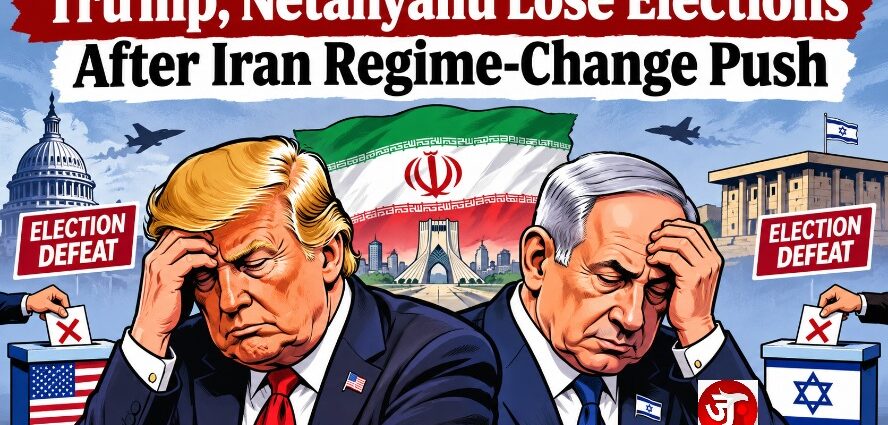
Trump and Netanyahu’s Iran Gamble: Two Leaders Face Electoral Rebuke as Regime-Change Ambitions Meet Political Reality
When two powerful leaders set out to reshape another country’s political destiny, their own voters have a reminder of their own: foreign wars do not come without a domestic political price.
Donald Trump and Benjamin Netanyahu entered their confrontation with Iran with an ambitious objective: weaken the Islamic Republic, dismantle its military capabilities and create conditions that could eventually bring about a change of government.
Both leaders projected military strength. Both spoke of a transformed Iran. Both appeared to believe that decisive military action could reshape the political landscape of the Middle East.
But November 2026 has brought a political reckoning for both.
In the United States, Trump’s Republicans suffered a sweeping defeat in the November 3 midterm elections, with Democrats capturing control of both the House of Representatives and the Senate. The result represents a major setback for Trump’s presidency, stripping his administration of unified congressional control for the final two years of his term.
In Israel, Netanyahu’s political bloc secured only 53 seats in the 120-member Knesset, falling eight seats short of the 61 needed for a governing majority. The opposition bloc secured 48 seats, while Arab-led parties won 19. Israel is therefore facing difficult coalition negotiations, with no clear governing majority emerging from the election.
Neither leader has been removed from office by these results. But both have suffered significant electoral setbacks, and the distinction matters.
Iran: The war that became a domestic political liability
The connection between the Iran conflict and the American electoral outcome is particularly significant.
According to Associated Press reporting, voter dissatisfaction over the war, rising fuel prices, the cost of living and concerns about the administration contributed to the Republican losses. Trump himself acknowledged that the eight-month Iran war and high petrol prices had hurt his party. AP News+1
The political consequences are substantial. Democrats now have the power to obstruct legislation, scrutinise the administration, investigate government decisions and challenge Trump’s political agenda. The war that was presented as an exercise of American strength has become an issue that his political opponents can pursue in Congress.
For Netanyahu, the electoral picture is equally complicated. His Likud party emerged with 27 seats, but his wider political alliance failed to secure a majority. The opposition, led by Gadi Eisenkot, has an opportunity to negotiate an alternative government, although the fragmented parliamentary arithmetic makes coalition formation difficult.
Two allies, different calculations
It is important to understand that Trump and Netanyahu did not always have identical objectives.
Netanyahu had pursued the weakening or overthrow of Iran’s leadership for decades. Trump, meanwhile, shifted between advocating regime change and insisting that his principal objectives were destroying Iran’s nuclear and missile capabilities.
In February 2026, Trump called on Iranians to take over their government. Netanyahu also encouraged an uprising against the Islamic Republic.
But the differences became apparent as the war progressed. A March 25 Axios report revealed that Trump had resisted Netanyahu’s suggestion that Iranians be urged to take to the streets, warning that they could face violent repression.
Destroying military infrastructure, eliminating political leaders and changing an entire political system are three very different undertakings.
Iran’s political future cannot simply be determined by Washington or Tel Aviv.
The limits of military power
The deeper question emerging from these elections is whether military victories can translate into political victories. A government may possess overwhelming military power, sophisticated weapons and powerful international alliances. but none of these automatically guarantees public support at home.
The American election has demonstrated that voters can judge a president not only on his foreign policy ambitions but also on the economic and political consequences of those decisions.
Israel’s election has exposed the difficulty Netanyahu faces in converting his security agenda into a parliamentary mandate, and Iran remains at the centre of a conflict whose ultimate political outcome is still uncertain.
There is a larger lesson here. Regime change is often discussed as though it were a military objective that can be achieved through airstrikes, assassinations and declarations from foreign capitals. But nations are not chessboards, and their populations are not pieces to be moved according to the ambitions of powerful leaders.
Trump and Netanyahu wanted to change Iran’s political destiny. Their own voters have now delivered a verdict on the direction in which their countries are being led.
Whether these electoral setbacks eventually alter their Iran policies remains to be seen. But one thing is clear: the political costs of war cannot always be contained within the borders of the country being bombed.
The irony here is Trump and Netanyahu wanted Iran’s regime changed. voters changed their fortunes!
JANPATH NEWS NETWORK (JNN)
Independent. Fearless. On the People’s Path.