








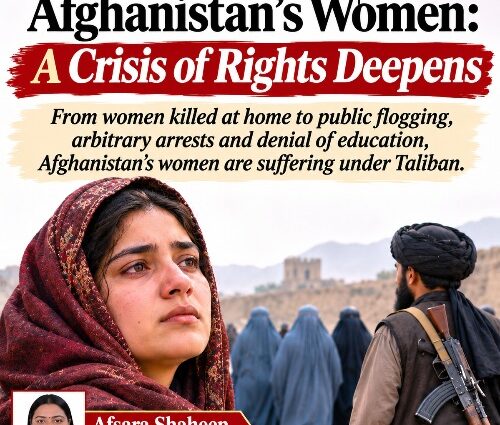
From women killed at home to public flogging, arbitrary arrests and denial of education, Afghanistan’s women are suffering under Taliban

By Afsara Shaheen
Research Associate, Institute for Conflict Management
Afghanistan’s women are facing a deepening crisis of violence and rights violations, with a series of killings, arbitrary detentions, public punishments and restrictions on education and employment exposing the growing vulnerability of women under Taliban rule.
The recent killings are particularly disturbing. On November 11, 2026, two women were killed and two men injured in a shooting inside a house in Damqol, in Faryab Province. A day earlier, 33-year-old Afsana, a mother of five who had returned from Iran approximately a year earlier, was killed and beheaded by unidentified assailants in Noda village, Farah Province.
These incidents are part of a wider pattern of lethal violence reported across the country. On September 16, a 20-year-old woman was found dead with apparent signs of torture in Logar Province. Five days later, four members of a family, including three women, were killed by gunmen in Kapisa.
Other victims include Leilma, an Ismaili woman who operated a tailoring workshop in Badakhshan and was shot dead on May 7, and Badriya, who was killed on her way to a Taliban court in Kabul on April 28. On March 14, Adolat Hamidi, a Tajikistani citizen who had provided maternity and healthcare services to women in Kunduz for years, was also killed by unidentified assailants.
The perpetrators and motives in these individual cases remain unclear. However, their frequency underscores the precarious position of women in a country where institutional protections and access to justice have been severely weakened.
The policing of women’s appearance and movement
Violence is accompanied by increasingly intrusive restrictions on women’s everyday lives. On October 15, 2026, the United Nations Assistance Mission in Afghanistan (UNAMA) reported that Taliban inspectors had detained or threatened more than 50 women over hijab regulations between July and September.
A separate UNAMA account documented at least 443 cases of arbitrary detention and 97 cases of mistreatment of women and men by officials of the Taliban’s Ministry for the Propagation of Virtue and the Prevention of Vice during the same quarter.
Women were reportedly detained for wearing colourful scarves, showing their hair, using makeup, not wearing a chador or appearing in public without a male guardian, known as a mahram.
Many were released after several hours. But the message conveyed by such enforcement is unmistakable: even ordinary decisions about clothing, movement and public participation can expose women to detention and intimidation.
Resistance has also been met with violence. On June 9, Taliban forces opened fire on demonstrators in Herat who were protesting the detention of women and girls over dress-code violations. At least two people, including a woman and a child, were killed, while several others were wounded.
Flogging, imprisonment and allegations of sexual violence
Corporal punishment has become another defining feature of the system. Afghanistan International reported on March 9, 2026, that Taliban authorities had publicly flogged more than 2,000 people, including 291 women, since 2024. The figures cited in the report included 78 women flogged in 2024, 170 in 2025 and 34 during the first two months of 2026.
Women have received lashes and prison sentences for alleged extramarital relationships, leaving home without permission and other offences.
The prison population has also grown. According to figures attributed to the Taliban Interior Ministry and reported by Afghanistan International on January 28, the number of women prisoners had reached 1,825, a reported increase of 435 per cent compared with the earlier baseline cited in the report. Women were being held in 34 prisons across the country.
Even more disturbing are allegations of sexual violence in detention where an investigative report published by Afghanistan International in February 2025, based on interviews with nearly 20 survivors, documented allegations of rape, sexual assault and harassment by Taliban members. Of the ten women who agreed to have their testimonies published, eight reported rape, while two described being photographed naked during interrogations.
The survivors included healthcare workers, former public servants, students, women’s rights activists and a model. Several described threats that recordings of sexual abuse would be released to humiliate and discredit them.
These remain survivor allegations documented by the investigation, but they raise grave questions about the safety of women in custody and the absence of independent mechanisms for accountability.
An entire generation denied education is the most consequential restriction
September 2026 marked five years since Afghan girls were barred from secondary education following the Taliban takeover. Millions remain unable to continue their studies beyond Grade 6. Women have also been excluded from universities and numerous professional training programmes.
The consequences extend far beyond the classroom. By denying girls access to education, Afghanistan is restricting their future employment, financial independence and participation in public life.
Employment restrictions have compounded this exclusion. Afghan women have been barred from working for the United Nations and prevented from participating in various humanitarian activities. September 2026 also marked one year since female UN employees were prevented from entering UN offices and facilities across the country.
The restrictions have serious implications for humanitarian operations, particularly when women and girls require assistance from female healthcare workers and aid personnel.
Women have also faced barriers in healthcare, sports, journalism and other professions. Female journalists and women-focused media organisations have encountered threats, detentions and closures, further narrowing the space available for women to participate in public life.
International accountability gathers momentum.
The Georgetown Institute for Women, Peace and Security placed Afghanistan last among 181 countries in its Women, Peace and Security Index released in 2026, assessing women’s inclusion, justice and security.
On October 5, 2026, the International Criminal Court made public arrest warrants for Taliban Supreme Leader Hibatullah Akhundzada and Chief Justice Abdul Hakim Haqqani over alleged crimes against humanity, including gender persecution.
The United Nations Human Rights Council has also urged the Taliban to repeal policies violating the fundamental rights of women and girls.
In September, France, speaking on behalf of 43 countries, called for restrictions on women’s education, healthcare and employment to be lifted. Representatives of 40 countries at the UN Security Council had similarly condemned the Taliban’s restrictive policies in March.
Yet international condemnation has so far failed to bring about a meaningful reversal of the restrictions. This is a crisis extending beyond individual incidents and Independent documentation by Afghanistan Women’s Rights Watch, in cooperation with the Türkiye-based ARSA Association, recorded 411 cases of rights violations against women and girls in 2025. These included approximately 300 cases of direct violence attributed to the Taliban, at least 76 intentional killings and more than 30 cases of suicide and self-immolation.
The organisation acknowledged that these were documented cases rather than a complete account of the violence. Not every killing can be attributed to Taliban authorities, and the perpetrators and motives behind several recent murders remain unknown. But the institutional environment in which Afghan women now live is increasingly defined by restrictions on movement, education, employment, personal autonomy and access to justice.
The combined effect is devastating. Women are not merely being excluded from particular professions or institutions. Their ability to make decisions about their own lives is being progressively diminished.
Afghanistan’s crisis is therefore not simply a question of women’s access to education or employment. It is a crisis of protection, dignity, equality and fundamental human rights.
An entire generation of Afghan girls is growing up with doors to education closed. Women who once worked as teachers, journalists, doctors, civil servants and entrepreneurs are being pushed out of public life. Those who resist face the risk of detention, punishment and intimidation.
The tragedy is not only that Afghan women are losing the freedoms they once possessed. It is that millions of girls are growing up without ever having the opportunity to experience them.
Afsara Shaheen
Research Associate, Institute for Conflict Management