









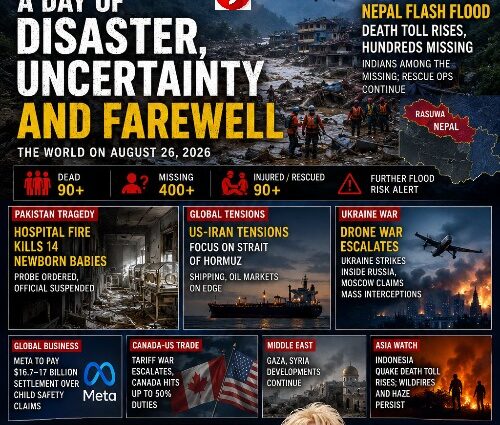
August 26, 2026, has unfolded as a day of extraordinary tragedy and uncertainty, with South Asia bearing some of the heaviest blows. In the Himalayas, a wall of water and debris tore through communities along the Nepal-China border, while in Islamabad, the deaths of newborn babies in a hospital fire left a nation grieving. Across the wider world, tensions involving Iran, Russia, Ukraine, Canada and the United States continued to deepen. And amid the grim headlines came the death of one of popular culture’s most beloved figures, Dolly Parton.
The catastrophe in Nepal has become the defining disaster of the day. Before dawn, a sudden torrent of water, mud, rocks and debris surged through Rasuwa district near the Nepal-China border, turning a remote Himalayan corridor into a landscape of destruction. Roads disappeared. Bridges were swept away. Buildings and vehicles were swallowed. Hydropower installations were damaged, and entire stretches of the route connecting Nepal and Tibet were cut off.
What began as a terrifying burst of water quickly became a national emergency.
The disaster raced downstream through the Bhote Koshi and Trishuli river systems, threatening communities in Dhading, Nuwakot, Chitwan and other areas. The precise trigger remains under investigation, with reports pointing towards a sudden collapse involving rock, ice or an avalanche in the high Himalayas. Whatever its origin, the result was brutally simple: an enormous mass of water and debris descended with almost no time for people to escape.
The death toll has continued to climb as rescuers reach areas that were initially inaccessible. Reports have varied dramatically through the day, reflecting the extraordinary difficulty of establishing the scale of the disaster. Dozens have been confirmed dead, while hundreds remain missing or unaccounted for. The number could rise substantially as search teams move through devastated settlements and infrastructure.
Among those missing are foreign nationals and a large number of Indians, including people travelling in connection with the Kailash Mansarovar pilgrimage. Families in India have been anxiously waiting for information as authorities work to identify survivors and locate those still missing.
Nepal’s Army and police have thrown helicopters and rescue teams into the operation, while emergency personnel on both sides of the border struggle against damaged roads, destroyed bridges and dangerous river conditions. Authorities have also warned that further flooding remains possible if debris has blocked waterways upstream.
For Nepal, this is not simply a flood. It is a disaster unfolding across an entire mountain corridor, with the possibility that the final human cost will not be known for days.
India has moved quickly to support its neighbour. Prime Minister Narendra Modi has spoken with Nepal’s leadership and offered full Indian assistance for relief and rescue operations. Indian authorities are coordinating efforts to trace missing citizens, while downstream states remain alert to the possibility of further flooding.
The Himalayan disaster has also exposed the extraordinary vulnerability of infrastructure built in some of the world’s most fragile terrain. Roads, bridges, hydropower projects and settlements can take years to build, yet a mountain can erase them in minutes.
And while Nepal was confronting the fury of nature, Pakistan was facing a different kind of catastrophe.
Fourteen newborn babies died in a fire at the Pakistan Institute of Medical Sciences in Islamabad, one of the country’s largest public hospitals. The blaze erupted in the Mother and Child Centre, reportedly after an air-conditioning unit malfunctioned or suffered a short circuit. Oxygen equipment inside the ward appears to have intensified the fire.
The image of parents desperately trying to save their children from a smoke-filled hospital is among the day’s most painful. One infant was reportedly rescued, but the others could not be saved.
Prime Minister Shehbaz Sharif ordered an immediate investigation and suspended the federal health secretary. Questions are now being raised about fire safety, emergency procedures, hospital infrastructure and whether lives could have been saved.
For the families who lost their babies, however, the coming investigations will never be enough. Fourteen tiny lives have disappeared before they had even begun.
Beyond South Asia, geopolitical tensions continue to cast a long shadow.
The confrontation between the United States and Iran remains a major source of anxiety, particularly around the Strait of Hormuz, through which a substantial share of the world’s energy supplies passes. Washington’s campaign of economic pressure against Tehran continues, while diplomatic discussions involving Oman have focused attention on shipping and maritime security.
Any serious disruption in the Strait of Hormuz could quickly become a global economic problem, sending shockwaves through oil prices, shipping costs and already-sensitive markets.
The Russia-Ukraine war is also continuing to evolve into an increasingly technological conflict. Ukrainian drones have struck targets inside Russia, while Moscow has claimed to intercept large numbers of incoming drones. The attacks demonstrate how unmanned systems have transformed modern warfare, allowing the battlefield to extend deep beyond traditional front lines.
Across the Atlantic, relations between Canada and the United States remain strained by escalating trade measures. Canadian tariff responses to American duties have intensified the dispute between two countries whose economies are deeply intertwined. What began as a trade confrontation increasingly threatens to become a broader political and economic test of one of the world’s most important bilateral relationships.
Technology giant Meta is meanwhile facing the consequences of a different battle. The company has reportedly reached a settlement of roughly $16.7 billion to $17 billion related to litigation over alleged social-media harms and addiction involving children. The agreement is expected to involve additional safety measures.
The enormous figure has revived a question governments and parents around the world are increasingly asking: how much responsibility should technology companies bear when the products they build are designed to keep people watching, scrolling and returning?
In India, the Nepal catastrophe has understandably dominated the national conversation. Alongside the rescue effort, New Delhi has rejected criticism associated with the UN Committee on the Elimination of Racial Discrimination, describing the remarks as politically motivated and malicious.
Meanwhile, India and China continue diplomatic discussions over their unresolved boundary question, with efforts focused on advancing a broader political settlement and boundary delimitation. Domestic politics, judicial developments, protests and the complicated monsoon picture are also occupying attention across the country.
But perhaps the most emotional news of the day came not from a battlefield, a parliament or a disaster zone.
It came from Nashville.
Dolly Parton, the extraordinary singer, songwriter, actress, entrepreneur and philanthropist who transformed the hardships of a poor Tennessee childhood into a global legacy, has died at the age of 80.
Parton died on August 25 after a brief battle with cancer, surrounded by loved ones. Her death closes one of the most remarkable chapters in modern music. She came from a family of 12 children in the Tennessee mountains and grew up with very little money. Yet she possessed something that poverty could not take away: a gift for turning human experience into song.
But Dolly Parton’s legacy cannot be measured in record sales alone. She built Dollywood. She became one of America’s most recognisable entertainers. She gave millions of children books through her Imagination Library. She used the wealth and fame that came from music to create opportunities for people who, like her younger self, might otherwise have been overlooked.
There was something almost defiant about her optimism. She never pretended that life was easy, she simply refused to believe that hardship should have the last word.
That is why her death resonates so deeply.
On a day when the headlines have been filled with floods, fire, war, missing people, frightened families and political confrontation, the world is also being reminded of the power of a single human voice. Dolly Parton’s voice will remain.
So will the laughter, the rhinestones, the enormous hair and the extraordinary story of a girl from the mountains who became an international icon without ever pretending she came from anywhere else.
And perhaps that is the strange symmetry of this terrible day.
In Nepal, families are searching through wreckage for those who may still be alive.
In Islamabad, families are mourning children who never had the chance to grow up.
Across the world, governments are arguing over borders, weapons, tariffs and power.
And somewhere, someone is playing a Dolly Parton record.
For a few minutes, the noise becomes quieter.
A song begins.
And the world remembers that beneath all the machinery of governments and wars and markets, history is ultimately made of human lives, fragile and astonishingly precious.
August 26, 2026, will be remembered for the disasters and conflicts that shook the world.
But it will also be remembered as the moment the world said goodbye to Dolly Parton.
JANPATH NEWS NETWORK (JNN)
Independent. Fearless. On the People’s Path.