


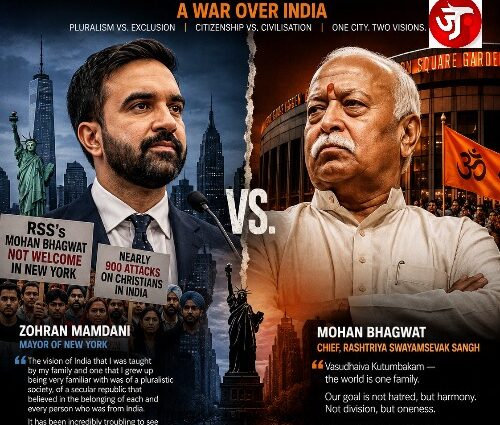
On the steps of New York City Hall this week, a private booking at Madison Square Garden became something far bigger than a Saturday night event.
It became a confrontation over India. The Rashtriya Swayamsevak Sangh, marking its centenary, is preparing to bring its chief, Mohan Bhagwat, to one of the world’s most recognisable stages. The event, billed as the “Universal Oneness Celebration,” is expected to draw about 5,000 people on August 29, 2026.
Its opponents have launched a campaign to stop it. Their banners leave little room for ambiguity: “RSS’s Mohan Bhagwat not welcome in New York” and references to allegations of attacks on Christians in India.
But the most politically consequential intervention has come from New York Mayor Zohran Mamdani. Mamdani has not banned the event, instead, he has done something more politically sophisticated: he has used the moral authority of the mayor’s office to draw a line between the India he believes in and the India he believes the RSS represents.
Asked whether the Madison Square Garden programme should be cancelled, Mamdani said:
“I don’t support the rally, but I don’t know if the city has any jurisdiction on cancelling a private event.”
That sentence is important. It acknowledges the limits of municipal power while making his opposition unmistakable. But Mamdani did not stop there. He turned the question from a dispute about a venue into a question about the character of India itself.
“The vision of India that I was taught by my family and one that I grew up being very familiar with was of a pluralistic society, of a secular republic that believed in the belonging of each and every person who was from India.”
Then came the sentence that has become the centre of the controversy:
“And it has been incredibly troubling to see the rise of a movement that is predicated on an exclusionary vision of any country, frankly.”
Mamdani then placed that opposition in the context of his own identity and the city he leads:
“It is one that I find myself in deep opposition to, not only as an Indian-American but also as the Mayor of a city that believes deeply in the belonging of each and every person, no matter their colour, their creed, their religion, their faith, wherever they’re from.”
There is the heart of the New York confrontation. Mamdani is not merely saying that he dislikes the RSS. He is making a constitutional argument. He is saying that the India he was taught to understand was a “pluralistic society”, a “secular republic” and a country in which there was a place for “each and every person who was from India.”
And he is saying that the movement represented by Bhagwat stands for an “exclusionary vision.” That is a devastating political contrast because it reduces the enormous argument over Hindutva to one fundamental question:
Who belongs?
The mayor’s words matter more than the cancellation
There is a temptation in political coverage to treat the issue as though Mamdani either has the power to stop Bhagwat or does not. That misses the point. He has already done what politicians often do when legal power is limited: he has changed the meaning of the event. Madison Square Garden remains a private venue and the programme can proceed.
But it now proceeds under the shadow of a mayor publicly declaring that he does not support it and associating its ideological project with what he calls an “exclusionary vision.”
That is politically significant: A municipal order would have produced a legal battle, a mayoral denunciation produces a political one, and political battles travel much farther than legal documents.
Mamdani’s remarks have consequently become the most important part of the controversy because they place the RSS question inside America’s own political vocabulary: pluralism, religious freedom, equal belonging and the rights of minorities. The question is no longer simply whether Bhagwat should be allowed to speak.
It becomes whether an organisation associated with Hindu nationalism should be presented to the American public as a legitimate representative of India’s civilisational identity.
The protesters have a different vocabulary
Outside City Hall, the language was considerably more confrontational.
The coalition opposing the event includes Muslim, Sikh, Christian, Dalit and dissident Hindu organisations. Their argument is that Madison Square Garden should not lend its name and prestige to an organisation they accuse of promoting Hindu majoritarianism and of being associated with violence and discrimination against minorities.
Their message is not simply debate the RSS, but not give RSS the stage. This thin line matters, because the campaign is therefore not principally about what Bhagwat might say during his speech, rather, about what the stage itself communicates.
Madison Square Garden is a global cultural symbol. A photograph of Bhagwat standing beneath its lights, speaking to thousands, would give the RSS something it values enormously: international recognition. Its opponents understand that. They want to prevent the photograph.
Or, failing that, they want to ensure that the photograph is surrounded by another one: protesters outside, declaring that the organisation does not represent the values of New York. The battle is over legitimacy.
Brad Lander reaches for New York’s darkest political memory
Brad Lander, the Democratic congressional nominee and former New York City comptroller, has taken the attack further.
Speaking alongside an interfaith coalition, Lander said:
“There is no room for Mohan Bhagwat and RSS hatred in our city.”
He accused the organisation of having:
“fomented violence and promoted hatred against Muslims, against Sikhs, against Dalits, against Christians.”
Then he invoked Madison Square Garden’s own history.
Lander compared the proposed event with the infamous German-American Bund rally held at Madison Square Garden in 1939.
He said:
“This event harkens back to that 1939 Nazi rally that was hosted at Madison Square Garden with banners of swastikas and tens of thousands of people cheering ethnic and religious hatred and violence of a very similar sort to what Mohan Bhagwat and the RSS are proposing.”
And then:
“And MSG said it wouldn’t do that again, that it wouldn’t host any more hate-filled, bigoted rallies. It should not host this one.”
It is a deliberately explosive comparison. But it should be understood as a political metaphor, not a literal historical equation.
The German-American Bund was a pro-Nazi organisation operating in the United States before the Second World War. The RSS is an Indian Hindu nationalist organisation with a different history, institutional structure and political environment. The analogy is designed to provoke a moral reaction, and it does. That is precisely why it was chosen.
The RSS answers with “oneness”
The RSS rejects the charge that it represents hatred or exclusion, iIts own presentation of the event is almost the mirror opposite of the protesters’ description. The gathering is called the “Universal Oneness Celebration.” Its philosophical language invokes Vasudhaiva Kutumbakam, the ancient Indian idea that the world is one family.
RSS communications chief Sunil Ambekar has described the New York programme as an interfaith gathering involving a diverse, multicultural and multi-faith audience. The message is clear: The RSS does not believe it is exporting hatred. It believes it is exporting Hindu civilisation. That distinction is central to understanding the dispute.
The protesters hear the word “Hindu” and see majoritarian politics.
The RSS hears the word “Hindu” and sees civilisation, culture, service and national unity.
The same word is being used to describe two radically different political realities.
What exactly is the RSS?
The Rashtriya Swayamsevak Sangh was founded in 1925 and has grown into one of India’s most powerful social and ideological organisations. It is not formally the Bharatiya Janata Party. But its relationship with the BJP is central to understanding its importance.
The RSS has supplied ideological influence, organisational networks and cadres to the wider Sangh Parivar, the family of organisations associated with Hindu nationalism. Its activities extend far beyond politics.
The organisation operates shakhas, educational initiatives, social-service programmes and disaster-relief efforts. Its supporters point to decades of seva, or service, as evidence that its principal mission is social reconstruction rather than political domination. Those achievements should not simply be erased. But neither should service automatically settle the ideological question. An organisation can provide relief after a flood and simultaneously hold a controversial conception of national identity.
The real argument is over Hindutva
The deepest criticism of the RSS is not that it is Hindu. It is that it is Hindu nationalist. That distinction is essential. Hinduism is a religion with extraordinary internal diversity while Hindutva is a political and cultural conception of Indian nationhood.
Critics argue that Hindutva defines India’s national identity through a Hindu civilisational framework and therefore risks turning religious minorities into citizens whose belonging is formally recognised but culturally conditional.
The RSS and its supporters reject that description. They argue that Hindu civilisation is fundamentally inclusive and that Hindutva is not equivalent to hostility toward other faiths. The argument therefore becomes one of competing definitions of inclusion.
What does it mean to belong to India?
Is belonging primarily constitutional? Or is it civilisational?
Mamdani’s answer is unmistakable.
He speaks of:
“a pluralistic society”
and
“a secular republic that believed in the belonging of each and every person who was from India.”
That is not merely nostalgia, but a political standard, and he applies that standard directly to the RSS.
“It has been incredibly troubling to see the rise of a movement that is predicated on an exclusionary vision.”
Those words explain why his intervention has resonated so strongly. He has framed the issue not as Hinduism versus Islam, or India versus America, or liberals versus conservatives. He has framed it as inclusion versus exclusion.
The RSS’s wider Sangh Parivar network has faced longstanding scrutiny over the role of affiliated groups in communal and political violence. The Bajrang Dal, often described as the VHP’s youth wing, has been accused of involvement in anti-minority clashes and vigilante violence; the Vishva Hindu Parishad (VHP) played a major organisational role in the mobilisation surrounding the Babri Masjid demolition and has been linked by critics to subsequent communal violence, including the 2002 Gujarat riots; while the Akhil Bharatiya Vidyarthi Parishad (ABVP), the RSS-linked student organisation, has repeatedly faced allegations of political intimidation and violent clashes on university campuses. These associations remain politically and historically contested, but they form an important part of the debate over the Sangh Parivar’s influence.
Gandhi remains the unresolved historical shadow
The organisation’s history also carries the memory of Mahatma Gandhi’s assassination. The RSS was banned by the Indian government in 1948 after Gandhi’s murder. The ban was lifted in 1949 after the organisation made undertakings concerning its constitution and organisational functioning.
Nathuram Godse, Gandhi’s assassin, had associations with Hindu nationalist circles, including a past relationship with the RSS that has remained politically contested. The organisation has consistently denied responsibility for the assassination. The RSS was banned. The ban was lifted. The RSS organisation was not convicted of Gandhi’s murder.
Mamdani’s intervention changes the frame
This is where Mamdani becomes central to the story. He has not attempted to become India’s political referee. He has instead spoken as the mayor of a city whose identity is built around immigration, pluralism and religious diversity.
His most powerful argument is therefore the simplest.
“It is one that I find myself in deep opposition to, not only as an Indian-American but also as the Mayor of a city that believes deeply in the belonging of each and every person, no matter their colour, their creed, their religion, their faith, wherever they’re from.”
That sentence deserves attention. Because it contains two identities: Indian-American. Mayor of New York.
Mamdani is effectively saying that both identities lead him to the same conclusion. As an Indian-American, he rejects what he sees as an exclusionary transformation of India. As mayor, he rejects exclusion as inconsistent with New York’s civic identity, and that is why his intervention has become more than a passing comment.
He has placed the RSS controversy inside a larger American conversation about who belongs in a pluralistic society.
The irony is that both sides claim universality!
There is a striking irony at the heart of this dispute. The RSS calls its event Universal Oneness. Its philosophical message is that the world is one family. Its opponents say that this language conceals a hierarchy of belonging.
Mamdani, meanwhile, speaks of a city where people belong:
“no matter their colour, their creed, their religion, their faith, wherever they’re from.”
Two different versions of universality are therefore colliding.
One begins with civilisation.
The other begins with citizenship.
When Mohan Bhagwat takes the stage, if the event proceeds as planned, he will be carrying more than a centenary message. He will carry a century of RSS history, it’s discipline, social work, Hindu nationalist philosophy, enormous organisational influence, political relationships, controversies, and unresolved historical shadows.
And outside the Garden will be those who believe that the language of Hindu nationalism has already gone too far into the territory of majoritarian politics.
They will argue that the world’s most famous Indian organisation cannot be allowed to define Indian identity without challenge.
The RSS will answer that it is speaking for a civilisation, not against a religion.
The protesters will answer that civilisation cannot replace equal citizenship.
Mamdani has already given that argument its most powerful formulation:
“a pluralistic society”
“a secular republic”
“the belonging of each and every person who was from India.”
Those are not merely words about India. They are a test of India.
And that is why a Saturday night booking at Madison Square Garden has become a war over the country itself.
The RSS wants the lights,
Its opponents want the legitimacy denied.
Mamdani has made clear where he stands, even while acknowledging where his legal authority ends.
And perhaps that is the most revealing part of all.
New York cannot decide India’s future.
But for one night, beneath the lights of Madison Square Garden, two competing visions of that future will be standing in the same frame.
One will speak of universal oneness.
The other will ask whether everyone truly belongs.
And somewhere between those two claims lies the unfinished argument over what India is becoming.
JANPATH NEWS NETWORK (JNN)
Independent. Fearless. On the People’s Path.