










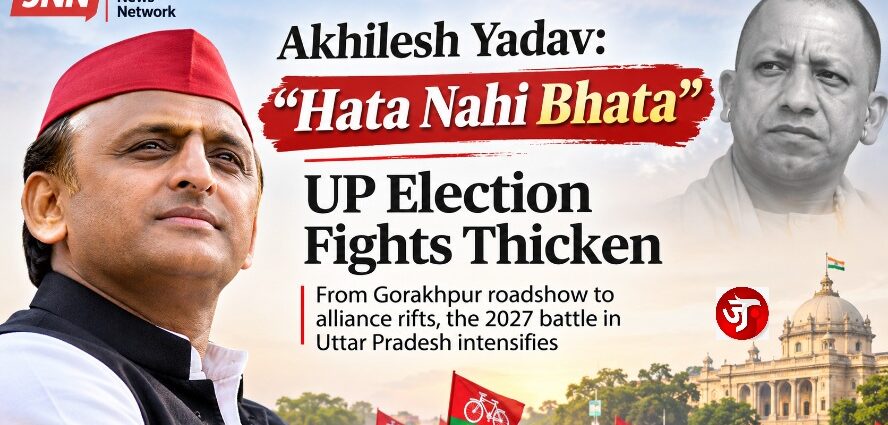
Akhilesh Yadav takes the fight to Yogi’s doorstep with wordplay “Hata Nahi Bhata”, while BJP is mobilising its grassroots machinery
UTTAR PRADESH, NOVEMBER 18, 2026: Taking the battle to Chief Minister Yogi Adityanath’s Gorakhpur stronghold, Akhilesh Yadav is attempting to expand the Samajwadi Party’s political footprint beyond its traditional PDA base, even as seat-sharing tensions threaten to complicate both the INDIA bloc and the NDA ahead of the 2027 Uttar Pradesh elections.
If political symbolism can unsettle an opponent, Akhilesh Yadav has chosen his battlefield carefully. The Samajwadi Party chief’s approximately 20-km PDA Rath Yatra through Gorakhpur, the political stronghold of Uttar Pradesh Chief Minister Yogi Adityanath, was more than a show of organisational strength. It was a calculated message: the SP intends to challenge the BJP where it considers itself most secure.
With supporters lining the route, drums beating and slogans filling the air, Akhilesh sought to demonstrate that Gorakhpur is no longer territory the opposition should approach with hesitation. His outreach, however, carried another significant political dimension.
The visit to Hata, the residence associated with the late influential Brahmin leader and former UP minister Harishankar Tiwari, was particularly symbolic. By meeting members of the Tiwari family, including SP leader Vinay Shankar Tiwari, Akhilesh was signalling an attempt to reach beyond the party’s established PDA formula of Pichhda, Dalit, Alpsankhyak (Backward, Dalit and Minority communities).
The wordplay, “Hata Nahi, Bhata”, adds another political layer to the message. The outreach is widely being interpreted as an effort to attract Brahmin support, traditionally an important BJP constituency, and challenge the perception that the SP’s social coalition has limited reach.
But while Akhilesh is expanding his political battlefield, the opposition alliance faces a battle of its own.
Reports of disagreements over seat-sharing between the SP and Congress have exposed the difficult negotiations ahead. Akhilesh has referred to a Congress demand for approximately 181 seats, while the SP’s stated position is that candidates should be fielded according to their winnability. Reports of a much smaller SP offer to Congress, around 34-35 seats, have further fuelled speculation about a possible repeat of the uneasy seat-sharing arrangements witnessed in 2017.
The NDA, meanwhile, is hardly free of its own complications. Smaller allies, including the Nishad Party, Om Prakash Rajbhar’s party and Anupriya Patel’s Apna Dal, are reportedly seeking a larger share of constituencies. Rajbhar’s party has also been pressing its electoral ambitions, with the number of seats becoming part of the negotiation.
The political irony is unmistakable. Both rival alliances are preparing to fight for Uttar Pradesh, yet both must first negotiate with their own partners.
Akhilesh’s Gorakhpur expedition may not immediately translate into electoral gains, but it has succeeded in putting Yogi’s stronghold into the political spotlight. The 2027 battle is beginning to look less like a straightforward BJP-versus-SP contest and more like a complicated struggle over caste coalitions, regional influence, political symbolism and the price of alliance loyalty.
In Uttar Pradesh, the road to power may well begin with a roadshow. But winning the state will require something far more difficult: keeping one’s own political house together.
JANPATH NEWS NETWORK (JNN)
Independent. Fearless. On the People’s Path.