










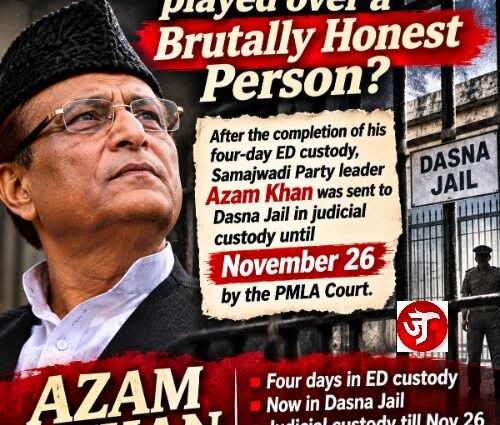
Ten-time MLA, former Uttar Pradesh minister, founder of Jauhar University, Azam Khan returns to Dasna Jail after 4 days of ED grilling
MONDAY NOVEMBER 16, 2026
For decades, Mohammad Azam Khan was one of the most formidable political figures in Uttar Pradesh. A man who could command crowds, influence electoral calculations and challenge governments with an unmistakable political voice, he was among the most influential faces of the Samajwadi Party.
Today, at 78, the veteran politician finds himself back behind prison walls. As the PMLA court remands him to judicial custody for ten days until until November 26, questions over political vendetta, accountability and the treatment of dissenting political voices grow louder. The court rejected the ED’s request for further custodial interrogation.
After completing four days of Enforcement Directorate (ED) custody in a money-laundering investigation linked to the Maulana Mohammad Ali Jauhar Trust and Jauhar University in Rampur, Khan was produced before a Ghaziabad court on Monday, November 16.
It is another chapter in an extraordinary political and legal battle that has followed the former minister for years. But beyond the courtroom proceedings lies a larger question: Is this simply the law catching up with a powerful politician, or has Azam Khan become a symbol of the increasingly bitter political battles in Uttar Pradesh?
Azam Khan’s statement before ED questioning, November 12, 2026
Speaking to journalists before being taken for interrogation, he said:
“Humne bachchon ko shikshit karne ka ‘gunaah’ kiya. Humne ek university banayi, humne school banaye. Ek Musalman ne shiksha ka mandir banaya, yahi galti thi.”
Translation:
“We committed the ‘crime’ of educating children. We built a university, we built schools. A Muslim built a temple of education. That was our mistake.”
From Rampur’s political strongman to a man behind bars
Azam Khan’s political journey is inseparable from Rampur. A ten-time MLA from Rampur Sadar, he became one of the most influential leaders in the Samajwadi Party and served as a Cabinet Minister in Akhilesh Yadav’s government between 2012 and 2017.
He was also elected to the Lok Sabha from Rampur. For the Samajwadi Party, Khan represented more than an electoral constituency. He was a prominent Muslim political voice in a state where minority representation, identity and political mobilisation have long been contentious issues.
His influence, however, also made him a controversial figure. His confrontational style, sharp political statements and repeated clashes with government officials made him a frequent subject of political controversy.
Over the years, numerous criminal cases were registered against him. Some resulted in convictions, while others remain subject to legal proceedings. His political career has consequently become entangled with an unusually extensive legal battle.
Jauhar University: His dream and his biggest legal challenge
At the centre of the current ED investigation is Mohammad Ali Jauhar University in Rampur, founded by Azam Khan in 2006 through the Maulana Mohammad Ali Jauhar Trust.
For Khan, the institution represented an ambitious educational project intended to expand access to higher education in the region. For his political supporters, the university remains an important part of his public legacy.
But the institution has now become the focus of a major financial investigation.
The ED alleges that government contract funds and construction materials were diverted through private contractors towards the university and its associated trust.
In an October 28 press release, the agency announced the provisional attachment of university land and buildings valued at ₹426.46 crore, with an estimated current market value of approximately ₹1,170 crore.
The agency’s investigation also concerns allegations involving land acquisition, government contracts, construction expenditure and financial transactions involving the trust.
The ED has alleged that approximately ₹416.14 crore of university construction expenditure remains unexplained.
Four days of interrogation: What happens next?
The ED secured four days of custodial interrogation beginning November 12. The agency sought to question Khan about the alleged diversion of public funds, transactions involving contractors, donations to the trust and the financial arrangements surrounding the university.
On November 16, after the remand period ended, the agency sought additional custody. The court instead ordered judicial custody until November 26.
The development means that the investigation will continue, but Khan will remain in prison rather than in the agency’s interrogation custody.
His legal battle has also reached the Allahabad High Court, after the Supreme Court declined to entertain his direct challenge to the ED arrest and transferred the matter to the High Court.
His legal team is contesting the arrest and seeking relief.
The political persecution argument
The Samajwadi Party has consistently maintained that Azam Khan and his family are being targeted through politically motivated cases.
After meeting Khan in October, party president Akhilesh Yadav accused the BJP government of deliberately targeting the Jauhar University project. Yadav argued that an educational institution was being destroyed in the name of political action.
The Samajwadi Party has also expressed concerns about Khan’s health and safety during his detention.
There is another dimension to the Azam Khan story.
His supporters point to his ten electoral victories in Rampur, his role in the Samajwadi Party and the creation of Jauhar University as evidence of a political career that left a substantial mark on the region.
They see a leader who gave political representation to a community and invested his political ambitions in an educational institution. His critics, however, point to the numerous criminal cases, convictions and allegations of abuse of political influence.
Azam Khan’s case comes at a time when the relationship between political opposition and investigating agencies is under intense national scrutiny.
Opposition parties have repeatedly accused central agencies of selective action against political rivals. The government and agencies have rejected allegations that investigations are politically motivated.
The credibility of the justice system depends on something more important than either side’s political claims: transparent investigations, credible evidence, independent judicial scrutiny and equal treatment before the law.
A politician with influence must not be above the law. But neither should the law be perceived as an instrument for settling political scores There is a fine line between justice and political vengeance
JANPATH NEWS NETWORK (JNN)
Independent. Fearless. On the People’s Path.