









The Congress may believe it is being cautious. It may actually be making one of the oldest mistakes in politics: allowing fear of yesterday to blind it to the opportunity of today.
The year was 2011. India watched as anti-corruption activist Anna Hazare sat on a fast that lasted 13 days, his health deteriorating as the nation followed every development. The Congress-led UPA government eventually entered negotiations, Parliament responded to key demands, and Hazare ended his fast.
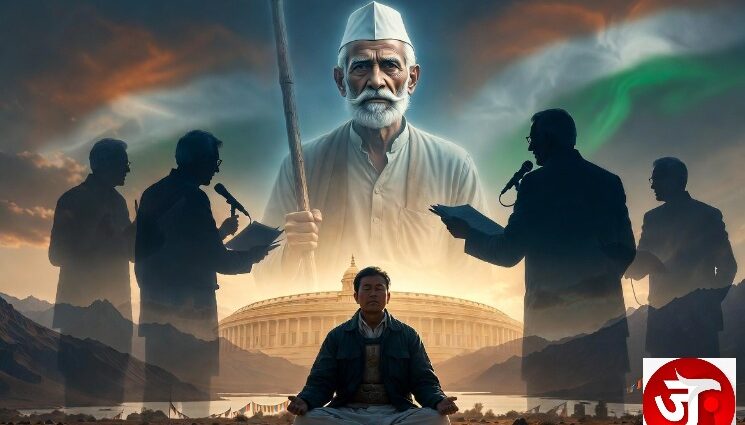
Now, the image appears hauntingly familiar. Sonam Wangchuk lies on a simple gadda on the floor, fasting in protest against the actions of the BJP-led government and demanding accountability, including the resignation of Education Minister Dharmendra Pradhan. Yet, despite the apparent similarity of the scene, the political response could hardly be more different.
One man fasted, and the government was compelled to engage while another man fasts, and the corridors of power appear unmoved.The imagery may seem the same: a frail protester, a mattress on the ground, a situation that is becoming more dangerous with each passing day, and a demand for accountability from those in power. But the circumstances, the political forces surrounding the protests, the media environment, and the government’s response are profoundly different.
Sonam Wangchuk, one of India’s most internationally recognised innovators, environmental campaigners and education reformers, is on an indefinite hunger strike over an issue that should, theoretically, place the entire Opposition on the same side of the barricade.
The protest concerns alleged examination irregularities, the crisis of trust surrounding competitive examinations and the demand for political accountability from the Union Education Ministry.
The government being challenged is led by the BJP; the minister whose resignation is being demanded is a BJP minister, and this anger being articulated is the anger of students and young Indians, precisely the constituency the Congress has spent years trying to reach.
And yet, while leaders from other opposition parties have moved towards the protest, questions are being asked about the Congress leadership’s distance.
If this distance is deliberate, it deserves serious examination because Congress may be fighting the ghost of Anna Hazare in 2011 instead of understanding Sonam Wangchuk in 2026.
The ghost that still haunts Congress. To understand Congress’s apparent hesitation, one must return to the political earthquake of 2011:
Anna Hazare’s anti-corruption movement did not begin as a conventional political party campaign but presented itself as a citizens’ movement. It spoke the language of morality, accountability and national frustration where millions of Indians were already angry over corruption scandals associated with the UPA era. Anna became the moral symbol of that anger.
The consequences were enormous; the movement helped delegitimise the Congress-led government. Arvind Kejriwal emerged from the agitation and eventually created the Aam Aadmi Party. The BJP, then in opposition, benefited enormously from the wider anti-incumbency atmosphere.
Congress never forgot.
There have long been allegations that the RSS and BJP helped the Anna movement through mobilisation and organisational support. Some former participants have even alleged deeper orchestration. But allegations are not proof that Anna Hazare himself was simply a manufactured political plant.
The truth is more complicated. Anna Hazare had been an activist for decades before 2011. Public anger against corruption was real. The crowds were real. The frustration was real.
Political organisations may support, amplify or benefit from a movement without having created the underlying public anger.
That distinction matters enormously today.
Congress risks making a catastrophic analytical mistake if it assumes that every independent movement capable of disrupting established politics must therefore be a conspiracy against it.
Sonam Wangchuk Is Not Anna Hazare 2.0
While the comparison is tempting, an elderly or widely respected public figure, a Gandhian-style fast, Jantar Mantar, a frustrated public; with a new movement attracting young people, and an established political system unsure how to respond.
Naturally, political India has begun whispering: Is Sonam Wangchuk becoming the next Anna Hazare?
And: Could Abhijeet Dipke eventually become another Arvind Kejriwal?
These are legitimate political questions, but not facts.
The political circumstances are fundamentally different:
Anna Hazare’s great mobilisation confronted a Congress-led government.
Sonam Wangchuk’s present hunger strike is placing pressure on a BJP-led government.
That single fact should make Congress pause.
If Congress is keeping its distance because it fears another Anna movement, it is effectively behaving as though it were still the government under attack, but it is not the government. Congress is now the principal national opposition party, thus the political geometry has reversed.
In 2011, an anti-establishment movement threatened Congress because Congress was the establishment, but in 2026, an independent movement challenging failures under a BJP-led Union government could reinforce many of the arguments Congress itself has been making.
Yet Congress appears worried that somebody else might receive the political credit, and this is where caution begins to resemble insecurity.
Sonam Wangchuk Has Not Been an Enemy of Congress
This makes the distance even more difficult to understand, because Wangchuk is not a lifelong anti-Congress crusader, neither is he standing at Jantar Mantar demanding the destruction of the Congress Party, and he is definately not campaigning for the BJP. In fact, his movements have drawn the eyes of the world on the BJPs, misdeeds.
And Wangchuck is also not a politician; he is not asking Indians to vote for any particular party.His public life has centred largely on education, environmental innovation, climate change and the constitutional and political concerns of Ladakh, while his activism has repeatedly challenged those in power.
Congress as a political party confident in its own democratic credentials should not demand personal loyalty from every citizen before defending that citizen’s right to protest.
And here lies the larger problem: Congress cannot simultaneously call itself the defender of democratic dissent and then become suspicious whenever dissent refuses to wear a Congress badge.
Democracy is not a franchise operation, movements do not have to be owned by political parties to be legitimate, and it becomes when party workers start demanding those badges before they protect or help.
At the present time, the question Congress should ask is not: “Who Controls CJP?” but it should ask: Are the grievances real?
Questions such as why are the students angry? What is compromising the examination systems?
Is not Sonam Wangchuk’s health now a matter of genuine concern? If Congress can say yes to this, it can support the principle without surrendering its political independence.
Cockroach Janta Party is not a registered party, but a movement;
It does not require Rahul Gandhi to endorse every statement ever made by Abhijeet Dipke, nor the Congress flag to be planted on the protest stage. It requires something much simpler: Human solidarity.
A senior Congress leader can visit Wangchuk and say: “We support your right to protest. We share the demand for accountability. We urge you not to sacrifice your life. India needs your voice alive.”
That is not political surrender, but political maturity.
AAP and SP Understand Something Congress Appears to Be Forgetting
Other opposition leaders and parties supporting or engaging with the protest do not necessarily own the movement: They understand something elementary about democratic politics: You do not have to control every movement you support. Sometimes politics requires standing beside people whose future intentions you cannot predict and this is called democracy.
The Congress seems haunted by the possibility that a new movement could produce a new political force. Perhaps it could. Perhaps it will not. Perhaps the Cockroach Janta Party will remain a protest movement. Perhaps it will disappear. Perhaps it will evolve. Perhaps Abhijeet Dipke will enter electoral politics.
Nobody can honestly know, but refusing solidarity today because someone might become a political competitor tomorrow is the kind of defensive thinking that shrinks political parties.
If Dipke becomes another Kejriwal one day, that will depend on millions of variables: organisation, ideology, leadership, elections, credibility and public support.
It cannot be prevented by pretending he does not exist.
The Anna Hazare Lesson Has Been Misunderstood
Congress appears to have learned the wrong lesson from 2011 where the lesson was not: Never support an independent movement.
The real lesson was: Never become so disconnected from public anger that someone else becomes its only credible voice.
Anna Hazare did not destroy Congress by fasting.
Congress was already suffering from a crisis of credibility. The movement became powerful because millions of people believed their frustrations were not being heard.
Political movements grow in the vacuum left by established institutions.
If Congress fears another Kejriwal, the answer is not to isolate every emerging citizens’ movement, but the answer is to become better at listening.
And What of the RSS Theory?
Political India loves conspiracy theories because ordinary reality is apparently insufficiently exhausting. Yes, there have been allegations that RSS workers supported or helped mobilise around the Anna Hazare movement.
Yes, BJP benefited politically from the anti-UPA atmosphere, definately, some former participants have subsequently alleged deeper involvement, but none of this conclusively proves that Anna Hazare’s entire public life or the genuine anger of millions of Indians was fabricated by the RSS. The same intellectual discipline must be applied today.
There is currently no credible evidence establishing that Sonam Wangchuk has been “sent by the RSS” or that his hunger strike is an RSS operation.
In fact, the immediate political target of the protest is the BJP-led Union government and its Education Minister.
If evidence of political manipulation emerges, investigate it. Until then, suspicion is not evidence, because rumour is not evidence.
A WhatsApp forward wearing a serious expression is still a WhatsApp forward.
Could Wangchuk Become the Next Anna?
Perhaps the more interesting answer is: He does not need to. Sonam Wangchuk already has his own identity. The Rebel of the Roof of the World revolutionised Ladakh with groundbreaking inventions, winning accolades and awards, engineered Ice Stupas, majestic artificial glaciers, saving millions of litres of water, spreading hope from Ladakh to the Alps, earning Asia’s Nobel while fearlessly championing his people’s rights against government delays. Reducing him to “the next Anna Hazare” may actually underestimate him.
Movements can acquire meanings their leaders never originally intended.
If Wangchuck’s health deteriorates further, and if the government continues to remain silent, students keep standing with Wangchuck, if opposition parties continue arriving in solidarity, and if if Congress still remains visibly absent, then the symbolism could become larger than the original demands.
That is how political moments are created, not necessarily through conspiracies. Sometimes through silence. The question is whether Congress has learned enough from Anna Hazare to recognise a political moment before history moves on without it, because in politics, refusing to stand beside a friend out of fear that he may someday become a rival is not strategy, is actually insecurity dressed as caution.
JANPATH NEWS NETWORK (JNN)
Independent. Fearless. On the People’s Path.