









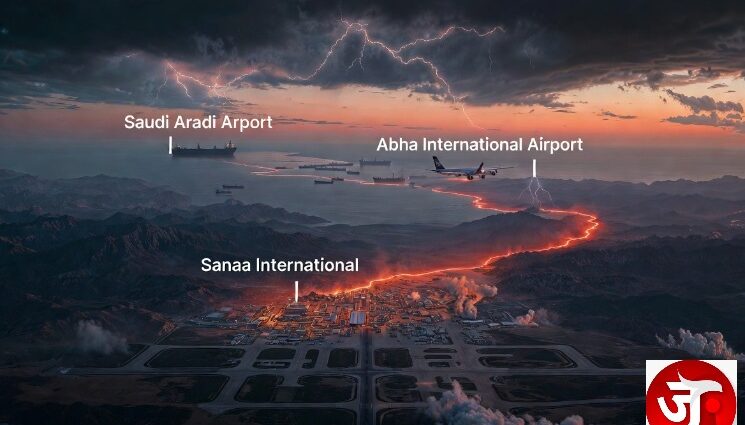
West, Asia, in the arid heart of Yemen’s long civil war, a single runway became the flashpoint for renewed catastrophe. On July 13, 2026, forces aligned with Yemen’s internationally recognized government, backed by Saudi Arabia, struck the runway at Sanaa International Airport. Their stated aim: to block an Iranian aircraft carrying a Houthi delegation from landing, amid disputes over airspace and a flight linked to mourning rites following the death of Iran’s supreme leader.
Hours later, the Iran-backed Houthis responded with ballistic missiles and drones targeting Abha International Airport in southern Saudi Arabia. The strikes damaged facilities, disrupted flights, and injured civilians – reports cite around two dozen wounded. This marked the most direct and significant cross-border clash between the Houthis and Saudi-led forces since the fragile 2022 truce that had largely held despite sporadic violations.
This exchange is not isolated. It unfolds against the backdrop of a wider, simmering confrontation involving Iran, the United States, Israel, and proxy networks across the region, from the Strait of Hormuz to the Red Sea. Iranian actions in the Gulf, including reported strikes on vessels and tensions over shipping lanes, have already drawn direct U.S. responses and elevated oil market anxieties.
The Sanaa-Abha cycle is a microcosm of the proxy dynamics that have defined West Asia for years: Saudi Arabia viewing the Houthis as an Iranian proxy threatening its southern flank; Iran seeing the Houthis as leverage against Saudi and Western pressure; and local actors caught in a web of external ambitions.
The Human and Strategic CostYemen’s war, ongoing since 2014–2015 with Saudi-led intervention from 2015, has already exacted a staggering toll: hundreds of thousands dead from direct violence, famine, and disease; millions displaced; infrastructure shattered. Sanaa Airport had been a rare, contested lifeline for humanitarian aid, commercial flights, and limited connectivity under Houthi control in the north.
Striking its runway, regardless of the rationale, further isolates a population already enduring one of the world’s worst humanitarian crises. Retaliatory strikes on Abha, a civilian airport serving southern Saudi communities, bring the conflict’s violence directly onto Saudi soil once again, shattering the relative calm that allowed economic recovery and de-escalation talks.These are not abstract chess moves. They are explosions that echo through homes, hospitals, and markets. Families in Sanaa and Abha alike now confront renewed fear: canceled flights, grounded commerce, the ever-present risk of escalation.
The cycle – strike, retaliation, accusation – feeds itself, radicalizing moderates, empowering hardliners, and deepening grievances that no external power can fully control.
This escalation cannot be viewed in isolation from the Iran-U.S. tensions over the Strait of Hormuz, where control of a vital artery for global energy flows remains contested. Disruptions there send oil prices surging and threaten supply chains worldwide. The Houthi-Saudi flare-up risks pulling Riyadh deeper into direct confrontation, potentially complicating any U.S.-led efforts to contain Iranian influence or stabilize the region. It also tests the limits of de-escalation diplomacy that had shown tentative promise in prior years.
For global powers, the stakes are clear: further fragmentation of the region risks drawing in more actors, overwhelming already strained alliances, and creating vacuums exploited by extremists. For Gulf states, it underscores the vulnerability of critical infrastructure to asymmetric threats, missiles and drones that bypass traditional defenses. For Yemenis, it is yet another chapter in a conflict that has outlasted multiple rounds of talks and truces, with ordinary people paying the highest price.
History offers stark lessons. Proxy wars and tit-for-tat strikes in West Asia have repeatedly proven easier to ignite than to extinguish. The 2019 Abha attacks and earlier Houthi operations against Saudi targets demonstrated the group’s capacity for long-range strikes, just as Saudi-led campaigns showed the limits of air power in achieving decisive political outcomes in Yemen. Renewed fighting risks unraveling whatever fragile stability the 2022 truce provided, potentially reopening fronts that had quieted.
A deeper, more powerful truth emerges here: sustainable peace cannot be imposed from afar or secured solely through military dominance. It requires addressing root causes – political inclusion in Yemen, legitimate security concerns on all sides, and the proxy dynamics fueled by regional rivalries. Ceasefires, humanitarian corridors, and renewed multilateral diplomacy (involving the UN, regional powers, and major stakeholders) remain the only realistic off-ramps. Punitive cycles only breed more suffering and instability.
The runway strike in Sanaa and the response at Abha are more than tactical episodes. They are warnings: the embers of conflict in West Asia are never fully extinguished. Whether leaders choose restraint and dialogue, or allow pride, retaliation, and external calculations to fan the flames—will determine if this remains a dangerous spark or ignites something far worse. The people of Yemen, Saudi Arabia, and the wider region deserve better than another descent into chaos. The choice, as always, lies in breaking the cycle rather than perpetuating it.
JANPATH NEWS NETWORK (JNN)
Independent. Fearless. On the People’s Path.