










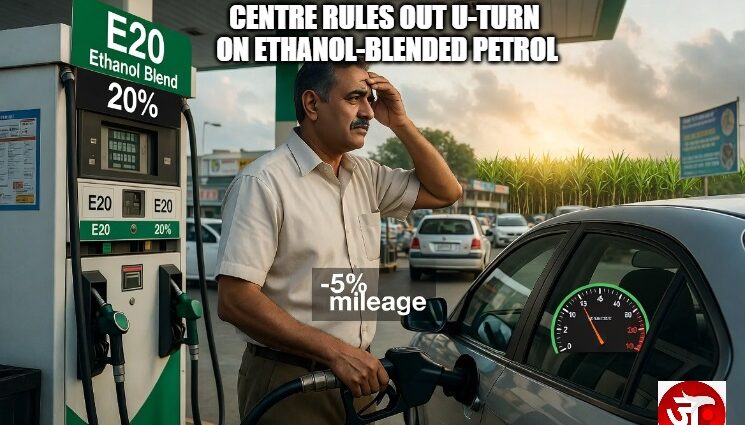
No Parallel Choice. Government Stands Firm on Ethanol-Blended Petrol as Drivers Raise Mileage Concerns
New Delhi, July 11, 2026: The Centre has drawn a firm line under the debate over India’s ethanol-blending programme, making it clear that there will be no rollback, dilution or parallel nationwide return to pure petrol or E10 as the country pushes ahead with E20 petrol as its standard fuel.
Despite concerns from motorists over reduced fuel economy and demands for greater consumer choice, the government has defended the transition as a strategic national policy tied to energy security, farmer incomes, lower crude-oil dependence and reduced carbon emissions.
The message from the Centre is blunt: E20 is not a temporary experiment. It is here to stay.
The government has ruled out offering pure petrol, known as E0, or lower-blend E10 petrol alongside E20 across the country’s vast retail fuel network.
According to the Centre’s reasoning, maintaining multiple petrol grades would create enormous logistical and financial complications across more than one lakh fuel stations, as well as refineries, terminals, depots, storage facilities and pipelines.
Separate grades would require separate infrastructure, storage and transportation arrangements, increasing costs and complicating inventory management across one of the world’s largest fuel-distribution systems.
In other words, consumer choice has run into the brick wall of national logistics.
With nearly ₹1 lakh crore investments at stake, the government has also pointed to the enormous financial ecosystem built around India’s ethanol programme.
Public-sector banks have reportedly financed massive investments in ethanol plants, distilleries, storage facilities and associated infrastructure. Any sudden reversal of the policy could leave major assets stranded and potentially hurt a wide network of farmers, sugar cooperatives, entrepreneurs, companies and financial institutions that invested on the strength of the national ethanol strategy.
The government argues that the programme has now grown too large and become too deeply integrated into India’s agricultural and energy economy to simply be reversed.
The government has cited substantial economic and environmental benefits from India’s ethanol-blending programme. According to figures highlighted in support of the policy:
More than ₹1.97 lakh crore in foreign exchange has been saved
Around 316 lakh metric tonnes of crude oil imports have been substituted
Approximately 952 lakh metric tonnes of carbon dioxide emissions have been avoided
More than ₹1.66 lakh crore has reportedly been transferred to farmers
For a country that remains heavily dependent on imported crude oil, the Centre sees ethanol blending as far more than a change in the composition of petrol. It is being presented as a long-term instrument of national energy strategy.
BUT MOTORISTS ARE ASKING: WHAT ABOUT MILEAGE?
The government’s firm position comes amid continuing concerns among vehicle owners over the impact of E20 petrol on fuel economy. Many motorists have reported a decline in mileage, with estimates commonly ranging between 3 and 5 per cent, depending on the vehicle, engine technology and driving conditions.
The government has acknowledged that some reduction in fuel efficiency can occur because ethanol contains less energy per litre than conventional petrol.
That has created a simple and increasingly contentious question for consumers: If motorists are paying for the fuel, should they not have the option to choose which blend they put into their vehicles?
For now, the Centre’s answer appears to be no. Officials have stressed that E20 also offers several technical advantages, including a higher effective octane rating of around 95, improved combustion characteristics, smoother acceleration and reduced emissions.
The government has also rejected suggestions that E20 is causing widespread vehicle damage.
It maintains that extensive testing was conducted with the involvement of institutions and industry bodies, including NITI Aayog and the Society of Indian Automobile Manufacturers, and that available industry data has not established widespread engine failures or warranty problems attributable to E20 use.
Automobile manufacturers have increasingly adapted newer vehicles for higher ethanol blends, although concerns remain among owners of older vehicles that were originally designed when lower ethanol blends were the norm.
THE ‘EXPERIMENT’ CONTROVERSY
The debate intensified after courtroom remarks attributed to the Attorney General were widely interpreted as describing the ethanol programme as an “experiment.”
The remark triggered criticism from motorists and commentators who questioned why consumers should bear the cost of what appeared to be an evolving fuel policy.
The government later clarified that the reference concerned supply volumes and implementation, rather than suggesting that the entire E20 policy itself was an untested experiment.
Nevertheless, the controversy added fuel, quite literally, to an already heated public debate.
India’s ethanol-blending journey has accelerated dramatically over the past decade. From blending levels of roughly 1.5 per cent before 2014, the country has moved to approximately 20 per cent ethanol blending, reaching the target years ahead of the original 2030 timeline. The government views this transformation as one of India’s major energy-policy achievements.
Critics, however, argue that the speed of the transition has left some consumers, particularly owners of older vehicles, worried about mileage, compatibility and the absence of alternative fuel choices.
A huge portion of India’s fleet (especially pre-2023 BS4/BS6 Phase 1 cars and bikes) was designed for E5/E10. Ethanol is hygroscopic (absorbs moisture, leading to corrosion) and acts as a solvent that can degrade rubber seals, fuel lines, pumps, and injectors over time.
Mechanics report issues like clogged filters, rough idling, and accelerated wear. Damage is often gradual (“normal wear”), making it hard to claim warranties or prove causation immediately, which is why ministers can challenge people to “show one broken car.”
While newer vehicles are better adapted, older ones (still on roads for years) face higher maintenance. The government’s response (free rubber part replacements during service) admits the problem exists but shifts the burden to owners and manufacturers.
While many drivers support the environmental and energy security aims but resent bearing disproportionate costs with limited recourse. Public pressure, surveys, and social media backlash reflect genuine frustration, not just rumour-mongering. The government should address these pain points directly rather than doubling down on mandates.