










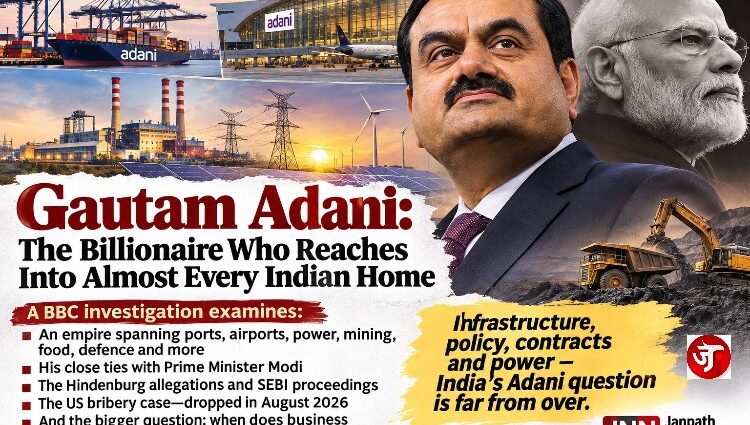
A BBC Investigation Examines How Billionaire Gautam Adani Reaches Into Almost Every Indian Home, With His Proximity To Power
November 7, 2026: A BBC investigation traces the extraordinary rise of India’s infrastructure tycoon, whose business empire stretches from ports and airports to electricity, food, mining and defence. But behind the story of entrepreneurial ambition lies a bigger question: where does corporate influence end and political power begin?
Imagine a country where the electricity you use, the food you consume, the port through which goods arrive, the airport you travel from and the infrastructure that moves the economy are all connected to one corporate empire.
It sounds like an extraordinary concentration of economic power. Yet this is the world of Gautam Adani, one of India’s richest businessmen and the founder of the Adani Group.
The BBC World Service programme Good Bad Billionaire, in its October 2026 episode titled Gautam Adani: The Multiple Mogul, examines how a young man who left formal education and began his career as a diamond trader built one of the country’s most expansive business conglomerates.
Presented by Simon Jack and Zing Tsjeng, the programme traces Adani’s journey from Gujarat to the commanding heights of Indian business, examining his extraordinary commercial instincts, political connections, controversies and influence over everyday life.
But the most consequential question raised by the programme is not simply how Adani became a billionaire. It is how one businessman came to occupy such a significant position in the economic infrastructure of the world’s largest democracy.
From a modest Gujarati background to a business empire
Born on June 24, 1962, in Ahmedabad, Gautam Adani came from a Jain family. His father was a textile merchant, and he grew up among eight siblings.
Adani did not follow the conventional path to business success. He left college before completing his education and moved to Mumbai, where he entered the diamond trading industry.
It was a world of commercial relationships, international markets, negotiation and risk. He learnt quickly, developed contacts and eventually returned to Gujarat to pursue larger business opportunities.
His early experience in trading helped him understand something fundamental about commerce: controlling the movement of goods could be more valuable than simply buying and selling them. This understanding would eventually define his business empire.
Mundra: The port that changed everything
The development of Mundra Port in Gujarat was a turning point. What began as an ambitious infrastructure project transformed into one of India’s most important commercial ports. The port gave Adani access to the enormous business opportunities associated with international trade, imports, exports, energy and logistics.
It also provided the foundation for vertical integration: instead of merely trading commodities, the group could own the infrastructure through which those commodities moved.
From ports, Adani expanded into power generation, coal, mining, transmission, airports and renewable energy. The strategy was ambitious. Control the infrastructure, participate in the supply chain and expand into businesses that depend on the same network.
Mundra was not simply another commercial investment. It became the foundation of an empire.
An empire that touches everyday India
The Adani Group’s interests extend across an extraordinary range of sectors.
Its major businesses include:
- Ports and logistics: Adani Ports and Special Economic Zone operates a network of commercial ports and logistics infrastructure.
- Airports: The group operates several major Indian airports, including Mumbai, Ahmedabad, Lucknow and Guwahati.
- Electricity: Its businesses cover power generation, transmission and distribution.
- Coal and mining: The group has significant interests in coal trading, mining and related infrastructure.
- Renewable energy: Adani Green Energy has developed large solar and wind energy projects.
- Food: Its former joint venture with Wilmar, now AWL Agri Business, built a major presence in edible oils and food products.
- Defence: Adani Defence and Aerospace has interests in defence manufacturing, aerospace and related technologies.
The reach is remarkable.
Ports determine how goods enter and leave the country. Airports connect people and businesses. Electricity powers homes and factories. Food products occupy supermarket shelves and kitchen cupboards.
The BBC’s description of Adani as a businessman whose interests extend from energy to food, ports to mining, and drinks to weapons captures the breadth of this conglomerate.
This is where the story becomes bigger than one man’s wealth. When a corporate group occupies strategic positions across so many sectors, its decisions can have consequences well beyond its shareholders.
Modi and Adani: A relationship that has attracted scrutiny
Perhaps the most politically significant chapter of the BBC programme examines Adani’s relationship with Narendra Modi. Their association dates back to Modi’s years as Gujarat Chief Minister, long before he became Prime Minister in 2014.
Adani emerged as one of Gujarat’s prominent industrialists during this period. His investments in ports, infrastructure and energy expanded as Gujarat pursued an aggressive industrial development model.
When Modi became Prime Minister, Adani’s business expansion continued, and the relationship between the two men attracted increasing national and international attention.
The BBC examines this proximity and the questions it raises about the relationship between political leadership and private capital.
Hindenburg: The controversy that shook the empire
In January 2023, US short-seller Hindenburg Research published a report accusing the Adani Group of stock manipulation, accounting irregularities and improper use of offshore entities.
The report triggered a dramatic market reaction. Adani Group companies lost substantial market value, and the controversy attracted international attention.
The Adani Group rejected the allegations, describing the report as an attack on India and its institutions. It maintained that its financial reporting and corporate governance complied with applicable laws.
The controversy prompted investigations by India’s market regulator, the Securities and Exchange Board of India (SEBI). The regulatory proceedings have produced several different outcomes. Some cases were settled or closed, while other investigations remained outstanding.
In September 2026, Reuters reported that four Adani companies had paid a combined Rs 1.51 crore to settle proceedings involving alleged disclosure and audit-compliance violations. The companies settled without admitting or denying wrongdoing.
Crucially, Reuters reported that investigations into certain offshore investors, public-shareholding requirements and possible trading manipulation remained pending.
The American bribery case: A dramatic legal turn
Another controversy emerged in November 2024, when the US Department of Justice announced criminal charges against Gautam Adani, his nephew Sagar Adani and others.
The indictment alleged that approximately $265 million in bribes had been promised to Indian government officials to secure solar-energy contracts, and that misleading statements had been made to investors.
The allegations concerned a purported scheme between 2020 and 2024. The Adani Group denied the accusations, calling them baseless and stating that it would pursue legal remedies. The case subsequently took a dramatic turn.
On August 10, 2026, a US federal judge dismissed the criminal charges against Gautam Adani, Sagar Adani and Vneet Jaain after federal prosecutors sought to abandon the prosecution.
The dismissal ended the criminal case against those three individuals. However, the judge expressed reservations about aspects of the government’s reasoning for dropping the prosecution. The court did not conduct a trial establishing that the original allegations were false.
Separately, the US Securities and Exchange Commission’s civil case ended through consent judgments. Gautam Adani agreed to a $6 million civil penalty and Sagar Adani to an $18 million penalty?
The correct recorded penalty for Sagar Adani was $12 million. Neither admitted the allegations in the civil complaint.
The criminal prosecution was dismissed, while the civil proceedings ended through consent judgments without admissions of wrongdoing!
The concentration of corporate power
The larger question raised by Adani’s rise concerns the concentration of economic power.
India is a rapidly expanding economy with enormous infrastructure requirements. Private investment has an important role in building ports, airports, power plants, highways and renewable energy facilities.
Large conglomerates can mobilise capital, undertake complex projects and build infrastructure at a scale smaller companies may struggle to achieve.
But concentration also carries risks. When a small number of corporate groups control strategically important infrastructure, questions arise about competition, market access, regulatory independence and the public interest.
What happens if one company becomes too important to several essential sectors?
Can smaller competitors obtain fair access to markets? Are government contracts awarded transparently? Do regulators have sufficient independence to scrutinise powerful corporations? Are consumers and taxpayers adequately protected?
These questions are not accusations against one businessman. They are essential questions for any democracy in which private capital plays an increasingly important role in public infrastructure.
The man behind the empire
The BBC programme also explores Adani’s personal story, including his experience during the November 2008 Mumbai terrorist attacks.
He was among the guests trapped inside the Taj Mahal Palace Hotel during the siege. The programme recounts how he survived the terrifying ordeal, while 166 people were killed across Mumbai during the attacks.
It also recalls his kidnapping in 1998, an episode that forms part of the dramatic story of his early business life.
The personal narrative is striking because it reveals a businessman whose life has included extraordinary risk, commercial ambition, political proximity and immense wealth.
His rise reflects the opportunities created by India’s economic transformation, but also the importance of understanding how economic and political power interact.
The question India must confront
Gautam Adani’s success cannot be explained by a single factor. Entrepreneurial ambition, commercial risk-taking, infrastructure investment, access to capital and an ability to identify opportunities all contributed to his rise.
The Adani Group has built substantial infrastructure and become an important participant in India’s economic development.
But admiration for entrepreneurship cannot replace scrutiny of corporate power. The public has a right to know how major contracts are awarded, how public assets are managed, how regulatory decisions are made and whether competition is protected.
A country cannot afford to confuse the success of an individual business empire with the success of its entire economy. Nor should political proximity become a substitute for transparent institutions.
While the BBP playfully toys with Gautam Adani’s good bad billionaire dimension, the more serious issue is whether India’s institutions can ensure that no businessman, however wealthy or influential, becomes too powerful to be scrutinised.
JANPATH NEWS NETWORK (JNN)
Independent. Fearless. On the People’s Path.