










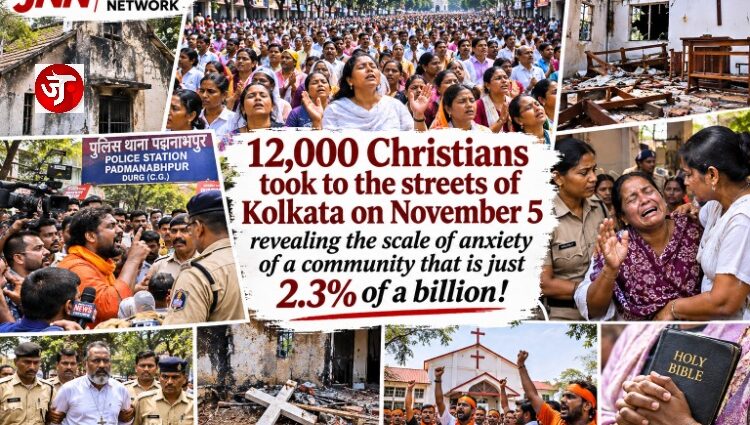
12,000 Christians took to the streets of Kolkata on November 5 revealing the scale of anxiety of a community that is just 2.3% of a billion
November 7, 2026
From the streets of Kolkata to remote villages in Chhattisgarh, Arunachal Pradesh and West Bengal, a disturbing pattern of alleged attacks, intimidation and disruption of Christian worship is raising urgent questions about religious freedom, police accountability and the safety of minorities.
Twelve thousand Christians took to the streets of Kolkata on November 5. They came from different districts of West Bengal and neighbouring states, carrying prayers, placards and a demand that should never have needed a public demonstration: the right to worship without fear.
https://www.facebook.com/watch/?v=2681041045684760
The six-kilometre prayer and protest march, organised by the Bangiya Christiya Pariseba (BCP), was a response to a growing number of reported attacks on Christian prayer gatherings, churches and families.
The organisation had expected around 5,000 participants. More than 12,000 turned up, according to its founding secretary, Herod Mullick. The scale of the mobilisation reflected the anxiety within a community that says its ordinary religious activities are increasingly being interrupted by groups alleging forced conversions.
According to BCP, 48 incidents targeting Christians have been recorded in West Bengal since May 2026. The organisation has alleged that police have failed to register complaints in several cases, saying only 16 FIRs had been filed.
These are figures supplied by the Christian organisation and require examination against police records. But the testimonies emerging from the state demand serious attention.
The question is no longer confined to individual confrontations. It concerns the ability of citizens to assemble, pray and practise their faith without intimidation.
https://www.facebook.com/watch/?v=1698904981817796
October’s disturbing incidents: Churches, homes and prayer meetings targeted
The November demonstration followed a succession of reported incidents across West Bengal.
October 31, Narayantala, South 24 Parganas: Church inauguration disrupted
A newly built church in Narayantala Village was allegedly attacked during its inauguration by Church of North India Bishop Subrata Chakraborty.
According to UCA News, a mob of more than 30 people entered the premises and assaulted pastors, worshippers, women and children. The ceremony was disrupted, and members of the congregation were reportedly injured.
The incident prompted Christian organisations to demand an investigation and protection for worshippers.
October 18–20, West Midnapore: Three Christian families allegedly assaulted
In another disturbing episode, three Christian families in the Chandrakona police station area were allegedly assaulted.
According to an investigation by The Indian Express, one woman was reportedly forced to undergo a public purification bath, while members of the families were made to participate in a ritual at a Durga Puja pandal.
Police registered an FIR containing charges including attempted murder, criminal intimidation, outraging a woman’s modesty and robbery. Police personnel were subsequently deployed near the families’ homes.
The victims reportedly remained fearful of further attacks.
October 9, Jalalkhali, Nadia: Bible conference disrupted
A Christian Bible conference attended by more than 1,900 people from the Santhal community was disrupted at St Louis Parish Church in Jalalkhali, near Krishnanagar.
According to eyewitness accounts reported by Fides, a crowd gathered outside the church, with some people entering the premises carrying bamboo poles and bricks. Decorations and banners were damaged, stones were thrown at the prayer hall and worshippers were allegedly assaulted.
The four-day gathering was brought to an abrupt halt.
Hindu Jagran Manch members alleged forced conversions, while Christian representatives disputed the accusation.
The All India Catholic Union called for an investigation and defended the community’s right to worship in its own language.
October 5, Kolkata: Christian body approaches human rights commissions
The Bangiya Christiya Pariseba formally approached the National Human Rights Commission, West Bengal Human Rights Commission and National Commission for Minorities, alleging a pattern of attacks, intimidation, vandalism and desecration of prayer spaces.
A public hearing brought together pastors, victims, eyewitnesses and civil society representatives.
Alt News had independently documented at least 35 incidents of violence and intimidation against Christians in West Bengal between July 1 and September 20, 2026.
The testimonies included allegations of attacks on house churches, assault of worshippers and disruption of private prayer gatherings.
Durg, Chhattisgarh: Christians Forced to Gherao Police Station Amid Hindutva Activists and Media – June 22, 2026
In a disturbing incident that exposes the vulnerability of a religious minority seeking protection, members of the Christian (Masih) community in Durg, Chhattisgarh, marched to and attempted to gherao Padmanabhpur police station, demanding the arrest of those accused of misbehaving with women from their community during an earlier disturbance at a church or prayer gathering.
The protesters alleged that despite complaints being registered, the accused had not been brought to justice. With a heavy police deployment and barricades preventing them from entering the station, the demonstrators sat outside, praying and singing hymns while demanding accountability. Community representatives, including Pradeep Dubey, questioned why women who had allegedly been harassed were still waiting for justice. Durg Rural ASP Manishankar Chandra confirmed that complaints had been filed by both sides and that the matter was under investigation
A woman told the media that the attackers branded members of their community “anti-national” and “Naxalwadi”, openly declaring that they should be shot with guns, even as Hindutva activists and a strong police contingent were present at the scene.
Arunachal Pradesh: United Christian Forum takes the issue to the Chief Minister
The concerns are not confined to West Bengal.
On April 20, 2026, the United Christian Forum (UCF) held a press conference in Itanagar, with national coordinator AC Michael addressing the media alongside Christian representatives from the Northeast.
The forum had written to Arunachal Pradesh Chief Minister Pema Khandu, seeking his intervention over reported violence against Christians.
Two representatives from the Northeast raised concerns about the situation in Arunachal Pradesh. The delegation had also issued an open letter to the Chief Minister after, according to the representatives, they were unable to secure a meeting with him.
The appeal was direct: the Chief Minister should initiate dialogue with the BJP, the RSS or the Union government to address the growing concerns. The forum also sought a public statement from him reaffirming that violence and intimidation against Christians would not be tolerated.
AC Michael said UCF had repeatedly submitted reports and representations to constitutional authorities, including the Prime Minister, the President and the Union Ministry of Minority Affairs.
He expressed frustration that repeated alerts had not resulted in adequate action.
The Arunachal Times report of April 21 recorded UCF’s figures: reported incidents had risen from 127 in 2014 to more than 834 in 2024. By mid-April 2026, the helpline had recorded 531 incidents.
Michael also cited 149 incidents in Arunachal Pradesh by mid-April 2026, compared with two in 2014.
These are UCF’s reported figures, not a government-certified national crime database. Nevertheless, the trend identified by the organisation deserves examination by the authorities.
The forum also raised concerns about the treatment of Dalit and Adivasi Christians and the increasing targeting of institutions engaged in education and social services.
A helpline born out of persecution in 2015
The United Christian Forum’s intervention did not begin this year.
The organisation was established against the backdrop of growing concerns over attacks on churches and Christian institutions.
On January 19, 2015, a toll-free helpline was launched in Delhi to provide assistance to Christians reporting violence, intimidation, coercion and discrimination.
UCF, with support from the United Christian Forum for Human Rights (UCFHR) and Christian legal networks, sought to create a system through which victims could report incidents and obtain legal assistance.
The helpline number was 1800-208-4545.
A January 22, 2015 update by AC Michael recorded 3,448 calls since its launch, including 1,097 calls transferred to its three agents. The calls included requests for legal assistance and reports of social ostracism against Christian families.
A January 24, 2015 Business Standard report documented the initiative, explaining that the helpline was intended to connect victims with lawyers, local networks and authorities.
More than eleven years later, the organisation is still raising similar concerns.
The persistence of these complaints raises an uncomfortable question: how much has changed for the people seeking protection?
Anti-conversion laws: Protection against coercion or a source of intimidation?
One of the central issues in the controversy is the spread and enforcement of state anti-conversion legislation.
Several states have introduced laws officially described as Freedom of Religion Acts. These laws prohibit conversion through force, fraud or inducement.
As documented in the UK government’s country information report, 13 states had such laws according to the 2022 US State Department religious freedom report: Assam, Arunachal Pradesh, Chhattisgarh, Gujarat, Haryana, Himachal Pradesh, Karnataka, Jharkhand, Madhya Pradesh, Odisha, Rajasthan, Uttarakhand and Uttar Pradesh.
The exact legal position has since evolved, with amendments and new legislation in some states.
Supporters argue that the laws protect vulnerable people from coercion and fraudulent religious conversions.
Christian organisations, however, contend that vague definitions of terms such as force, fraud and allurement allow ordinary religious activities, charity, education and prayer meetings to be treated with suspicion.
UCF national coordinator AC Michael has alleged that these provisions are being misused to harass religious minorities.
There is an important distinction that must not be lost: forced conversion, where established, is unlawful. But an allegation of forced conversion is not proof of a crime. Nor does it authorise private groups to enter homes, disrupt worship, assault people or take the law into their own hands.
Himachal Pradesh, for instance, introduced its first post-independence Freedom of Religion Act in 2006 and replaced it with a stricter law in 2019.
Christian organisations have also challenged the repeated allegations of widespread forced conversion. But it would be equally inaccurate to claim that no individual case of coercive conversion has ever been established anywhere in India. Each case must be judged on evidence and judicial findings.
The constitutional principle remains straightforward: religious conversion must be voluntary, and religious freedom must be protected.
The numbers: India’s Christians constitute just 2.3%
There is another dimension to this story. According to the 2011 Census, Christians constituted approximately 2.3% of India’s population, numbering around 2.78 crore people.
India has not yet published a newer official religion-wise census count. This is a small religious community in a country of more than 1.4 billion people.
Yet Christian organisations continue to report attacks on worshippers, disruptions of prayer meetings, vandalism of churches and intimidation of pastors and families.
The issue is not whether a community is large or small. Constitutional rights do not depend on population share.
But when a relatively small minority repeatedly reports being threatened, assaulted or prevented from practising its faith, the responsibility of the state to protect it becomes particularly important.
Article 25: The constitutional promise
Article 25 of the Indian Constitution guarantees freedom of conscience and the right freely to profess, practise and propagate religion, subject to public order, morality, health and other constitutional provisions.
It does not grant any community the right to force another person to convert.
Equally, it does not permit a mob to decide who may pray, which religious gathering is legitimate or whether a pastor should be allowed to conduct a service.
If an unlawful act takes place, the police must investigate. If someone is guilty, the courts must decide. Vigilante groups cannot substitute themselves for the law.
The presence of police during a confrontation also raises questions about whether officers intervened effectively, registered complaints impartially and protected those at risk.
The question India cannot avoid
From the November 5 march in Kolkata to the complaints placed before human rights commissions, from the church attack in Nadia to the appeal by AC Michael in Arunachal Pradesh, a common demand runs through the accounts: protection, impartial policing and accountability.
The government has a duty to investigate allegations of forced conversion wherever credible evidence exists. But it has an equally serious duty to protect people who are threatened or assaulted because of their religious identity.
No citizen should have to produce a majority population behind them to claim the protection of the Constitution.
A person does not become anti-national by praying in a church. A pastor does not become a criminal by conducting a prayer meeting. And a religious minority does not surrender its constitutional rights because it is outnumbered.
India’s secular character is not measured by the number of religious festivals celebrated or the number of communities represented in official photographs. It is measured by whether every citizen can practise their faith without fear.
JANPATH NEWS NETWORK (JNN)
Independent. Fearless. On the People’s Path.