





Putin lands on disputed Kuril island as Japan protests, Colombia earthquake death toll climbs and Iran-US tensions remain dangerously high
The global news cycle on Thursday was dominated by a striking mixture of geopolitical confrontation, natural disaster, public-health anxiety and political upheaval, from the disputed islands of the North Pacific to the shattered cities of Colombia and the increasingly dangerous standoff between Washington and Tehran.
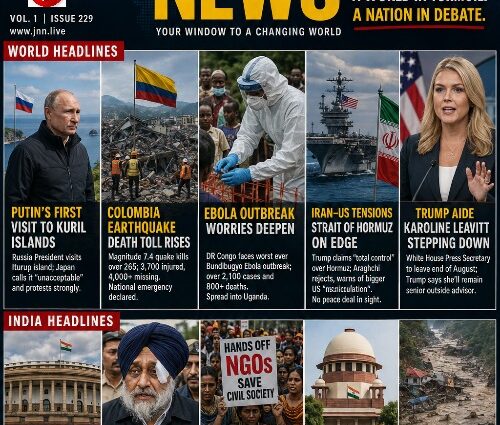
Russian President Vladimir Putin made his first personal visit to the disputed Kuril Islands since coming to power nearly 27 years ago, travelling to Iturup, one of four southern islands claimed by both Russia and Japan. Putin toured a fish-processing plant, a hospital and a school, met local residents and held discussions with Sakhalin Governor Valery Limarenko during his Far East tour.
The visit immediately provoked a sharp reaction from Tokyo. Japan regards the islands as its Northern Territories and considers them Japanese territory. Prime Minister and Foreign Minister condemned Putin’s visit as unacceptable, while Tokyo lodged a formal protest. The territorial dispute has remained one of the central obstacles to a formal peace treaty between Russia and Japan since the end of the Second World War.
Putin’s decision to personally visit Iturup therefore carries significance beyond a routine regional tour. The Kremlin is reinforcing Russia’s control over territory that Japan continues to claim, at a moment when Moscow’s relations with the West and its Asian neighbours remain under intense strategic pressure.
Meanwhile, Colombia is confronting a major humanitarian catastrophe following the magnitude 7.4 earthquake that struck the western part of the country on August 10.
The death toll has risen to at least 265, with more than 3,700 people injured and hundreds still officially missing. Civilian estimates have suggested that the number of people unaccounted for could be considerably higher. More than 9,500 homes have been destroyed, while Cali, Pereira, Manizales, Quibdó and surrounding areas have suffered extensive damage.
Rescue teams have been working around the clock, racing against the critical window in which survivors may still be found beneath collapsed structures. Soldiers, emergency workers, sniffer dogs and specialised detection equipment have been deployed, while international assistance has begun arriving.
The disaster has placed enormous pressure on Colombia’s newly installed government as it confronts the immediate rescue operation as well as the immense task of rebuilding homes, hospitals, schools and infrastructure. President Abelardo de la Espriella has pledged an emergency reconstruction fund as the country begins confronting the scale of the destruction.
In Central Africa, the Democratic Republic of Congo continues to battle a serious outbreak of Ebola disease caused by the Bundibugyo virus. The outbreak was declared in May and has spread across several health zones, with Ituri remaining the principal epicentre. WHO declared the outbreak a Public Health Emergency of International Concern because of the severity of the disease and its potential for international spread.
The latest WHO figures available in its July reporting recorded 2,124 confirmed cases and 828 deaths in the DRC as of July 15, with cases reported across five provinces. Uganda had recorded 20 confirmed cases, linked to infections originating in the DRC. WHO has warned that insecurity, displacement and population movement are making contact tracing and surveillance particularly difficult.
The outbreak is particularly worrying because there is currently no licensed vaccine specifically approved for Bundibugyo virus and no specific licensed therapeutic for the strain. WHO says response efforts therefore depend heavily on rapid detection, supportive treatment, infection prevention, contact tracing, safe burials and community engagement. Clinical research into potential treatments and vaccines is under way.
The Middle East remained another major pressure point.
Tensions between the United States and Iran continued to centre on the strategically vital Strait of Hormuz, with President Donald Trump claiming that the United States has effectively established control over the waterway through overwhelming naval power. Iranian Foreign Minister Abbas Araghchi rejected the assertion and warned Washington against what he described as a potentially dangerous miscalculation.
The competing claims underline the continuing uncertainty surrounding one of the world’s most important energy corridors. Any prolonged disruption around Hormuz could have consequences well beyond the region, affecting shipping, energy markets and global trade.
There has been little sign of a diplomatic breakthrough, while reports of military movements, security threats and possible assassination plots have added another layer of danger to an already volatile confrontation.
In Washington, another notable development came from inside the White House. Press Secretary Karoline Leavitt is stepping down at the end of August, with President Trump saying she will spend more time with her family while continuing to serve as an outside adviser. Leavitt, 28, became the youngest White House press secretary in US history and has been one of Trump’s most prominent and combative public defenders.
Trump is also undertaking a rare Western fundraising tour, with stops in California and Nevada as Republicans look towards the approaching midterm elections. The administration continues to face battles over election rules, White House construction and a range of domestic policy issues.
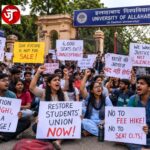
Back in India, the Monsoon Session of Parliament has ended after weeks of disruption and political confrontation. The session saw repeated clashes between the government and Opposition over student protests, police action and a range of other contentious issues.
Among the legislation passed was the Mines and Minerals (Development and Regulation) Amendment Bill, 2026, while the controversial Foreign Contribution (Regulation) Amendment Bill remains under scrutiny after being referred to a 31-member Joint Parliamentary Committee.
The FCRA legislation has triggered significant concern among civil-society groups, churches and political leaders in parts of the Northeast, with Meghalaya, Mizoram and Nagaland among the states pressing for safeguards and broader consultation.
Another disturbing development came from Nanded, Maharashtra, where Shiromani Akali Dal president Sukhbir Singh Badal was attacked at a gurdwara. Reports said the attacker was dressed in traditional Nihang attire. Badal was not seriously injured, while a security guard sustained injuries and the suspected attacker was taken into custody.
The incident has revived concerns about political security and religious-site security, particularly given that Badal survived another attack at the Golden Temple in Amritsar in 2024.
Across India, the monsoon continues to pose a major challenge. Heavy rainfall, floods and landslides have disrupted transport and damaged infrastructure in several states, with Himalayan regions particularly vulnerable as saturated slopes give way and roads become increasingly fragile.
The day therefore closes with an unusually broad spectrum of crises.
In the Pacific, Putin has physically stepped onto territory Japan still claims.
In Colombia, rescuers are still searching through the ruins of cities struck by one of the country’s most powerful earthquakes in a century.
In Central Africa, health workers are fighting an Ebola strain for which there is still no licensed vaccine specifically targeting the virus.
In the Persian Gulf, Washington and Tehran continue to trade increasingly dangerous claims over the Strait of Hormuz.
And in India, Parliament has closed for the session but left behind a series of unresolved political battles over recruitment, foreign funding, federal power and the functioning of democratic institutions.
Territory is being contested. Institutions are being tested. Governments are under pressure. Natural disasters are overwhelming communities. And ordinary people are once again left to navigate the consequences.
For one night, at least, the world has managed to provide more than enough news.
JANPATH NEWS NETWORK (JNN)
Independent. Fearless. On the People’s Path.