







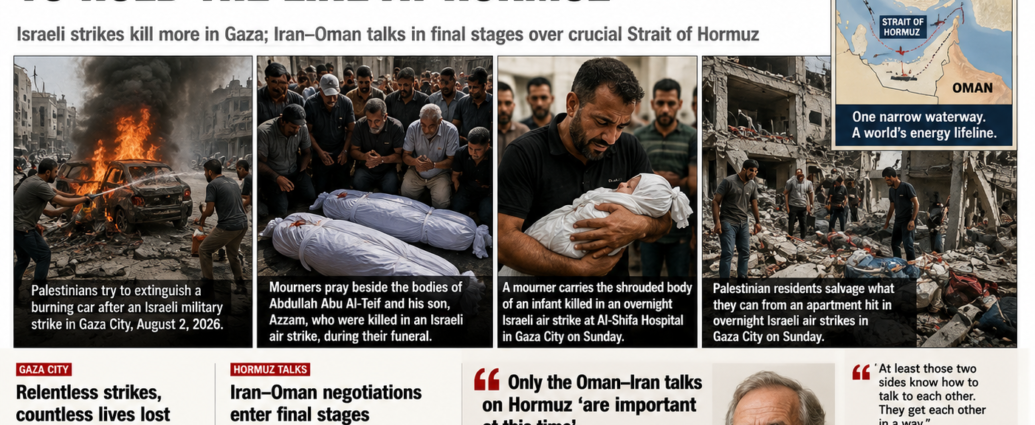
NEW DELHI, AUGUST 3: Across a Middle East caught between relentless warfare and fragile diplomacy, two starkly different scenes unfolded this weekend: Palestinians search through the wreckage for their dead, & Iran decided it’s not worth talking to the USA, as they can’t count on what they say
In Gaza City, Israeli military strikes continued to exact a heavy toll. Palestinians rushed to extinguish a burning vehicle after a strike on Sunday, August 2, as smoke rose above streets already scarred by months of conflict. Elsewhere, residents picked through shattered apartments, salvaging whatever possessions remained after overnight bombardment.
The human cost was visible at funerals and hospitals. Mourners gathered beside the bodies of Abdullah Abu Al-Teif and his son Azzam, reportedly killed in an Israeli air strike. In contrast, another mourner carried the shrouded body of an infant reported killed in an overnight strike, according to photographs and captions supplied by international news agencies.
Yet even as Gaza mourned, another potentially explosive Middle Eastern confrontation was being addressed through diplomacy.
Iran has decided it is not worth talking to the United States, because they “can’t count on anything the US says”, says Alan Eyre, a distinguished diplomatic fellow with the Middle East Institute in Washington, DC.
“Nothing has changed. President Trump has promised to annihilate Iran, five or six times, and then backs down at the last minute. I think it’s highly doubtful there are talks, that he’s reaching an agreement with Iran on the nuclear issue or the Strait of Hormuz,” Eyre told Al Jazeera.
Thus, Iran and Oman are negotiating over the future of the Strait of Hormuz, one of the world’s most strategically important shipping corridors. Tehran said on August 2 that negotiations with Muscat were entering their final stages, following several rounds of technical and political discussions on navigation, security, and the control of maritime traffic.
The talks have assumed extraordinary importance amid tensions involving Iran and the United States.
Former U.S. diplomat Alan Eyre, who participated in negotiations surrounding the 2015 Iran nuclear agreement, argued that the Oman-Iran channel may now matter more than speculation about direct Washington-Tehran negotiations. Iran has previously insisted that the talks with Oman concern Hormuz and are separate from negotiations with the United States.
At the heart of the dispute is a question with consequences far beyond the Gulf: who controls passage through Hormuz, under what conditions, and whether vessels could ultimately face transit charges. Oman and Iran have been discussing mechanisms for safe navigation while attempting to reconcile Iranian claims of sovereign rights with international concerns over freedom of shipping.
Thus the Middle East enters another uncertain week with two realities unfolding simultaneously.
In Gaza, families bury their dead and survivors search through rubble. In Muscat and Tehran, diplomats negotiate over a narrow stretch of water that can shake global energy markets.
One crisis is measured in human lives. The other could determine whether an already volatile region moves towards negotiation or another devastating confrontation.
JANPATH NEWS NETWORK (JNN)
Independent. Fearless. On the People’s Path.