








“Mohammad Deepak” Stands Beside Sonam Wangchuk: The Man Who Defied a Mob Returns to the Frontlines of Protest
New Delhi – July 20, 2026:
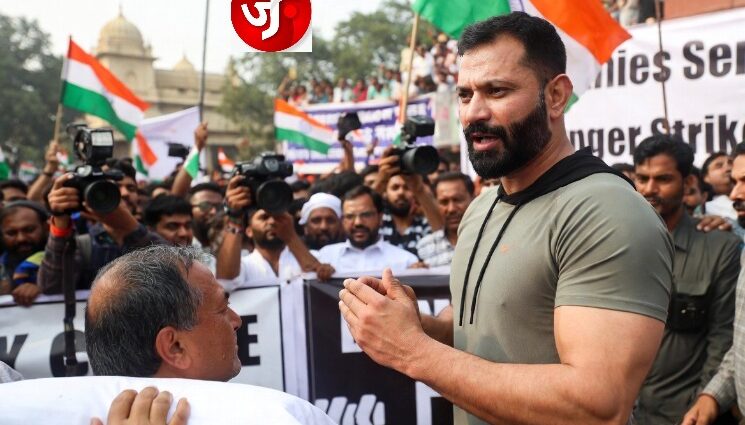
Deepak Kumar, the Uttarakhand gym owner who became known across India as “Mohammad Deepak” after confronting a mob to protect an elderly Muslim shopkeeper earlier this year, has now emerged at Delhi’s Jantar Mantar in support of activist Sonam Wangchuk and the nationwide student-led protest movement.
His appearance comes at a time when the demonstrations over alleged examination irregularities, education reforms, and government accountability have become one of the country’s most closely watched mass movements. Wangchuk’s prolonged hunger strike, which ended after police shifted him to the hospital due to deteriorating health, has transformed him into a central figure of the protests.
Deepak first entered the national spotlight in January 2026 after intervening when a group confronted an elderly Muslim shopkeeper in Kotdwar, Uttarakhand, demanding that the word “Baba” be removed from his shop’s name. Standing between the mob and the shopkeeper, Deepak declared the now-famous words, “Mera naam Mohammad Deepak hai” (“My name is Mohammad Deepak”), a statement that quickly went viral across social media and television, earning praise from many as a powerful message of communal harmony while also drawing fierce criticism and threats from others.
Now, months later, Deepak has once again stepped into a politically charged public space by joining supporters gathered at Jantar Mantar. The protest has attracted students, activists, retired professionals and public figures demanding greater transparency and accountability in India’s education system following the controversy surrounding competitive examinations.
His presence has generated sharply divided reactions online. Supporters describe him as someone who consistently stands with people facing injustice regardless of religion or politics, arguing that his participation reflects the same principles he demonstrated in Kotdwar. Critics, however, accuse him of selectively engaging in issues that align with opposition narratives, reviving debates that have followed him since his viral intervention earlier this year.
Regardless of where public opinion falls, Deepak Kumar remains one of the most recognisable civilian faces associated with acts of interfaith solidarity in recent times. His decision to stand alongside Sonam Wangchuk has once again placed him at the centre of a national conversation about dissent, citizenship, and the increasingly blurred lines between social activism and political symbolism.
As the demonstrations continue to reverberate across India, the image of the man who once answered a hostile crowd with the words “My name is Mohammad Deepak” has returned to the spotlight, this time amid a movement that has grown far beyond a single protest site