









Sansad Chalo Turns Battleground: Police Force, Student Sacrifice, and Political Shadows Exposed
As darkness settles over the national capital, Delhi bears the scars of another day when the hopes of India’s youth collided head-on with the machinery of the state. What began as a movement demanding accountability for repeated examination paper leaks has transformed into one of the most emotionally charged confrontations of recent years.
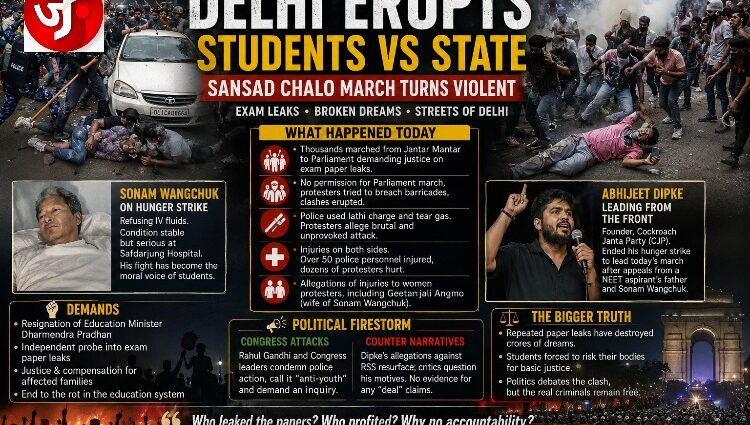
Thousands of students, led by the Cockroach Janta Party (CJP) founded by Abhijeet Dipke, alongside other youth organisations, marched from Jantar Mantar toward Parliament under the banner of “Sansad Chalo.“ Their demands were painfully simple: the resignation of Education Minister Dharmendra Pradhan, an independent investigation into repeated examination paper leaks, justice for families devastated by student suicides, compensation for victims, and structural reforms to restore faith in India’s education system.
Instead, the nation witnessed smoke, chaos, sirens, broken barricades, injured bodies, and a generation once again asking whether anyone in power is listening.
Videos circulating across social media capture scenes that are difficult to watch. Riot police advancing with lathis into tightly packed crowds. Protesters falling to the pavement. Young men and women carrying the injured away from the chaos. Thick clouds of smoke engulfing Parliament Street. A protester lying motionless beside a mobile phone that continued recording as history unfolded around him.
The images are haunting.
But they are also incomplete.
Protesters allege an unprovoked and brutal lathi charge accompanied by tear gas against what they describe as a peaceful demonstration. Delhi Police reject that narrative. Officials maintain that the march had no permission to approach Parliament, that protesters attempted to breach security barricades, and that officers responded with standard crowd-control measures after clashes erupted. Police sources further claim that more than fifty personnel were injured during the confrontation.
Both claims now compete across television studios and social media feeds.
The reality appears far more uncomfortable than the simplified versions being promoted by opposing political camps.
Hospitals across central Delhi have received both protesters and police personnel suffering fractures, bruises, head injuries, and respiratory distress caused by tear gas. Protest groups also allege injuries to women demonstrators, including claims involving Geetanjali Angmo, wife of hunger-striking activist Sonam Wangchuk, though several of these accounts are still awaiting independent verification.
There was pain on both sides of the barricades.
And pain, unlike politics, cannot be edited into convenient narratives.
At the heart of today’s march remains Sonam Wangchuk, whose prolonged hunger strike over examination corruption has become the moral centre of this movement. Days after being shifted under medical supervision to Safdarjung Hospital following severe physical deterioration, Wangchuk continues to refuse intravenous nutrition, insisting that the conscience of the nation cannot be sustained by medical drips while justice itself remains on life support.
His name echoed repeatedly through today’s demonstrations.
Many marched not merely for an examination.
They marched for trust.
Leading the protests from the front was Abhijeet Dipke, founder of the Cockroach Janta Party. Having recently ended his own hunger strike following appeals from the grieving father of a NEET student who died by suicide and encouragement from Wangchuk himself, Dipke returned to the streets determined to carry the movement forward.
He insists the fight is not against a government alone but against an education system that has repeatedly betrayed millions of hardworking students.
Political reactions arrived almost as quickly as the tear gas.
Congress leaders, including Rahul Gandhi, condemned the police response as excessive and anti-youth, demanding an immediate inquiry into today’s events.
Meanwhile, Dipke’s earlier allegations accusing individuals linked to the RSS of targeting him have resurfaced, while critics have attempted to question his own political motivations through speculation about alleged hidden understandings with rival groups. At present, none of those claims are supported by publicly available evidence, and they remain part of an increasingly toxic political blame game surrounding a movement born from genuine public frustration.
The louder politics becomes, the quieter the students seem to grow.
And that may be the greatest tragedy of all.
Because today’s story did not begin with barricades outside Parliament.
It began years ago inside examination halls.
Repeated paper leaks have steadily eroded confidence in India’s education system. Millions of students from ordinary families have sacrificed childhoods, family savings, and years of relentless preparation only to discover that integrity itself had become negotiable. For some, disappointment turned into depression. For others, it became unbearable.
Those silent tragedies brought today’s crowds onto Delhi’s streets.
The Parliament march, however, entered territory where constitutional protest met national security concerns. Authorities had refused permission for the procession to approach Parliament, creating an inevitable confrontation once demonstrators pushed toward heavily protected zones.
The result was exactly what the nation witnessed.
Force met resistance.
Resistance met force.
Everyone lost.
Selective video clips can inflame outrage.
Political speeches can harvest applause.
Hashtags can dominate timelines for a few hours.
None of them answer the questions that truly matter.
Who leaked the examination papers?
Who profited?
Why has accountability moved so slowly despite repeated scandals?
Why must students repeatedly gamble with their futures before anyone pays attention?
And why has a generation that asked for fairness found itself confronting batons instead?
As Delhi settles into another uneasy night, barricades still stand across parts of the capital, hospitals continue treating the injured, and millions of students watch anxiously from every corner of the country.
The debate has shifted from education reform to street confrontation.
Perhaps that is the greatest victory for those who fear accountability.
Because while India argues over who threw the first stone or swung the first baton, the original crime risks fading into the background.
The examination paper leaks that ignited this movement remain unresolved.
The families shattered by student suicides still await justice.
And somewhere tonight, another student will open a textbook wondering whether merit still has meaning.
That question, more than any clash on the streets of Delhi, deserves the nation’s full attention.
Humanity has a remarkable talent for forgetting why the fire started while arguing over the smoke. The students, meanwhile, are still waiting for an answer sheet that contains something rarer than marks: justice.
JANPATH NEWS NETWORK (JNN)
Independent. Fearless. On the People’s Path.