









The controversy surrounding Rahul Gandhi and other Opposition MPs over their Parliament skit raises a question India cannot afford to bury beneath political outrage: Which is the greater insult to faith: questioning the alleged theft of devotees’ offerings, or the alleged theft itself?
The controversy surrounding Rahul Gandhi and other Opposition MPs over their Parliament skit raises a question India cannot afford to bury beneath political outrage: What is the greater insult to faith: questioning the alleged theft of devotees’ offerings, or the alleged theft itself?
The skit staged outside Parliament was provocative. It was meant to be.
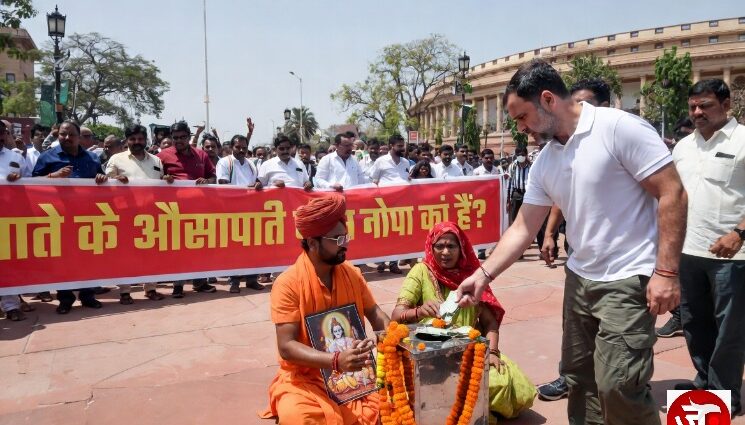
Rahul Gandhi and other INDIA-bloc MPs used donation boxes to dramatize allegations concerning the diversion of offerings at the Shri Ram Janmabhoomi Temple in Ayodhya. Independent MP Pappu Yadav, dressed in saffron robes, played the role of the figure who pocketed the donations. The symbolism was hardly subtle. Political theatre rarely arrives carrying footnotes.
But the message was not that every Hindu priest is a thief, nor that saffron robes represent corruption. The political argument being enacted was that religious faith must never become a shield behind which corruption can hide.
And that distinction is crucial. The allegations surrounding temple donations were serious enough to trigger investigation, arrests and institutional consequences. Money offered by devotees is not ordinary revenue. Every rupee placed before a deity carries something beyond its monetary value: trust.
A labourer may donate ₹10. A pensioner may give ₹100. A family may contribute from savings because the offering represents devotion, gratitude or sacrifice. If such money is misappropriated, the first people entitled to demand answers are Hindus themselves.
Yet the extraordinary irony is that the political dramatisation of alleged wrongdoing has now led to an FIR against Rahul Gandhi, Pappu Yadav, and Awadhesh Prasad, following complaints that the portrayal wounded religious sentiments.
People are perfectly entitled to dislike the skit. Saints and devotees may genuinely feel that using saffron robes and a priest-like character crossed a line. Their hurt should not simply be mocked or dismissed.
But neither should religious hurt become a substitute for answering the question the skit was attempting to raise: Where did the devotees’ money go, who was responsible, and how will such alleged wrongdoing be prevented from happening again?
Religion is vastly older than any political party, government, trust, or office-holder. It does not require allegations of corruption to be hidden to protect its dignity. Indeed, accountability should strengthen religious institutions rather than weaken them.
The saffron robe is sacred to millions precisely because it represents renunciation, discipline and service. If someone entrusted with religious responsibility exploits devotees, demanding accountability for that conduct is not necessarily an attack on saffron. It can equally be understood as a defence of what saffron is supposed to represent. That was the essential argument behind the parliamentary performance.
The donation box became a metaphor. The act of putting money into it represented the ordinary devotee. The theatrical removal of that money represented the allegation being protested. The politicians were not engaging in theological discourse. They were using satire to make a political accusation visible.
One may argue that the imagery was crude. One may argue that it was insensitive. One may even argue that Opposition MPs should have chosen a different symbol, but criticism of the manner of protest cannot erase the substance of the issue.
Because if the alleged diversion of temple offerings is established, the deepest injury is suffered not by politicians but by the devotees whose faith was entrusted to an institution.
The scenes outside Parliament were political theatre, certainly. But beneath the costumes, slogans, and donation boxes lay a serious proposition: Defending the integrity of a temple cannot mean silencing questions about what happens to devotees’ offerings.
Questioning alleged corruption is not an attack on faith. Protecting faith requires the courage to question corruption, and that, ultimately, was what the skit was trying to show.
JANPATH NEWS NETWORK (JNN)
Independent. Fearless. On the People’s Path.