










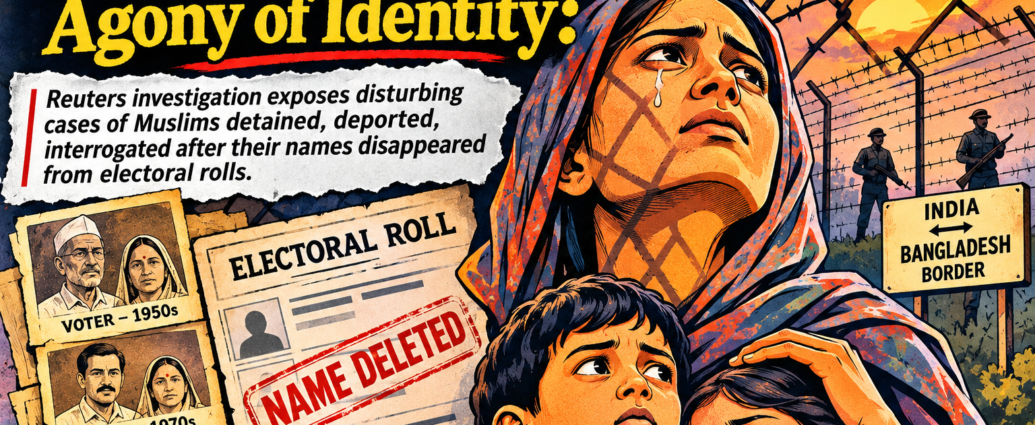
Reuters investigation exposes disturbing cases of Muslims detained, deported, interrogated after their names disappeared from electoral rolls
MONDAY, NOVEMBER 16, 2026
A woman steps out of her Mumbai home to buy vegetables. She tells her younger son she will return in a few minutes. More than three months later, she is living in a village in Bangladesh, separated from her husband and two children. Her name is Sahida Fakir. She is 38 years old.
Her story, uncovered in a major Reuters investigation published on November 16, raises disturbing questions about India’s voter-list revision, citizenship verification and the treatment of people suspected of being undocumented migrants.
On July 19, Fakir says, plainclothes officers detained her, seized her mobile phone, which contained copies of her identity documents, and eventually forced her across the India-Bangladesh border.
Court records identify the officials involved as members of the Mumbai Police Crime Branch. The department did not respond to Reuters‘ request for comment.
Fakir says she was taken to Bangladesh without being given an opportunity to establish her Indian identity using documents stored on her phone.
“I never imagined, not even for a moment, that they would send me to Bangladesh,” she told Reuters. Her family is now fighting her case in court. But Fakir’s case is not an isolated account.
130 million names deleted: A question of identity
Reuters interviewed ten families whose relatives had been detained, deported or questioned about their citizenship after being dropped from India’s revised electoral rolls.
The investigation found that the country’s sweeping voter-roll revision has become entangled with a separate government drive to identify and expel suspected illegal immigrants.
Being removed from an electoral roll does not automatically establish that a person is a foreign national.
Yet, for some people, deletion has been followed by police detention, citizenship inquiries and deportation proceedings.
The nationwide revision removed approximately 130 million names, making it the largest deletion of voters in India’s history. West Bengal witnessed particularly extensive deletions, with approximately nine million names removed ahead of the state elections earlier this year.
The exercise has triggered protests and allegations that legitimate voters are being excluded from the democratic process. The BJP has denied targeting Indian citizens.
A family history rooted in India
Fakir’s family history presents another troubling dimension. Records reviewed by Reuters show that her parents and grandparents were registered voters in Swarupnagar, West Bengal, dating back to India’s first general election in 1952.
Their names also appeared on the 2002-03 electoral rolls, a benchmark used in the latest revision. Fakir herself had appeared on West Bengal’s electoral rolls since at least 2008.
However, Mumbai’s Foreigners Regional Registration Office told the Calcutta High Court that she had produced a Bangladeshi birth certificate during an inquiry and had failed to provide what it considered credible documentary evidence of Indian citizenship. Her family disputes the circumstances of her deportation.
A petition filed in the Supreme Court in August argued that deletion from electoral rolls cannot determine citizenship and that deportation cannot be based on an untested executive assertion.
Court filings indicate that Fakir was among 149 people deported during the operation after authorities identified them as Bangladeshi nationals. The Mumbai Police said she was handed over to the Border Security Force and subsequently deported through designated authorities.
The case remains a matter of legal dispute.
There is another major development. On November 14, the Election Commission filed an affidavit in the Supreme Court outlining measures to help eligible voters wrongly excluded during SIR regain their place on electoral rolls. The Commission has also assured the court that people whose names were omitted can apply through Form 6 without facing prosecution merely for seeking re-enrolment.
The Supreme Court is scheduled to hear related petitions on November 17. But a lot of damage has already been done.
Detention, fear and unanswered questions
Reuters also documented cases of other Muslims who said they were detained after their names disappeared from electoral rolls, including individuals whose appeals were still pending.
One man described being confined at a holding facility, saying he could not leave the premises. Meanwhile, human rights activists have raised concerns about the slow pace of tribunals dealing with challenges to electoral-roll deletions.
Kirity Roy, a human rights activist, told Reuters that millions of people were waiting for justice. The central concern is whether people are being given a fair opportunity to establish their identity before facing detention or deportation.
The investigation also raises questions about the coordination between electoral authorities, police, immigration officials and border agencies.
When the state gets someone’s identity wrong
India has every right to identify undocumented immigrants, enforce its laws and protect the integrity of its borders. But that responsibility comes with an equally important obligation: ensuring that genuine citizens are not wrongly identified, detained or deported.
An electoral roll is a record of eligible voters. It is not, by itself, a final determination of nationality. A person whose name disappears from a voter list does not automatically become a foreigner. Nor should a family have to spend months fighting through courts to bring a mother, wife or child back home because of a disputed identity determination.
The larger question is no longer simply how many names have been deleted, but whether the process has adequate safeguards to protect people from administrative errors, arbitrary detention and wrongful deportation.
When a person’s roots, family history and years of belonging can be cast aside by an administrative decision, the question is no longer merely about voter-list revision. It is about the power of the state to strip people of their sense of security, identity and belonging without first establishing the truth.
For a democracy, this is not a minor administrative lapse. It strikes at the very foundations of citizenship, equality before the law, due process and the fundamental right to belong.
JANPATH NEWS NETWORK (JNN)
Independent. Fearless. On the People’s Path.