








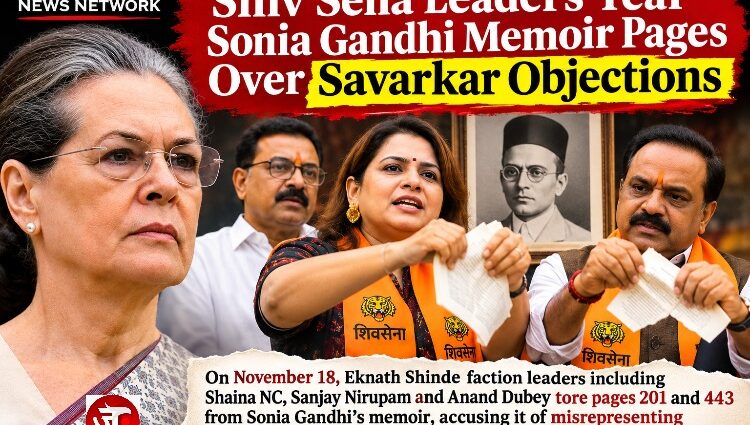
A political storm exploded over Sonia Gandhi’s book after Shiv Sena leaders tore the book, accusing it of insulting Vinayak Damodar Savarkar.
THURSDAY NOVEMBER 19, 2026: On November 18, Eknath Shinde-led Shiv Sena faction including Shaina NC, Sanjay Nirupam and Anand Dubey targeted pages 201 and 443 of Sonia Gandhi’s memoir Belonging: A Journey of Love, objecting to passages concerning Savarkar, his petitions to the British and his association with Hindutva. accusing it of insulting freedom fighter Vinayak Damodar Savarkar and misrepresenting his controversial mercy petitions.
Their protest went beyond criticism. The leaders demanded that publisher HarperCollins withdraw the disputed passages, make corrections and halt sales of the book across Maharashtra until their objections were addressed.
But the spectacle of politicians tearing pages from a published memoir has opened another, rather uncomfortable debate: where does political disagreement end and intolerance begin?
The controversy took an additional turn when videos circulating online appeared to show Shaina NC tearing a photograph of Bal Thackeray. She denied deliberately tearing the image, adding another layer of political drama to an already explosive confrontation.
Journalist Rajdeep Sardesai criticised the book-tearing spectacle, describing it as an expression of intolerance rather than a legitimate exercise in democratic disagreement.
He said:
Tearing up a book?? REALLY, GUYS! Books have traditionally been revered in our great Indian civilisation. If you don’t like Sonia Gandhi’s book, don’t read it. Disagree with it, criticise it, challenge it. Better still, write a better one! But tearing up a book? That’s not protest, it’s intolerance and yes, idiocy! .
The irony is difficult to miss. A memoir, which invites readers to engage with an author’s recollections and interpretations, has become the centre of a street-level political confrontation over historical memory.
Savarkar’s legacy remains deeply contested in Indian politics, with sharply opposing interpretations of his role in the freedom movement and his relationship with the British.
But destroying pages does not settle historical arguments. It merely raises a larger question: can a democracy defend its heroes without silencing those who write about them differently?
JANPATH NEWS NETWORK (JNN)
Independent. Fearless. On the People’s Path