









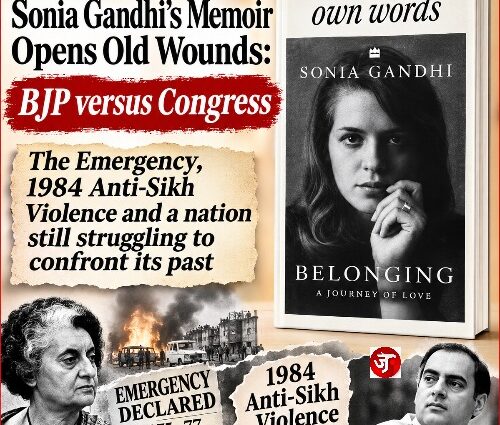
Sonia Gandhi’s Memoir Opens Old Wounds: The Emergency, 1984 Anti-Sikh Violence and a nation still struggling to confront its past
November 12, 2026
A book has reopened some of India’s deepest political wounds. Sonia Gandhi’s memoir, Belonging: A Journey of Love, has become the centre of a fierce political confrontation, with the BJP accusing her of attempting to whitewash the past of the Nehru-Gandhi family, while Congress has accused the ruling party of turning a personal memoir into another instrument of political warfare.
The controversy touches almost every major fault line in modern Indian political history: Indira Gandhi’s Emergency, the assassination of the former Prime Minister, the anti-Sikh violence of 1984, the demolition of Babri Masjid, the RSS, the Gujarat riots and Sonia Gandhi’s own complicated journey from a private individual to one of India’s most influential political figures.
But there is a larger issue that deserves attention. Does a woman who has spent decades being discussed, criticised, scrutinised and often personally vilified have the right to finally tell her own story? And should her recollections automatically be treated as an attempt to defend everything her family did?
A memoir is not a court judgment. It is a personal account, and it must be examined critically. But the author must also be allowed to speak.
1984: The darkest test of Congress’s political legacy
The most serious controversy concerns the anti-Sikh violence that followed Indira Gandhi’s assassination on October 31, 1984.
Nearly 2,733 Sikhs were killed in Delhi alone, according to the Ahuja Committee. Homes were looted and burnt, gurdwaras attacked, and innocent men, women and children subjected to horrific violence.
Sonia Gandhi describes the episode as a tragic and shameful chapter. She questions the failure of the administration to protect citizens and discusses the delayed deployment of the Army. At the same time, she defends her husband, Rajiv Gandhi, against allegations of complicity.
This is where the argument becomes particularly difficult for Congress. The Justice Nanavati Commission recorded credible material against Congress leader Sajjan Kumar and concluded that he was probably involved in attacks described by witnesses. Kumar was subsequently convicted in a murder case arising from the 1984 violence and sentenced to life imprisonment. He died in August 2026 while serving that sentence.
Other Congress-linked figures, including Jagdish Tytler, also faced serious allegations and prolonged legal proceedings.
The Nanavati Commission documented allegations of organised attacks, failures of police investigation and the apparent confidence with which mobs operated.
Congress cannot simply turn the page on this history.
In 2005, Prime Minister Manmohan Singh apologised to the Sikh community and the nation, saying he bowed his head in shame over the tragedy. That apology was necessary. The victims deserved justice, not political explanations.
But was 1984 solely a story of Congress versus Sikhs?
The historical record also deserves to be examined beyond party boundaries. There were accounts of people belonging to different political and social organisations helping Sikh families escape, providing shelter and protecting them during the violence.
Accounts involving RSS involvement in the massacre have also been reported. However, the evidence does not justify declaring that the RSS as an organisation either orchestrated the violence or was uniformly responsible for protecting victims. Individual involvement and organisational responsibility must be established through evidence.
The same standard must apply to Congress. The crimes of individual Congress leaders cannot be dismissed because some people associated with other organisations helped victims. Equally, no entire organisation or community should be assigned collective guilt without evidence.
The tragedy should be investigated honestly, not appropriated by political parties.
Rajiv Gandhi: An appointment in a national crisis, followed by an extraordinary electoral mandate
An important historical distinction is often lost in the political argument. Following Indira Gandhi’s assassination on October 31, 1984, Rajiv Gandhi was sworn in as Prime Minister that evening. He had not yet received a fresh electoral mandate for the office.
He subsequently went to the electorate in December 1984. The result was extraordinary.
Congress won 404 Lok Sabha seats, securing approximately 49 per cent of the vote. The BJP was reduced to just two seats. It remains the largest Lok Sabha victory in Congress’s electoral history.
Rajiv Gandhi had received an overwhelming democratic mandate, although the election took place amid a tremendous sympathy wave following his mother’s assassination. That mandate is a legitimate part of India’s democratic history.
But here is the distinction that must not be forgotten: winning an election does not erase responsibility for what happened before it.
The electoral victory did not absolve the government of the failure to protect Sikh citizens. Nor should the violence erase the fact that Rajiv Gandhi subsequently sought and received the people’s endorsement.
Both truths belong in the historical record.
The Army deployment controversy: Sonia’s account faces scrutiny
One of the most contentious passages in the memoir concerns the deployment of the Army. Sonia writes that General A.S. Vaidya had received orders on the night of October 31 but did not mobilise certain nearby units because they were manned by Sikh soldiers, fearing that this could aggravate the situation.
She says that units from farther away were subsequently ordered to move towards Delhi, delaying their arrival.
However, General Vaidya’s testimony before the Misra Commission presents a different account of the mobilisation. He stated that he had ordered a brigade from Meerut to move to Delhi on the morning of October 31 and that it had arrived before midnight.
The Army deployment, the availability of troops and the role of the civilian administration remain important questions in understanding how the violence was allowed to continue.
Sonia’s recollection should be read alongside the commission’s records, not treated as the final word. This is precisely where a memoir must invite scrutiny rather than end discussion.
The Emergency: Indira Gandhi’s mistake cannot be explained away
The BJP has also attacked Sonia’s treatment of the Emergency imposed by Indira Gandhi in 1975. Sonia portrays her mother-in-law as politically isolated and under immense pressure. She suggests that Sanjay Gandhi’s influence contributed to the circumstances that led to the Emergency.
Yet, what led to the Emergency is often forgotten: Jayaprakash Narayan (JP), popularly known as Lok Nayak. At a massive rally in Delhi, JP appealed directly to the armed forces, police and government employees not to obey orders they considered illegal or immoral.
He also announced a nationwide civil disobedience campaign demanding Indira Gandhi’s resignation.
The appeal was politically extraordinary because the armed forces and police are expected to remain under constitutional civilian authority.
The government interpreted JP’s appeal as an attempt to provoke rebellion and paralyse the state. That night, the Emergency was declared.
On the night of June 25, President Fakhruddin Ali Ahmed signed the proclamation under Article 352, citing internal disturbance.
In the early hours of June 26, opposition leaders, including JP, were arrested. Electricity to newspaper offices was cut, and press censorship followed.
India entered 21 months of Emergency rule, lasting until March 21, 1977.
But the historical consequences cannot be softened. Opposition leaders were imprisoned, civil liberties suspended, newspapers censored and democratic institutions severely compromised.
Explaining the pressures that surrounded Indira Gandhi is not the same as justifying the decision. The Emergency was a serious assault on Indian democracy. Congress must acknowledge that without qualification.
At the same time, the BJP cannot claim exclusive ownership of democratic principles or use the Emergency as a permanent political weapon while avoiding examination of its own record.
Babri Masjid, Gujarat and the other controversies
Sonia Gandhi’s memoir also revisits the demolition of Babri Masjid in December 1992, Sonia’s political differences with Narendra Modi, the RSS and the Gujarat riots of 2002.
Her recollections have provoked sharp reactions from the BJP, which argues that she selectively interprets historical events to protect her family’s political legacy.
Congress, meanwhile, sees the criticism of Sonia Gandhi and her memoir as an attempt to discredit her personal account.
There are also passages concerning the Batla House encounter and the 26/11 Mumbai attacks that have attracted political criticism.
These subjects deserve examination on their individual merits. Neither the BJP nor Congress should be allowed to substitute political slogans for documentary evidence.
Even the book’s accuracy is under fire
There is, however, a legitimate criticism that Sonia Gandhi and her publishers must address.
The memoir has been questioned over a series of factual inaccuracies. Reports have identified errors concerning the RSS’s founding year, the Anna Hazare movement, Ahmed Patel’s death, the Kargil War chronology, parliamentary procedures and election figures.
India Today has reported an examination identifying 55 factual and contextual issues. These are not all equally serious, but a memoir dealing with major events in India’s political history requires rigorous fact-checking.
Anna Hazare’s unusually forceful response adds another dimension to the controversy. He rejected Sonia Gandhi’s suggestion that the 2011–12 anti-corruption movement had covert BJP-RSS backing, saying he had no links with either organisation and questioning how she could comment on him without ever having met him. He also warned that responsible people must speak responsibly.
The controversy over the change of publisher from Penguin Random House to HarperCollins has added another dimension. Reports indicated disagreements over proposed editorial changes and deletions. Penguin, however, maintained that it remained willing to publish the book.
The woman behind the political surname
Perhaps the most overlooked aspect of this controversy is Sonia Gandhi herself.
Sonia Gandhi entered India as a young Italian woman who married Rajiv Gandhi. For years, she preferred a private life, far removed from the demands of electoral politics.
Then came the assassinations of Indira Gandhi and Rajiv Gandhi, the devastating loss of her husband, and the eventual pressure to enter public life.
Sonia Gandhi has had arrows constantly strung against her: Her Italian origins have repeatedly been used against her. Her marriage, family, personal relationships and motives have been subjected to political insinuations. Even her right to belong in India has at times been questioned. This, personally, has been a thorny path for Sonia Gandhi.
There is a distinction between political criticism and personal vilification.
Sonia Gandhi is a public figure and her political decisions deserve examination. But questioning her account of history is not the same as attacking her character, nationality or personal life.
Sonia Gandhi has every right to write about her experiences, her grief, her family and the political world she inhabited.
Readers, in turn, have every right to disagree with her interpretation.
Sonia Gandhi or any woman’s memoir should not be treated as a political confession simply because she carries a famous surname.
History cannot be the property of political parties
India’s past is neither exclusively Congress’s inheritance nor the BJP’s property.
The Emergency happened. The 1984 anti-Sikh violence happened. The demolition of Babri Masjid happened. The Gujarat riots happened. The failures of governments, police forces and political leadership must be examined without fear or favour.
Congress must answer for its record in 1984. The BJP must answer for its own political and administrative record. The RSS’s role in historical events must be assessed through evidence, not blanket accusations or convenient absolutions.
And Sonia Gandhi must be allowed to tell her story, while accepting that her recollections will be challenged where they conflict with established facts.
And perhaps that is the most important lesson of this controversy: political leaders may inherit offices, parties may inherit power and families may inherit legacies, but nobody inherits the right to rewrite the truth.
History belongs to the people who lived it, the victims who suffered it and the generations who deserve to know it without political filters.
JANPATH NEWS NETWORK (JNN)
Independent. Fearless. On the People’s Path.
Special Political Analysis