










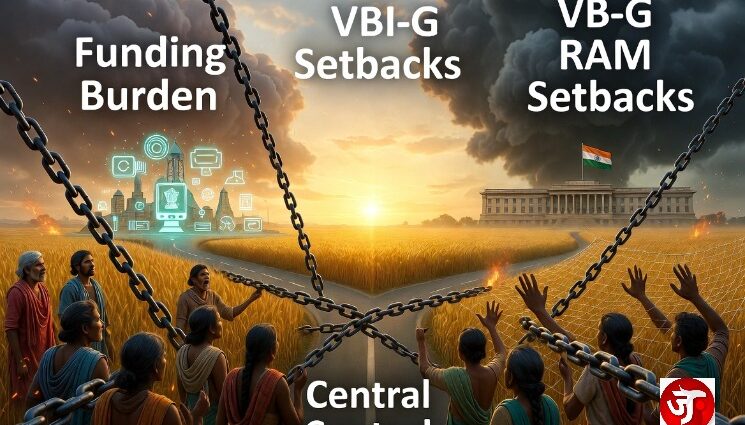
The Major Setbacks Exposed On July 1, 2026, India’s landmark rural employment safety net underwent a dramatic overhaul. The VB-G RAM G (Viksit Bharat – Guarantee for Rozgar and Ajeevika Mission Gramin) Act replaced the two-decade-old MGNREGA with a bold new framework promising 125 days of work per rural household (up from 100) and alignment with the ambitious Viksit Bharat 2047 vision. Yet, beneath the headlines of “reform” and “modernization,” a storm of criticism is brewing.
Opposition parties, worker unions, activists, and even some state governments warn that this shift risks dismantling a hard-won right to work, burdening states, and leaving the poorest more vulnerable. Here’s a clear, hard-hitting look at the scheme’s biggest setbacks.
1. Crushing Financial Load on States – “Cost-Shifting by Stealth”MGNREGA kept the Centre almost fully responsible for wages. VB-G RAM G flips the script to a 60:40 Centre-state split (90:10 for some special category states). This move could force states to cough up an extra ₹50,000+ crore nationally. Kerala alone might face an additional ₹2,000–2,500 crore burden.
Even BJP-ruled states like Madhya Pradesh, Bihar, and Uttarakhand have pushed back. Critics call it classic cost-shifting: the Centre claims credit while states foot a heavier bill. If cash-strapped states can’t pay up, the entire “guarantee” could shrink or stall.
2. From Enforceable Right to Conditional Scheme MGNREGA was revolutionary – a legal right to demand work. No work in 15 days? Unemployment allowance kicks in. VB-G RAM G moves to a supply-driven model with centrally capped budgets and “normative allocations.” The guarantee now feels more like a government handout subject to budgets, targets, and administrative whims than an ironclad entitlement. Worker unions and activists see this as a dangerous dilution of hard-fought rights, especially for women, Dalits, OBCs, and Adivasis who rely heavily on the program.
3. Top-Down Control Erodes Local Democracy: Gone is the strong bottom-up planning via Gram Sabhas and labour budgets. The new scheme tilts toward centralized decision-making and a “National Infrastructure Stack.” This centralization weakens federalism and sidelines panchayats, precisely the bodies meant to understand local needs. As one union leader put it, the design “weakens the federal structure and adversely affects those most dependent on public employment programmes.”
4. Digital Traps That Exclude the Vulnerable: The push for tech-driven “transparency” – e-KYC, facial recognition attendance, mobile apps, sounds efficient. In reality, it creates fresh barriers: server crashes, connectivity failures, biometric mismatches, and hours wasted without pay. Rural workers, especially in remote areas, already report worksites vanishing from systems and wages delayed or denied due to technical glitches. Technology meant to help is instead punishing the very people the scheme should protect.
5. Seasonal Blackouts and Funding Shortfalls: Reports of a potential 60-day “blackout” during peak agricultural seasons raise alarms exactly when many households need extra income most.
Combined with overall funding constraints, this could mean the headline 125-day promise delivers far fewer actual workdays on the ground. Early transition trends already showed declining employment in key states. With capped allocations, the scheme risks becoming another underfunded program rather than a genuine expansion.
6. Fierce Political and Legal Pushback: The backlash is loud and growing. Rural worker groups have called for protests. The Congress and allies label it an “assault on social justice” and are exploring Supreme Court challenges, with states like Telangana coordinating strategies. The very name change, dropping Mahatma Gandhi for “Viksit Bharat” and evoking “Ram”, has added fuel to accusations of ideological overreach.
The Spark That Matters: VB-G RAM G arrives with noble goals on paper: more days, faster payments, better assets. But its critics fire back that it replaces a rights-based lifeline, proven vital during crises, with a centrally controlled, fiscally strained scheme that burdens states, sidelines locals, and risks excluding the neediest through digital hurdles and budget caps.
Whether this overhaul strengthens rural India or quietly rolls back two decades of progress will play out in the fields, panchayat offices, and courts in the months ahead. For millions of rural families, the difference isn’t academic, it’s about survival, dignity, and the promise of work when they need it most. The fire is lit. Implementation will decide if it forges real progress or burns the very safety net it claims to upgrade. Keep watching the ground reality.