








As India’s student movement gathered momentum in the summer of 2026, one of its most powerful voices emerged not from a political podium, but from a hunger strike.
Neha Bora, the national president of the All India Students’ Association (AISA), has become one of the defining faces of the nationwide youth uprising over alleged examination irregularities and demands for education reform.
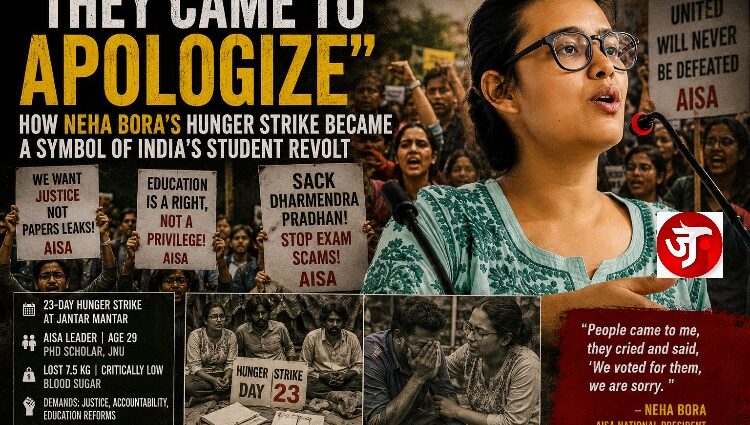
In a widely shared BBC Hindi interview, Bora recalled one of the most emotional moments of her 23-day indefinite fast at Delhi’s Jantar Mantar. Visitors came to meet her every day, many of them breaking down in tears. According to Bora, several apologized for having voted for the BJP, saying they felt responsible for the crisis that had driven students onto the streets. Among them, she said, were grieving families, including the father of a NEET aspirant who had died by suicide. Those encounters, she explained, strengthened her resolve even as her health deteriorated.
A 29-year-old PhD scholar in Theatre and Performance Studies at Jawaharlal Nehru University, Bora undertook the hunger strike alongside fellow AISA activists Ameen Amitoj and Manish Kumar. Their protest ran parallel to the broader youth movement at Jantar Mantar, where activist Sonam Wangchuk and the Cockroach Janta Party (CJP) platform drew national attention to alleged paper leaks, demands for accountability from the National Testing Agency, and calls for sweeping reforms in India’s education system.
The fast came at a heavy personal cost. Bora reportedly lost around 7.5 kilograms, while all three hunger strikers suffered severe health complications after more than three weeks without food. The strike concluded on 20 July 2026 following appeals from opposition leaders, academics, civil society groups, and public figures, who urged them to continue the movement through democratic and political means.
Five days later, Union Education Minister Dharmendra Pradhan resigned. For many student activists, Bora’s hunger strike had become more than an act of sacrifice. It had become a symbol of a generation determined to demand accountability, transparency, and dignity in India’s education system.