









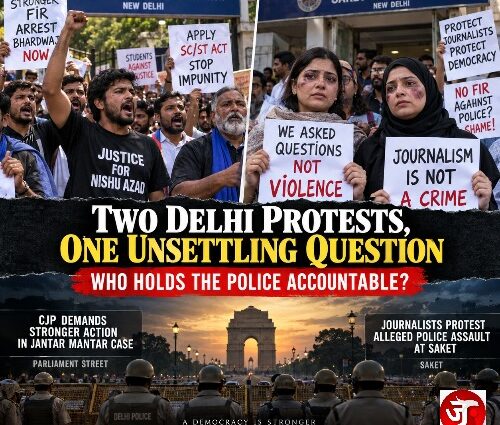
Two separate protests unfolded around Delhi police stations on Friday, bringing protesters, journalists, activists and political leaders into confrontation with a common demand: accountability from the Delhi Police.
New Delhi, September 4, 2026:
At Parliament Street Police Station, members and supporters of the youth-led Cockroach Janta Party (CJP) demanded stronger legal action against influencer Swatantra Bhardwaj over the alleged assault of Sanjay Kumar, father of CJP activist Nishu Azad, during a Jantar Mantar protest.
At Saket Police Station, journalists, lawyers, activists and supporters gathered over allegations that two women journalists, Shaheen Khan and Nafisa Khan of 4PM News Network, were detained and assaulted by police personnel while covering a high-security event.
The two protests have no organisational connection. Yet together they expose a deeper and increasingly uncomfortable question for Delhi Police: when citizens accuse the police of either failing to act or using excessive force, who ensures that the police themselves are held to account?
From Jantar Mantar To Parliament Street: CJP Demands Action
The CJP protest centred on the case of Sanjay Kumar, who was injured during clashes connected with the movement’s Jantar Mantar agitation.
CJP leaders, including Saurav Das and Ashutosh Ranka, joined supporters outside Parliament Street Police Station. Bhim Army chief and Nagina MP Chandrashekhar Azad and Purnia MP Pappu Yadav also joined the delegation.
The protesters demanded that the case include stronger provisions, including attempt to murder and sections of the Scheduled Castes and Scheduled Tribes (Prevention of Atrocities) Act. They also demanded the arrest of Swatantra Bhardwaj.
The controversy intensified after a video circulated in which Bhardwaj reportedly spoke about the confrontation and claimed to have seriously injured Sanjay Kumar. CJP activists argued that the remarks strengthened their demand for a more serious investigation.
Delhi Police, however, has disputed the characterisation of the incident. Police said the injury was a simple laceration caused during a scuffle involving a metal bracelet or kada, and maintained that the investigation had proceeded according to law without political interference.
After Friday’s protest, CJP representatives said Delhi Police assured them that sections of the SC/ST Act would be added, a fresh medical examination would be conducted to determine whether the facts support an attempt-to-murder charge, and that Bhardwaj would be arrested within 72 hours. Reports later said he had been detained in Bulandshahr.
The protest also received public political backing, including from Congress leader Rahul Gandhi.
At Saket, Two Women Journalists Say The Police Became The Story
Barely miles away, another confrontation was unfolding around Saket Police Station.
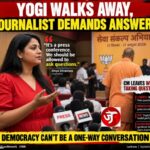
Journalists and activists began a sit-in after Shaheen Khan and Nafisa Khan alleged that they were detained and assaulted by Delhi Police while covering the inauguration of a new wing at Max Smart Super Speciality Hospital, an event attended by Union Home Minister Amit Shah and Delhi Chief Minister Rekha Gupta.
According to the journalists, they were attempting to question the Chief Minister when they were stopped, taken to the police station and allegedly beaten by police personnel, including women officers.
The two women have further alleged that the treatment became more severe after police personnel learned that they were Muslim, and that religion-specific abuse was directed at them. Videos circulated showing what the journalists described as bruises and injury marks.
The allegations have triggered condemnation from several major press organisations, including the Press Club of India, Indian Women’s Press Corps, Delhi Union of Journalists, Press Association and Kerala Union of Working Journalists.
The organisations have demanded punitive action against the police personnel involved, including the SHO, and called for an independent and fair investigation. They have also urged the Press Council of India to take cognisance of the matter.
But Delhi Police has presented an entirely different account.
Police say the journalists had parked a scooter on a designated VVIP route and refused repeated requests to move it. They were subsequently taken to the police station for enquiry, police said, while rejecting as “factually incorrect” and “misleading” the allegations that they were assaulted for asking questions or because of their religion.
That leaves two sharply conflicting narratives: two journalists displaying injuries and alleging custodial assault and communal targeting, against a police account that says the women were taken in for an enforcement-related enquiry and were not assaulted.
The demand from journalists and activists is therefore straightforward: investigate the allegations independently and determine what actually happened inside the police station.
Two Police Stations, Two Different Grievances
The Parliament Street and Saket protests are fundamentally different.
The CJP demonstrators accuse police of not acting forcefully enough against a person they say attacked a protester’s father.
The journalists and their supporters accuse police of using excessive force themselves against women reporters.
One protest demands an arrest, while the other demands action against police officers. Also of note, one centres on alleged caste-related violence and demands application of the SC/ST Act, while the other centres on allegations of religious discrimination against Muslim women journalists.
Yet both converge on the same democratic principle: Police power cannot exist without police accountability.
The timing is significant.
The CJP protest follows months of agitation around examination-paper leaks and student mobilisation, including the movement’s confrontations with authorities at Jantar Mantar. Friday’s demonstration shows that the dispute has moved beyond the original protest site and into a larger political battle over policing, protest rights and accountability.
The Saket controversy, meanwhile, touches another pillar of democracy: the freedom of journalists to question those in power.
A citizen asking for justice should not have to become a protester outside a police station before being heard. A journalist doing her job should not have to prove that she was injured before allegations of police misconduct are taken seriously. And a police officer accused of wrongdoing should not be judged guilty merely because the allegation is politically explosive.
The real test of policing is not how effectively it controls a crowd, but whether the law is equal for all on the streets, without unnecessary brute force – equal for the person demanding justice, the powerless, a protester, a journalist, a woman, a minority or simply an ordinary citizen.