










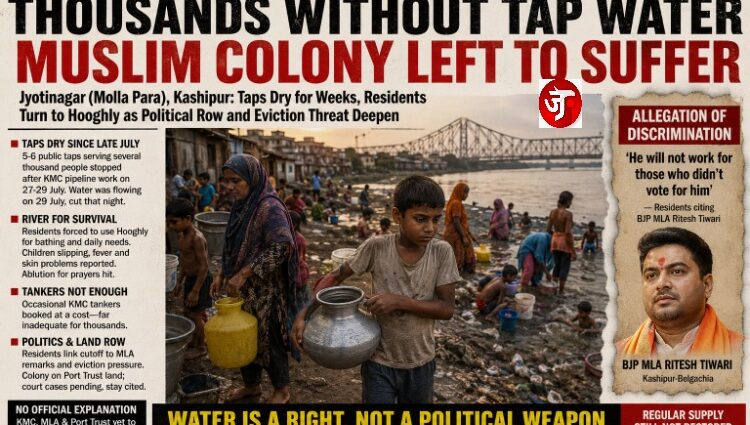
SEPTEMBER 2: Thousands of residents of Jyotinagar Colony in Kashipur-Cossipore, locally known as Molla Para or “Muslim Colony,” have reportedly been living without regular piped water for weeks after municipal pipeline work in late July, according to reports by multiple media outlets.
The crisis has transformed a basic public utility into a deeply contested political and humanitarian issue.
Around five to six public taps, reportedly serving several thousand people, stopped functioning after Kolkata Municipal Corporation pipeline work around July 27–29. Residents say water was flowing on July 29 before the supply was cut that night. Neighbouring settlements along the same road reportedly continued to receive water.
The consequences have been severe. With the public taps dry, residents have reportedly been forced to turn to the Hooghly River, part of the Ganga system, for bathing and other daily needs. Reports describe children slipping or falling while accessing the river, while residents have complained of fever and skin problems. Students face difficulties maintaining basic hygiene, while Muslim residents have also reported problems obtaining water for ablution before prayers.
For a community already living under difficult conditions, the disappearance of its primary water source has become a daily struggle for survival.
The water shortage has also acquired a political dimension.
Residents and opposition voices have linked the crisis to statements attributed to newly elected BJP MLA Ritesh Tiwari, who represents Kashipur-Belgachia. Reports say residents have cited remarks in which he allegedly indicated that he would not work for people who had not voted for him. Earlier remarks allegedly describing residents as illegal Bangladeshi immigrants have further fuelled fears within the colony.
That remains an allegation made by residents and opposition political voices. Residents have also raised concerns about eviction pressure.
The settlement is reportedly located on Kolkata Port Trust land, with litigation concerning eviction continuing in court. A stay has reportedly been cited in connection with the proceedings.
A competing explanation raised in reporting concerns the settlement’s disputed land status and the ongoing eviction litigation.
Occasional municipal water tankers have reportedly been arranged, sometimes through CPI(M) or slum-dweller organisations. But residents say the tankers are nowhere near sufficient for a population numbering in the thousands.
A tanker can temporarily fill a bucket, but cannot replace a functioning public water network.
Nor can residents reasonably be expected to depend indefinitely on political organisations or private arrangements for something as fundamental as drinking water, sanitation and personal hygiene.
The absence of a clear official explanation has deepened the controversy.
Early local reporting quoted a municipal official as saying the corporation was not aware of a complaint and would look into the matter. The Wire reported that it contacted the MLA, the municipal commissioner and the Port authority but had received no response at the time of publication.
That leaves several fundamental questions unanswered:
Why did the taps stop working immediately after the pipeline work? Why has regular supply reportedly not been restored for weeks? Why are neighbouring areas receiving water while this settlement remains without functioning public taps?
Is the interruption a technical failure, a consequence of infrastructure work, an issue connected to the disputed land, or something else?
And most importantly:
Who is responsible for ensuring that thousands of citizens are not left without water while these disputes continue?
The most disturbing dimension of the story is that the residents’ religious identity has become part of the political argument.
Whether the allegations of discrimination are ultimately proven or disproven, the principle should be uncomplicated: access to water cannot depend on religion, political allegiance, voting patterns or the legal status of the land on which people live.
If the settlement is on land that is subject to eviction proceedings, that is a legal question for the courts.
If municipal infrastructure requires repair, that is an administrative question for the corporation.
If political allegations have been made, those allegations require evidence and investigation. But none of these questions makes thousands of human beings less entitled to water today.
The people of Jyotinagar Colony need more than promises, accusations and occasional tankers. And as of early September, reports indicate that regular piped supply had still not been restored.
JANPATH NEWS NETWORK (JNN)
Independent. Fearless. On the People’s Path.