




July 17, 2026: Sonam Wangyal, father of Sonam Wangchuk, once had an incredible encounter with Indira Gandhi; it started with a glass of juice!
The year was 1984. Ladakh was politically isolated, geographically remote, and its indigenous communities feared that their distinct identity would slowly disappear without constitutional protection. It was then that Sonam Wangyal, a respected Ladakhi leader, former Jammu & Kashmir Cabinet Minister, and father of climate activist Sonam Wangchuk, chose the most powerful weapon available to a democracy: a non-violent hunger strike.
Wangyal demanded that Ladakh’s indigenous communities, including the Balti, Beda, Bot (Boto), Brokpa, and others, be granted Scheduled Tribe (ST) status, ensuring constitutional safeguards, educational opportunities, reservations, and protection for their unique cultural and linguistic heritage.
As the days passed and Wangyal refused food, the movement gathered moral force. His fast was not merely about policy, but about preserving an ancient civilisation living on one of the world’s harshest frontiers.
Then something remarkable happened!
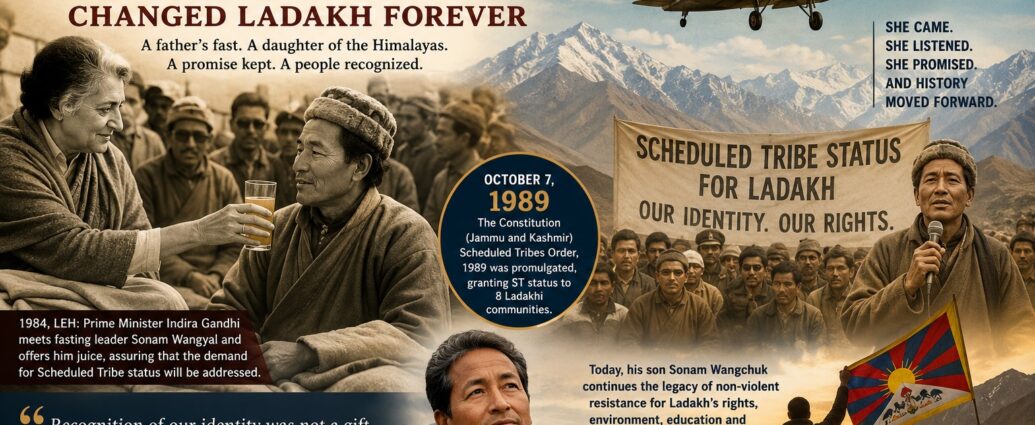
Prime Minister Indira Gandhi did not wait for an invitation, nor did she call it a conspiracy, nor did she use the word “anti-national,” nor did she wait for the protest to fade from public memory. She flew personally to Leh, undertaking the difficult journey across the Himalayas to meet the fasting leader.
Prime Minister Indira Gandhi, standing beside Sonam Wangyal, she offered him a glass of juice, assuring him that his demand would receive serious attention.
The image became one of the most powerful symbols in Ladakh’s political history: a Prime Minister travelling to the country’s farthest frontier, acknowledging the pain of its people, and engaging directly with a peaceful democratic movement.
The promise was not forgotten!
On October 7, 1989, the Constitution (Jammu and Kashmir) Scheduled Tribes Order, 1989 formally recognised eight Ladakhi communities as Scheduled Tribes. The decision brought constitutional protection, reservations, and access to tribal welfare schemes, transforming the social and political future of the region.
For Ladakh, where nearly 97 percent of the population belongs to tribal communities, it was more than an administrative notification. It was recognition of identity, history, and dignity.
Sonam Wangyal reportedly undertook more than one hunger strike for the cause, refusing to abandon the movement despite delays and political uncertainty. His struggle became part of a broader campaign for Ladakh’s rights, one that would later include demands for greater autonomy, constitutional safeguards, and eventually Union Territory status.
Today, nearly four decades later, that history has returned to the national conversation through his son, Sonam Wangchuk, whose own peaceful protests for Ladakh’s constitutional protections, environmental security, educational reforms, and Sixth Schedule safeguards have drawn national and international attention.
For many Ladakhis, the parallel is impossible to ignore.
A father once fasted so that his people could secure constitutional recognition. Today, his son fasts so that those constitutional and environmental protections are not weakened in a rapidly changing Himalayan landscape.
This story transcends one family to demonstrate the enduring tradition of non-violent resistance in Ladakh, where people have repeatedly chosen dialogue over confrontation and sacrifice over violence.
It also serves as a reminder of a timeless democratic lesson: when governments choose empathy over indifference, dialogue over distance, and engagement over silence, history often moves forward.
The 1984 hunger strike remains one of the defining chapters in Ladakh’s modern history, proving that determined citizens, principled leadership, and peaceful protest can together reshape the Constitution itself. It is a story of sacrifice, and powerful trust in democracy. And above all, a story of how one man’s empty stomach helped secure a future for generations yet to be born.
In that decisive hour, Prime Minister Indira Gandhi displayed rare statesmanship and magnanimity. She listened, she acted, and she delivered constitutional protection to a vulnerable region, without cynicism, without delay, and without demanding political loyalty in return. Her government honoured the hunger strike not with token promises but with substantive change. How unfortunate, then, that today’s dispensation chooses to ignore the same spirit of democratic accommodation.
Today, when Sonam Wangyal’s son, Sonam Wangchuk, undertakes yet another peaceful fast, nearly dying, pleading for justice for the students of India, they are met with silence and indifference. The contrast is stark and sobering: one leader saw the moral force of an empty stomach and responded with greatness; the present establishment looks away, diminishing both the legacy of 1984 and the promise of Indian democracy itself.
JANPATH NEWS NETWORK (JNN)
Independent. Fearless. On the People’s Path.