








By Janpath News Network
NEW DELHI: July 29, 2026: In the midst of a political tug-of-war over who deserves credit for the massive student movement that swept across India, an unexpected exchange has shifted attention to a far more fundamental question: Why is Rahul Gandhi the Leader of the Opposition?
The debate erupted after BJP MP and actor Kangana Ranaut questioned Rahul Gandhi’s political stature during an interaction with journalists.
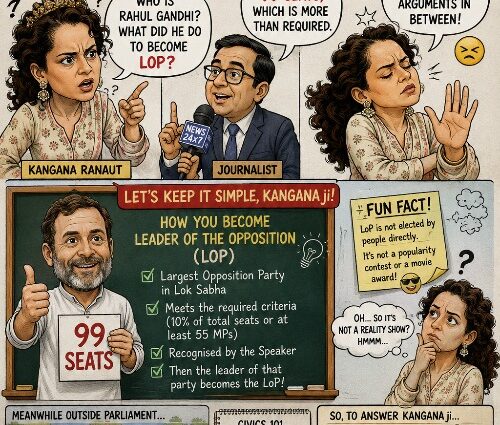
“Who is Rahul Gandhi? What did Rahul Gandhi do to become the Leader of the Opposition?” she asked.
A journalist responded with a simple constitutional fact: “He won 99 seats, which is more than required.”
Kangana reportedly interrupted, replying, “I can’t talk if you give such arguments in between.”
The exchange quickly spread across social media, exposing a surprising reality: many Indians remain unclear about how the Leader of the Opposition (LoP) is chosen.
Contrary to a common misconception, the post is not elected directly by the public, nor is it awarded based on popularity or seniority. Under India’s parliamentary system, the Leader of the Opposition is typically the leader of the largest opposition party in the Lok Sabha that meets the applicable recognition criteria and is recognised under parliamentary rules and conventions. Following the 2024 Lok Sabha elections, the Congress emerged as the largest opposition party with 99 seats, making Rahul Gandhi the natural choice to lead the opposition benches.
The discussion comes at a time when Congress and members of the Cockroach movement are publicly sparring over who deserves credit for the nationwide student protests. Congress leaders argue that the demonstrations were fundamentally a student-led movement that received support from Rahul Gandhi and leaders from several opposition parties, while some activists have claimed a greater share of the credit for mobilising public opinion.
Political observers note that, regardless of who claims ownership of the protests, the constitutional position of the Leader of the Opposition is determined by parliamentary arithmetic, not by street movements or political narratives.
The viral exchange has therefore become more than a moment of political theatre. It has opened a broader conversation about how India’s parliamentary democracy functions and why understanding constitutional offices matters just as much as following election campaigns.
Sometimes the loudest political arguments end up teaching the simplest civics lesson. A rare public service, considering how infrequently constitutional procedure trends on social media unless someone is arguing about it.
JANPATH NEWS NETWORK (JNN)
Independent. Fearless. On the People’s Path.