






FROM HUNGER STRIKES TO CHILDREN RISKING THEIR LIVES FOR SCHOOL, INDIA FACES QUESTIONS OF JUSTICE AND BASIC ACCESS, AS WAR, OIL AND BIG TECH KEEP THE WORLD ON ITS TOES
NEW DELHI/ RANCHI/ MADHYA PRADESH/WORLD
India closes August 6 with two images that should trouble any functioning democracy: young aspirants going hungry while demanding clean examinations, and schoolchildren risking their lives simply to reach a classroom.
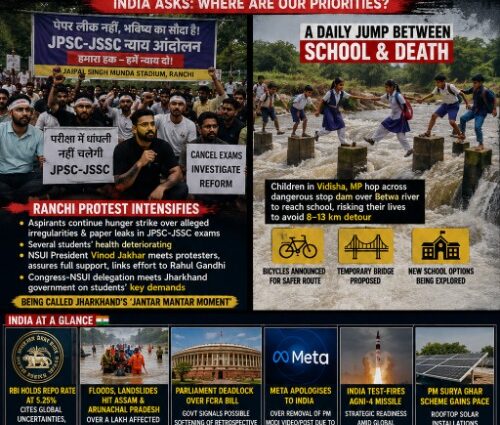
In Ranchi, the protest by competitive examination aspirants over alleged irregularities and paper leaks in JPSC and JSSC recruitment examinations is intensifying.
Students gathered at Jaipal Singh Munda Stadium have continued their agitation into another week, with several remaining on hunger strike. Protesters have reported weakness, dizziness and deteriorating health as they demand accountability, investigations into alleged irregularities, cancellation of disputed examinations where warranted, and meaningful recruitment reforms.
NSUI national president Vinod Jakhar met the protesting students and pledged support for their demands. A Congress-NSUI delegation has also engaged the Jharkhand government, while Jakhar linked the campaign for justice to Leader of Opposition Rahul Gandhi.
For some observers, Ranchi is beginning to resemble Jharkhand’s own “Jantar Mantar moment”: students turning their bodies into the final instrument of protest when petitions, examinations and institutions appear to have failed them.
THE ROAD TO SCHOOL SHOULD NOT BE A TEST OF SURVIVAL
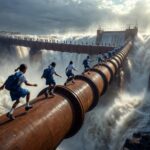
Hundreds of kilometres away in Madhya Pradesh, another disturbing image has captured national attention. A viral video from Vidisha district shows schoolchildren, including girls, precariously hopping across exposed pillars or sections of a stop dam over the fast-flowing Betwa River to reach their high school at Paloh.
One slip could mean catastrophe.
Children from villages including Karua/Kakraua reportedly use the dangerous crossing because the safer road journey can add roughly 8 to 13 kilometres to their route.
Residents say the practice has continued for years. During the monsoon, when water rises, currents strengthen and concrete surfaces become slippery, an already reckless journey becomes potentially deadly.
Following public outrage, officials announced measures including bicycles so children can take the longer road route, consideration of a temporary bridge and examination of options for schooling closer to the affected villages.
But the larger question remains painfully simple: Why did children have to risk falling into a river before the system noticed they needed a safe route to school?
RBI HOLDS RATES AS INDIA WATCHES AN UNCERTAIN WORLD
The Reserve Bank of India’s Monetary Policy Committee kept the repo rate unchanged at 5.25%, with global uncertainty and energy prices remaining important concerns.
Markets reacted positively, with the Sensex gaining and the Nifty remaining above the 24,600 mark.
Meanwhile, floods and landslides continued to batter parts of Assam and Arunachal Pradesh, affecting more than a lakh people. Union Minister J.P. Nadda visited affected areas and assured central assistance.
In Parliament, political confrontation continued over the FCRA Amendment Bill, although the government signalled possible flexibility regarding controversial retrospective provisions.
India also test-fired the Agni-4 medium-range ballistic missile, underscoring the country’s continuing strategic preparedness amid an increasingly unstable international security environment.
Elsewhere, discussions continued around LPG-related funding for strategic reserves, expansion of rooftop solar installations under PM Surya Ghar, and weather warnings across several states.
META APOLOGISES, BUT A MUCH BIGGER QUESTION REMAINS
Technology giant Meta apologised to the Indian government following the temporary removal of content involving Prime Minister Narendra Modi, reportedly attributing the incident to automated or AI-driven filtering.
But beyond one high-profile post lies a much larger controversy. Across the world, users continue to complain of Facebook and Instagram accounts being suspended or permanently removed with little warning, limited explanation and frustrating appeals processes.
For ordinary users, these are not merely social-media profiles. They can represent years of work, businesses, professional networks, journalism, art, communities and livelihoods.
Meta’s Oversight Board has itself repeatedly raised concerns about transparency and due process in content enforcement.
When a digital platform becomes part marketplace, part public square and part professional identity, an unexplained algorithmic deletion can carry very real human and economic consequences. The uncomfortable question for the age of artificial intelligence is therefore no longer simply what technology can remove, rather, it is who holds technology accountable when it gets the decision wrong.
WORLD: THE STRAIT THAT COULD SHAKE THE GLOBAL ECONOMY
Diplomatic attention remains fixed on the Strait of Hormuz, one of the world’s most strategically important energy corridors.
Iran and Oman reported progress in discussions toward coordinates for a safe shipping corridor, while negotiations involving the United States under President Donald Trump continued around a wider temporary de-escalation arrangement. A final breakthrough remained elusive, with Iran linking a complete reopening to an end to US naval actions.
For global markets, the stakes extend far beyond the Gulf. Any sustained disruption through Hormuz threatens oil supplies, freight costs, insurance premiums and ultimately the price ordinary consumers pay for fuel and goods thousands of kilometres away.
UKRAINE: ANOTHER DEADLY NIGHT
Russian missile and drone attacks on the Kyiv region reportedly killed at least 17 people, as Ukraine again appealed for stronger air-defence support. President Volodymyr Zelenskyy highlighted continuing shortages in allied air-defence supplies.
The European Union, meanwhile, moved toward releasing approximately €1.4 billion from profits generated by frozen Russian assets to support Ukraine.
Security concerns also spread beyond the immediate battlefield after an explosive drone was reportedly discovered near a Ukrainian cargo aircraft at a German airport.
In southern Lebanon, continuing tensions between Israel and Hezbollah brought further strikes and evacuation warnings, another reminder that several of the world’s conflicts remain dangerously capable of widening.
AMERICA’S POLITICAL MAP SHIFTS
In the United States, progressive candidate Abdul El-Sayed narrowly won Michigan’s Democratic Senate primary against an establishment rival, adding another chapter to the ideological contest unfolding inside the Democratic Party.
Elsewhere, Red Sea tensions involving the Houthis, tariff disputes, shifting trade relationships and extreme heat across parts of East Asia added to a night in which politics, climate and conflict once again crossed borders with remarkable ease.
THE NIGHT’S MESSAGE
From Ranchi, where students are refusing food to demand faith in examinations, to Vidisha, where children are risking a fall into a swollen river for an education, tonight’s stories share a common thread.
Institutions matter most when ordinary people need them.
An examination system must be credible.
A school must be safely reachable.
A social-media platform powerful enough to erase someone’s livelihood must also be accountable.
And diplomacy must work before disagreements over waterways and borders become wars whose costs are paid by people who never chose them.
Tonight, India celebrates missiles, markets, technology and economic ambition.
But somewhere a student is hungry for justice.
Somewhere else, a child is balancing above dangerous water because she wants to reach school.
Development cannot only be measured by what a nation launches into the sky.
Sometimes it must be measured by whether its children can reach a classroom without risking their lives.
JANPATH NEWS NETWORK (JNN)
Independent. Fearless. On the People’s Path.