








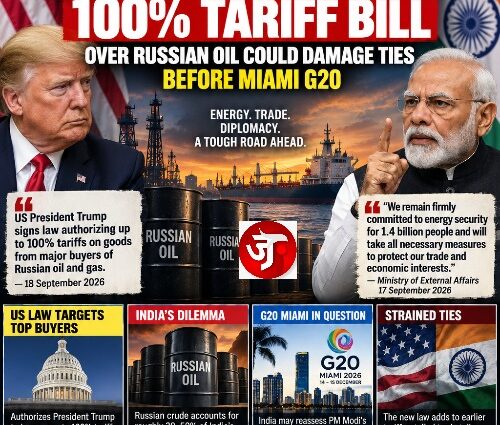
A major new flashpoint has opened in India-US relations after US President Donald Trump signed the Lindsey O. Graham Sanctioning Russia and Iran Act of 2026, giving Washington sweeping new powers to impose tariffs of up to 100% on countries that continue significant purchases of Russian oil and gas.
The legislation had cleared the US House of Representatives on September 16, 2026 by 262-159, after passing the Senate in August. Trump signed it into law on September 18. India and China, among the world’s largest buyers of Russian crude, are among the countries that could be affected.
The law does not automatically impose a 100% tariff on India. Instead, it gives the US president broad authority to impose such tariffs under the legislation’s provisions. The actual level and application will depend on decisions by the Trump administration.
New Delhi has already made clear that it regards the issue as a serious threat to bilateral relations. India’s Ministry of External Affairs said it had raised the matter with senior US interlocutors and explained the potential consequences for India-US relations and global energy markets. It reaffirmed India’s commitment to securing energy for its 1.4 billion people through diversified sources and said India would take “all necessary measures” to protect its trade and economic interests.
The message marks a significant escalation in diplomatic language, but India has stopped short of announcing retaliation or any withdrawal from engagement with Washington.
Russian crude has become a major component of India’s oil supply. Reuters reports that India is among the world’s biggest buyers of Russian crude, and that abandoning those supplies rapidly could push up domestic fuel costs while putting pressure on refiners and the wider economy. At the same time, continuing large-scale purchases could expose Indian exports to the US to potentially punitive tariffs.
That leaves New Delhi facing a difficult economic calculation: reduce Russian oil purchases and potentially pay more for energy, or continue buying and risk much higher trade barriers in India’s biggest export market.
Indian refiners have also raised concerns that replacing Russian crude quickly could prove difficult, particularly amid already-tight global energy markets.
The dispute comes just months before the G20 Summit in Miami on December 14-15, where Prime Minister Narendra Modi had been expected to meet Trump. US Ambassador to India Sergio Gor has previously indicated that Modi would be high on Trump’s list of leaders for bilateral engagement during the summit, with a possible India-US meeting on the sidelines.
The new sanctions law now adds a major economic and diplomatic issue to the agenda, alongside stalled India-US trade negotiations.
Reuters reported that India remains interested in progress on trade while simultaneously warning Washington that pressure over Russian oil could damage the broader relationship.
The new law comes after an already difficult period in India-US relations, marked by tariff disputes and disagreements over India’s continued purchases of Russian energy.
The United States remains India’s largest export destination, making the prospect of tariffs of up to 100% particularly consequential for Indian manufacturers and exporters. Reuters reported that US goods imports from India reached $42.79 billion during April-August, up from $40.39 billion a year earlier.
At the same time, India has been pursuing stronger commercial relationships with other partners, including the UK, European Union and Canada, while continuing to regard the United States as an important economic and technology partner.
What happens next?
The new law gives the White House a powerful instrument, but its consequences will depend on how the Trump administration chooses to use it.
India could seek exemptions or negotiated arrangements, adjust its Russian oil purchases, accelerate diversification of energy supplies, or prepare countermeasures to protect its trade interests. None of those outcomes has been formally announced as India’s chosen course.
For now, New Delhi’s public position is clear: energy security remains paramount, trade interests will be protected, and Washington has been warned that punitive action could damage the wider India-US relationship.
JANPATH NEWS NETWORK (JNN)
Independent. Fearless. On the People’s Path.