










October 14, 2026
Delhi Police Brute Force: On October 10 and 11, central Delhi became a theatre of disturbing confrontations as the Delhi police moved to suppress demonstrations demanding Chief Election Commissioner Gyanesh Kumar’s resignation.
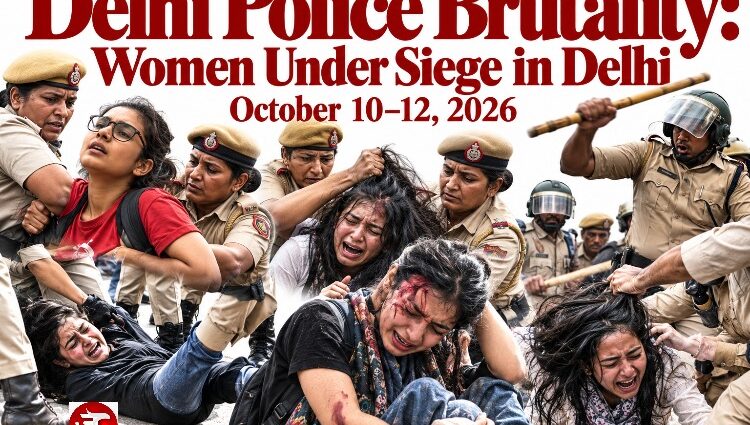
Women protesters were grabbed, dragged and forced towards detention buses. Reuters footage shows policewomen grabbing women by their legs as they resisted being taken away, while other protesters were forced into vehicles amid chaotic street clashes. Delhi Police had denied permission for the demonstrations and imposed prohibitory restrictions.
Related footage and reporting describe confrontations involving women members of the National Students’ Union of India (NSUI) and women police officers around Connaught Place and Rajiv Chowk as protesters were detained and placed in buses. Accounts refer to slapping and hair-pulling, while other online claims allege that protesters also assaulted police personnel.
Students were reportedly struck on the head with police lathis during the Delhi protests. A woman NSUI member subsequently alleged that she had been struck in the face and beaten, while footage circulated showing a woman being dragged by her hair.
At least two protesters were reported to have been bruised and bleeding inside a detention bus, while journalists covering the demonstrations were also detained. Senior advocate Shadan Farasat alleged that police tore his shirt and threw him into a moving bus as he tried to intervene in another detention. From allegations of beatings and rough handling during detention to a student leader being pursued on the streets, the disturbing footage raises urgent questions about women’s safety, police accountability and the right to dissent.
A report published by The Free Press Journal on October 11 quoted CJP legal affairs head Ratna Singh as alleging that officers who detained her in Jangpura repeatedly said they had “orders from above.” She said that 30–35 officials had confronted her and that she was pressured to go to a detention centre or remain under house arrest. Lawyers were also allegedly denied access to detained activists.
In another incident, Priyanka Gandhi Vadra lay on the road holding a copy of the Constitution as police moved to break up the Opposition sit-in. She was subsequently detained and, according to accounts of the incident, roughly dragged into a van. The confrontation also raised allegations of excessive force against Opposition leaders. Mahua Moitra was reported to have sustained injuries to her face and hands during the confrontation. Other Opposition leaders were pushed into police buses amid allegations of excessive force.
During the October 12 protests in Delhi against Chief Election Commissioner Gyanesh Kumar and the Special Intensive Revision (SIR) of electoral rolls, Rahul Gandhi, leading the INDIA Bloc, Neha Bora, students, activists, lawyers and journalists were caught up in extensive police operations.
Neha Bora was particularly supported and protected by Rahul Gandhi and Priyanka Gandhi during the October 12 protest march to the Supreme Court, after allegedly being roughed up by Delhi Police during earlier protests. Neha had publicly displayed scratches and bruises on her arms and body, alleging that she had suffered police mistreatment during earlier detentions. On October 11, the confrontation intensified as police pursued her and fellow protesters through central Delhi before detaining her near Vijay Chowk. Reports describe protesters being dragged or carried towards buses, while Bora subsequently alleged that detainees were crammed into confined compartments and subjected to excessive force.
The police response has generated disturbing allegations of physical mistreatment, including from women protesters. Videos circulating online show forceful physical restraint, chaotic confrontations and assaults on demonstrators. Participants have described being slapped, beaten, dragged or manhandled during detention.
The footage and testimony now demand more than political outrage. They demand a transparent investigation. Many women burst into tears as they recounted what had happened to them. A video circulated by the National Students’ Union of India (NSUI) shows a woman describing an alleged assault. Tearful, she says she was struck in the face and beaten.
The central question is straightforward: Were the force and methods used during these detentions lawful, necessary and proportionate?
Who were these men without badges?
One of the most troubling aspects of the alleged crackdown was the presence of men involved in the rough handling of protesters whose police identification was reportedly not visible. Their identities, official status and authority to use force must be established. Some protesters and observers have questioned whether these men were police personnel in plain clothes or individuals affiliated with political organisations, including the Rashtriya Swayamsevak Sangh (RSS).
The questions are unavoidable. Who were these men? Under whose authority were they operating? Were they deployed by the police, and why was their identification not visible? If they were police personnel, they must be identified and held accountable for any unlawful use of force. If they were civilians, the authorities must explain what role they played and whether they were permitted to participate in detentions or assaults.
The assault by men claiming links to the Hindu Raksha Dal (HRD) is one of the most disturbing aspects of the Delhi protests of October 10, 2026. It raises a question that goes beyond the violence itself: were political activists allowed to intimidate and attack protesters while police personnel were present?
One of the most disturbing videos from October 10 shows men physically attacking students and manhandling women on DDU Marg. The men involved were not identified as police officers in the reporting; they were described as claiming links to the Hindu Raksha Dal.
According to The Indian Express, Delhi Police arrested four men in connection with the assault footage. Police said the men claimed to be members of the Hindu Raksha Dal.
The four men were identified as Raman Saini, 50; Vivekanand, alias Vivek, 32; Kapil Kumar, 27; and Ravinder Singh, alias Govind Hindu/Govinda, 35
According to reports by The Indian Express, Business Standard and NDTV, four men were arrested on October 11 in connection with the alleged assault. Police reportedly took action after the video circulated widely, despite no formal complaint having been received at that point. The footage also reportedly shows a police personnel at the scene while the attack unfolds.
That detail raises a separate question: what did the officers present at the scene see, and what steps did they take to stop the violence?
The arrests are an important development, but accountability must extend to any failure to intervene where officers had a lawful opportunity and duty to act.
Reuters reported on October 12 that journalists covering the youth-led protests had accused police of excessive and targeted force. Reported incidents included journalists being detained, allegedly manhandled and having their equipment seized, including cases in which media workers said they had identified themselves as journalists.
These are allegations requiring examination, not a substitute for it. But they raise a serious issue: if journalists documenting a public demonstration are themselves subjected to questionable treatment, who ensures that the public receives an independent account of what happened?
The answer cannot be that journalists must simply accept the risks of being present when the authorities move against protesters. The detention of senior advocate Shadan Farasat added another dimension to the confrontation. Video footage showed him being carried by his arms and legs towards a police bus, with reports stating that his shirt was torn during the incident.
Every use of force must be justified by the circumstances. Arrest and detention must follow applicable legal safeguards. Allegations of assault must be investigated fairly, including when the accused are police officers.
Abhijeet Dipke had issued a direct warning to Union Home Minister Amit Shah before the October 10 protests: do not order another lathi-charge against students. If the same mistake were repeated, Dipke warned, the next resignation should be Shah’s. The warning was reported publicly on October 2.
Yet the protests that followed produced fresh allegations of women being dragged, students being manhandled and demonstrators being subjected to excessive force during detention. These incidents demand a clear explanation from the authorities. Were the operations conducted under instructions from senior officials, and were those instructions consistent with the law?
There is no publicly established evidence that Amit Shah personally ordered specific assaults. But as the Union Home Minister overseeing Delhi Police through the Ministry of Home Affairs, he bears political responsibility for ensuring that the force operates lawfully and that credible allegations of abuse are investigated independently.
The responsibility of those in power
Delhi Police operates under the Union Ministry of Home Affairs, headed by Union Home Minister Amit Shah, while the Lieutenant Governor of Delhi, Taranjit Singh Sandhu, also holds an important constitutional and administrative role. This places a special responsibility on the authorities overseeing the force to ensure that the police protect citizens rather than intimidate them.
If protesters were peaceful and unarmed, as organisers and participants have maintained, their right to assemble and express dissent must be respected, subject to lawful restrictions.
Amit Shah, the Ministry of Home Affairs and the relevant Delhi authorities must answer for the systems they oversee. In a constitutional democracy, the police are empowered to enforce the law, not to punish citizens for exercising their rights.
A government fighting its own citizens?
The growing feeling on the streets is that the government is fighting its own citizens by using brute police force, in this case, the Delhi police, instead of listening to their grievances. Every allegation of brutality, every image of a woman being dragged, and every unanswered question about police orders deepens the divide between the state and the people it is meant to serve.
But dissent is not treason, and demanding accountability is not an act of hostility towards the nation. As anger grows and questions mount, the clarion call for democracy, dignity and justice grows louder.
JANPATH NEWS NETWORK (JNN)
Independent. Fearless. On the People’s Path.