










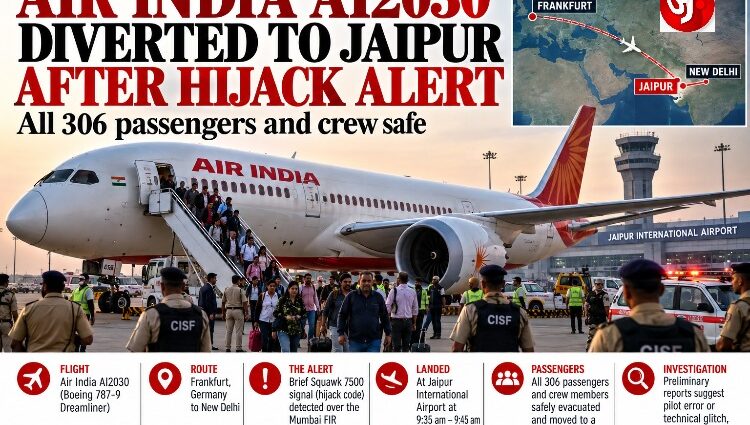
Hijack Scare: Air India Frankfurt–Delhi flight got a hijack scare, and made a precautionary emergency landing at Jaipur International Airport on Wednesday, all 306 aboard safe.
October 14, 2026: Hijack fears certainly disrupted a peaceful flight on Wednesday. The Air India flight operating from Frankfurt, Germany, to New Delhi made a precautionary emergency landing at Jaipur International Airport on Wednesday after a brief hijack alert triggered an aviation security response. All 306 passengers and crew members were reported safe.
The aircraft, a Boeing 787-9 Dreamliner operating as flight AI2030, reportedly transmitted Squawk 7500, the internationally recognised transponder code used to indicate a hijacking or unlawful interference with an aircraft. The signal was detected by air traffic control while the plane was flying through the Mumbai Flight Information Region, prompting authorities to divert the flight to Jaipur as a precaution.
According to media reports, the aircraft landed safely at Jaipur at approximately 9:35 am to 9:45 am local time. Following the landing, passengers and crew were moved to a designated holding area while security personnel conducted checks on the aircraft parked in an isolated section of the airport.
What triggered the hijack alert?
Preliminary reports suggest that the hijack alert may have been activated accidentally by the pilot or resulted from a technical malfunction. However, the precise cause of the signal had not been conclusively established in the reports available at the time of writing.
Squawk 7500 is treated seriously by aviation authorities because it can indicate that an aircraft is experiencing a hijacking or another form of unlawful interference. Even a brief transmission can trigger emergency procedures, security assessments and the diversion of a flight.
The precautionary response underscores the importance of treating such alerts seriously until authorities can establish whether an actual hijack threat exists.
Passengers safe as security checks begin
The safe landing brought relief to passengers and their families after the unexpected diversion. Reports indicated that all 306 people aboard were safe and that security teams were inspecting the aircraft as part of the response.
There was no confirmed evidence in the reports cited here that the flight had actually been hijacked. The hijack incident was being investigated to determine whether human error, a technical issue or another factor had caused the alert.
Investigation and flight status
The immediate priority for the authorities was to establish the origin of the transponder signal and ensure that the aircraft and everyone aboard were safe from any attempted hijack. Further clarification from Air India and the relevant aviation authorities would be important in determining the sequence of events.
The flight’s subsequent departure from Jaipur and its eventual arrival in New Delhi require confirmation from an official airline or airport update.
The hijack incident serves as a reminder of how a brief cockpit alert can set an extensive aviation security response in motion. While the aircraft landed safely, the investigation must establish exactly what triggered the hijack warning before the incident can be fully explained.
JANPATH NEWS NETWORK (JNN)
Independent. Fearless. On the People’s Path.