










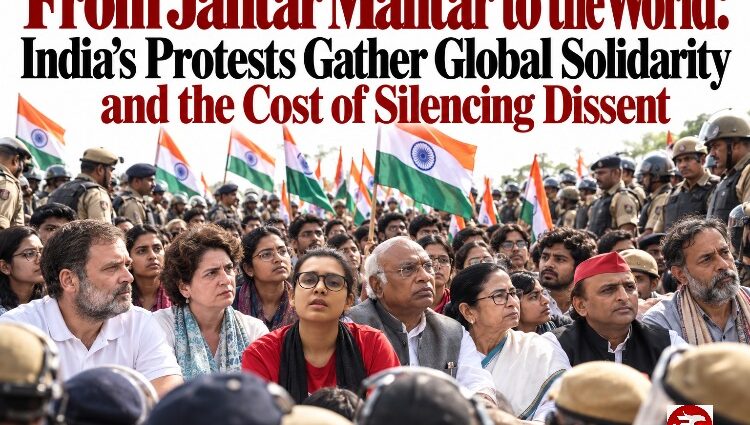
Jantar Mantar birthed a wave of movements starting from major paper leak protests in India in May 2026, scaled into continuous protests at Jantar Mantar in June and July 2026, and culminated into an ongoing national movement in September-October.
October 15, 2026: From Rahul Gandhi meeting a murdered young woman’s parents at India Gate to young activists Ashutosh Ranka and Saurav Das being sent to Tihar Jail, and disturbing allegations of police violence against women protesters, India’s protests are becoming a global test of democratic accountability. As solidarity grows, the government risks turning a political confrontation into a far more damaging crisis of international credibility.
The protests have drawn together an increasingly diverse collection of voices: opposition parties, students, youth activists, lawyers, academics, journalists, civil society organisations and ordinary citizens. The INDIA bloc has challenged the Election Commission over electoral integrity and democracy, while student groups and the youth-led Cockroach Janata Party have pushed the agitation into a huge debate about accountability, employment and the right to protest.
The developments have attracted international media attention. Reuters, the Associated Press, Al Jazeera, the Financial Times and The Guardian have reported on the demonstrations, police detentions and the confrontation over electoral rolls. The scale of the coverage reflects a basic reality: when a country of India’s size experiences a confrontation over the credibility of its democratic institutions, the implications are difficult for the world to ignore.
The protests have also demonstrated an important feature of modern dissent. When access to a designated protest site is blocked, demonstrations can reappear elsewhere. When one group is detained, another can take up its demands. When a local confrontation becomes an international story, the government is no longer addressing only the people assembled on a Delhi street. It is also addressing an audience watching from abroad.
On October 10, the restrictions and detentions surrounding the planned CJP rally became a major international news story. Reuters reported large-scale detentions and restrictions in the capital, while The Guardian and the Financial Times also covered the crackdown. Students, academics, activists and opposition figures became part of the wider story.
The question is no longer simply whether the authorities can prevent a particular gathering. It is whether restricting gatherings will deepen the very discontent they are trying to contain.
Solidarity is spreading beyond party lines
One of the most significant aspects of the movement is the possibility of solidarity across political, social and generational boundaries. In an unexpected moment of solidarity, Rahul Gandhi’s support for jailed CJP leaders Ashutosh Ranka, Saurav Das, and Ajinkya Shinde signals how a shared concern for democratic freedoms can bring together political voices that have travelled different paths.
The solidarity shown by prominent public figures has helped bring these questions into the national conversation. Rahul Gandhi and Priyanka Gandhi Vadra have faced detention during protests against Chief Election Commissioner Gyanesh Kumar, while activists and student leaders have also been detained. The participation of academics and civil society figures has widened the debate beyond conventional party politics. The circumstances of these protests differ, and they should not be carelessly collapsed into a single political narrative. Yet they intersect at a fundamental point: people who believe institutions have failed them must have a meaningful and peaceful way to demand answers.
When even grieving parents are detained while seeking justice, the optics are especially damaging. The image is not merely one of a government managing a crowd. It is of a state confronting citizens whose demands require a response beyond the deployment of police personnel.
Indian diaspora communities have taken to the streets
In the United Kingdom in October 2026, in London, Cardiff, Leeds and Edinburgh. Diaspora groups and students rallied in solidarity with the Delhi protests, supporting demands for electoral accountability and the right to protest. Organisers included the South Asia Solidarity Group, Cambridge South Asian Forum Against Hindutva, Indian Workers’ Association and SOAS Ambedkar Society.
In Germany, Berlin. Indian diaspora members, students and professionals demonstrated in solidarity with the protest movement. The reported gatherings initially focused on education-related grievances and police action.
In Ireland, in Dublin. Indian students and working professionals held a solidarity gathering outside the Indian Embassy during the earlier wave of protests.
In The Netherlands, The Hague and Amsterdam. Earlier demonstrations were reported in solidarity with Indian student protesters. The Hague gathering was reported near the International Criminal Court.
In Canada, Montreal and Vancouver. Global News reported a Montreal demonstration on October 12, 2026, where members of the Indian diaspora expressed solidarity with the protesters and opposed the security crackdown. Vancouver was also reported as a site of solidarity during the earlier protests.
In the United States in Massachusetts, New Jersey, Georgia, Texas and California. The Indian American Muslim Council reported solidarity rallies across these states on October 10–11, alongside Hindu, Dalit and other South Asian partners. Earlier reporting also documented gatherings in New York.
The protests have now drawn the attention of the United Nations Human Rights Office, taking the controversy beyond India’s domestic political arena. On October 10, 2026, the UN voiced concern over reports of mass detentions involving protesters, political and civil society leaders, lawyers and journalists in Delhi. It urged the Indian government to respect the right to peaceful assembly, ensure that police exercise “utmost restraint”, and immediately and unconditionally release anyone arbitrarily detained. It also stressed that restrictions on peaceful protests must meet strict tests of necessity and proportionality.
The cost of looking authoritarian
The government may believe that heavy security, preventive detentions and restrictions on public gatherings demonstrate control. But control and confidence are not the same thing.
Every additional barricade, every widely circulated image of a protester being carried away, and every report of a peaceful gathering being dispersed can become part of an international narrative about India’s political direction. Such images do not, by themselves, establish that a country has become authoritarian. But repeated restrictions on dissent can contribute to that perception, particularly when allegations of excessive force or arbitrary detention are not convincingly addressed.
This is a reputational risk that extends beyond the immediate fortunes of any political party. India competes for foreign investment, manufacturing capacity, technology partnerships, skilled workers, research collaboration and global supply chains. Investors consider markets, infrastructure, labour costs, taxation and regulation. They also pay attention to institutional predictability, the rule of law, political stability and the credibility of public institutions.
There is no automatic rule that protests or police detentions cause trade to fall. Nor would it be credible to claim that every foreign investor will reconsider an investment because of political demonstrations. But a sustained perception of institutional instability, shrinking civic freedoms or unpredictable government responses can become one more factor in how international businesses assess risk.
For a country seeking to attract capital and move up the global economic ladder, that is an entirely avoidable complication. The danger is not simply that foreign audiences might criticise India. It is that the country could spend years building a reputation as an open, democratic and forward-looking economy, only to weaken that reputation through responses to dissent that appear disproportionate or politically defensive.
Trade and progress require more than impressive economic statistics. They require confidence: confidence that contracts will be honoured, institutions will function, rules will be applied fairly and public disagreement will not automatically be treated as a security problem.
A democratic badge cannot substitute for democratic conduct
The most consequential mistake the government could make is to assume that its electoral mandate gives it unlimited authority over the public square. An electoral victory confers the power to govern. It does not extinguish the right of citizens to question the government, demand institutional reform or peacefully challenge decisions they believe are unjust.
The same principle applies to the Election Commission. Its credibility is not protected by insulating it from criticism. It is protected by demonstrating impartiality, answering legitimate questions and ensuring that eligible citizens are able to exercise their voting rights.
Nor is the answer to assume that every protester is correct, every allegation is proven or every police action is unlawful. Democracies must enforce legitimate laws and protect public safety. But restrictions must be lawful, necessary and proportionate, and allegations of misconduct must be investigated impartially.
The line between maintaining public order and suppressing dissent is fundamental. A state that forgets it risks damaging the very institutions it claims to defend.
The world is watching, but the real audience is at home.
JANPATH NEWS NETWORK (JNN)
Independent. Fearless. On the People’s Path.