NSUI’s complete wipeout in the Delhi University Students’ Union elections has triggered serious questions within and outside the organisation.
For the first time since 2015, NSUI failed to win even a single post on the DUSU central panel. More damagingly, former NSUI aspirant Deepanshu Shokeen, who was denied the organisation’s ticket, went on to win the Vice-President’s post as an independent by a huge margin.
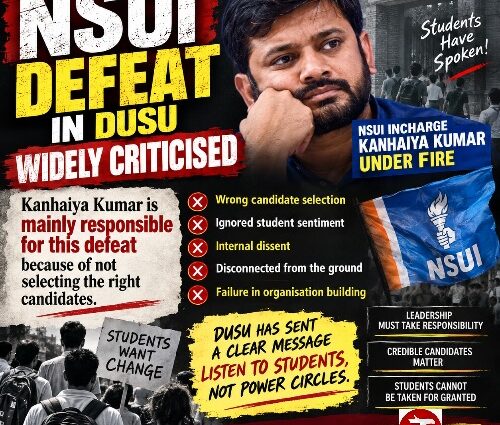
The result has put NSUI in-charge Kanhaiya Kumar’s role in candidate selection under intense scrutiny. Critics within the organisation are questioning whether the leadership misread the ground sentiment and failed to select candidates with sufficient support among students.
NSUI ultimately won zero of the four DUSU central posts, its first complete washout since 2015. ABVP won three, while Shokeen, the former NSUI aspirant, won the fourth as an Independent.
The Deepanshu Shokeen decision was the biggist issue:
Deepanshu Shokeen was initially part of NSUI’s candidate calculations but ultimately did not receive the Vice-President ticket. NSUI’s own side says it offered him the President’s nomination, while Shokeen wanted to contest Vice-President. Other reports say the ticket was withdrawn after disagreement over the position. Reports also allege that Veer Chatrath was given that position due to family connections.
Shokeen then contested independently and won the Vice-President election with 30,615 votes. The NSUI candidate for the same post, Veer Chatrath, received only 4,313 votes and finished third..
The choice of Veer Chatrath became controversial
Reports say NSUI replaced Shokeen with Veer Chatrath, whose father, Manish Chatrath, is a senior Congress leader. Critics interpreted this as favouring a politically connected candidate over a grassroots aspirant. That interpretation has been reported.
If the organisation had retained or accommodated its strongest grassroots candidates, it might not have split its own
There is also a previous example critics are pointing to which is not being discussed in isolation: At Panjab University in 2025, reporting says the local NSUI unit and then-national president Varun Choudhary preferred one candidate, while Kumar backed another. The preferred local candidate subsequently contested independently, received 2,660 votes, while NSUI’s official candidate received 1,359. ABVP won.
There was an earlier rebellion at Panjab University in 2024 as well, when NSUI rebel Anurag Dalal won as an Independent after a ticket dispute, while the official NSUI candidate finished sixth with 501 votes.
So critics are arguing that there is a pattern: candidate – selection disputes, disgruntled aspirants contest independently – rebels perform strongly or defeat official candidates.
Reports have also highlighted another former NSUI aspirant, Vishesh Yadav, who contested with Samajwadi Chhatra Sabha backing and finished ahead of NSUI’s official candidate for Joint Secretary.
Kanhaiya Kumar’s supporters have disputed some of the criticism surrounding the ticket decisions, saying Shokeen had been offered another position and that the circumstances behind his candidature were more complicated.
But politically, the numbers are stark: Three central posts went to ABVP; the Vice-President’s post went to a former NSUI aspirant contesting independently, and NSUI won nothing.
The defeat has therefore become more than an electoral setback. It has opened a much larger debate about leadership, candidate selection, internal democracy and whether the NSUI organisation is listening to its own grassroots workers.
The responsibility for a defeat may never rest on one individual alone. But when candidate selection becomes a central factor in the post-election debate, the leadership responsible for that process inevitably comes under scrutiny. Kanhaiya Kumar is considered mainly responsible for this defeat due to not selecting the right candidates amid some other lapses.
JANPATH NEWS NETWORK (JNN)
Independent. Fearless. On the People’s Path.