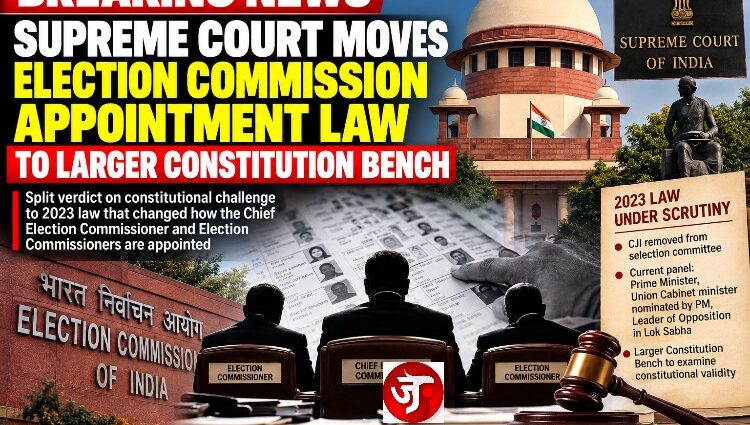
The Supreme Court has paved the way for a larger Constitution Bench to examine the law governing the appointment of India’s Chief Election Commissioner and Election Commissioners, after a two-judge bench delivered a split verdict on the constitutional challenge to the legislation.
September 24, 2026: The development comes amid a growing controversy over the functioning of the Election Commission, with an investigation reporting that two Election Commissioners, Sukhbir Singh Sandhu and Vivek Joshi, formally objected at least 14 times over roughly 10 months to decisions taken under Chief Election Commissioner Gyanesh Kumar.
The judges differed on whether the constitutional challenge to the 2023 law governing appointments to the Election Commission could be decided by the existing bench. With the disagreement unresolved, the matter will now go before the Chief Justice for consideration by a larger Constitution Bench.
What is the dispute over the appointment law?
The controversy centres on the 2023 Chief Election Commissioner and Other Election Commissioners Act, which changed the composition of the committee responsible for selecting the country’s top election officials.
Under the present law, the selection committee consists of:
- The Prime Minister
- A Union Cabinet minister nominated by the Prime Minister
- The Leader of the Opposition in the Lok Sabha
The legislation removed the Chief Justice of India from the selection panel.
The constitutional challenge questions whether this arrangement adequately preserves the independence of the Election Commission, a constitutional body entrusted with conducting India’s elections.
The Supreme Court has not, at this stage, declared the law unconstitutional. The larger Constitution Bench will have to consider the constitutional questions raised by the challenge.
The Supreme Court development coincides with revelations about disagreements within the Election Commission itself. An Indian Express investigation reported that Election Commissioners Sukhbir Singh Sandhu and Vivek Joshi recorded at least 14 formal objections over approximately 10 months concerning issues including voter additions and deletions, the Special Intensive Revision of electoral rolls, changes to Form 6 and control of electoral-roll databases.
The Election Commission has rejected the suggestion that these objections demonstrate an institutional breakdown, saying that differences of opinion are normal and that its final decisions were taken unanimously or according to the legally prescribed decision-making process.
Opposition parties, however, have seized on the revelations to demand action against CEC Gyanesh Kumar, including his removal, and have renewed their criticism of the SIR exercise.
The larger bench will be examining a question that goes beyond the current dispute inside the Election Commission: how independent should the process for appointing India’s election commissioners be, and what constitutional safeguards are required to protect the Election Commission’s autonomy?
The outcome could determine whether the existing appointment framework remains in force or whether Parliament may be required to reconsider the mechanism through which the country’s top election officials are selected.
For now, the Supreme Court’s referral does not amount to a ruling against the appointment law. It means that the constitutional questions surrounding the legislation are considered significant enough to warrant examination by a larger bench.
The development comes at a particularly sensitive moment, as the Election Commission faces growing scrutiny over electoral-roll revisions and internal decision-making, putting both the independence of the institution and the legal framework governing its leadership under the national spotlight.
JANPATH NEWS NETWORK (JNN)
Independent. Fearless. On the People’s Path.