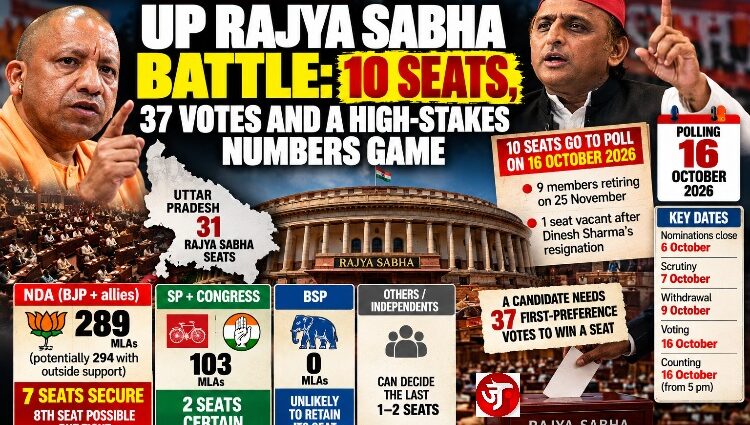
Uttar Pradesh is heading for a closely watched Rajya Sabha contest on October 16, with 10 seats up for election and the Assembly’s arithmetic setting the stage for a battle over the remaining berths.
SEPTEMBER 30: Uttar Pradesh has 31 Rajya Sabha seats, the largest allocation among the states. Nine Rajya Sabha members from the state are completing their terms on November 25, while another seat fell vacant following the resignation of BJP leader Dinesh Sharma.
The election will be decided through proportional representation using the single transferable vote. With the effective strength of the Uttar Pradesh Assembly at around 397, a candidate requires 37 first-preference votes to secure a seat.
The numbers currently give the BJP-led NDA a clear advantage. The alliance has around 289 MLAs, with its potential strength rising to approximately 294 if outside support is counted. That is sufficient for seven seats, but the eighth would require about 296 votes, leaving the alliance short by a small margin.
The Samajwadi Party and Congress together have around 103 MLAs, giving the SP enough numbers to secure two seats.
The SP has formally announced Ram Gopal Yadav and Dhanraj Parimal Nathwani as its two candidates. Yadav is a veteran parliamentary figure and a founding member of the party, while Nathwani, a senior Reliance Industries executive and sports administrator, is a relatively unexpected choice.
Attention is now turning to whether the Samajwadi Party will field a third candidate. Such a move would dramatically change the contest. After allocating the required votes for two candidates, the party would need additional support from legislators outside its core alliance to mount a serious challenge for another seat.
Reports have pointed to the possibility of support from smaller parties or individual MLAs, while speculation about cross-voting has also surfaced. However, no such movement has been confirmed, and the SP has not formally announced a third candidate.
The BJP-led alliance faces its own numbers problem if it seeks an eighth seat. With its potential strength estimated at around 294, it would need additional votes to cross the 296-vote mark.
That leaves the contest vulnerable to last-minute political manoeuvring. Smaller parties, independents and surplus votes could become crucial once nominations close.
The Bahujan Samaj Party, which previously held one of the Rajya Sabha seats from Uttar Pradesh, currently has no MLA in the state Assembly and therefore lacks the numbers to independently retain its representation.
The nomination process will close on October 6, with scrutiny scheduled for October 7 and withdrawal of nominations on October 9. Voting is scheduled for October 16, followed by counting the same day.
For now, the arithmetic points towards two SP victories and at least seven NDA seats. The fight for the remaining seat or seats will depend on the final candidate list, surplus votes and whether legislators cross established political lines.
In Uttar Pradesh, where electoral arithmetic has a habit of becoming considerably more complicated once the actual voting begins, the next two weeks could be decisive.
JANPATH NEWS NETWORK (JNN)
Independent. Fearless. On the People’s Path.