








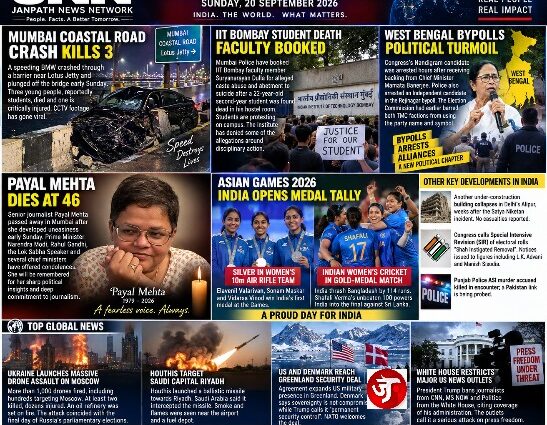
For India, Sunday carried sharply contrasting images: India’s tireless journalist gone, three young lives lost in a devastating Mumbai crash, a student death at IIT Bombay prompting serious allegations and protests, an unexpected political alignment in West Bengal followed by an arrest. At the same time, Indian athletes delivered moments of pride at the Asian Games, securing the country’s first medal and sending the women’s cricket team into a gold-medal contest.
September 20, 2026: A series of tragic accidents, India’s Parliament journalist’s sudden death, institutional controversy, political turbulence, sporting achievement and escalating international tensions have dominated headlines across India and abroad on Sunday, September 20, with Mumbai witnessing two deeply unsettling developments within hours of each other, while the Asian Games brought some welcome relief with India opening its medal account and reaching the women’s cricket gold-medal match.
Mumbai woke to the horrific news of a fatal crash on the Coastal Road early Sunday morning after a speeding BMW carrying four young people crashed into a divider near Lotus Jetty, opposite Lala Lajpatrai College, and plunged from the elevated road. Police and news reports said the vehicle was travelling from Marine Drive towards the northbound stretch when the driver allegedly lost control at high speed. Three people were killed and another was critically injured. Some reports have described the occupants as students, while the investigation into the precise circumstances of the crash remains underway. CCTV footage of the accident has circulated widely, bringing renewed attention to the dangers of high-speed driving on Mumbai’s newly developed coastal infrastructure.
Then news cake that Parliament journalist Payal Mehta died in Mumbai at the age of 46. She was the one who came early and went home the last, faithful to the last beat. Mehta, associated with CNN-News18, had extensively covered Parliament, the Union government and the BJP beat. According to reports, she developed sudden uneasiness while visiting Mumbai and was taken to hospital in the early hours of Sunday, but died before treatment could be administered. Her sudden death prompted an outpouring of condolences from across the political and journalistic spectrum.
Prime Minister Narendra Modi, Congress leader Rahul Gandhi, Union ministers, Lok Sabha Speaker Om Birla and several chief ministers paid tribute to Mehta. Modi remembered her as a hardworking journalist who remained closely connected with developments on the ground, while colleagues recalled her long presence in Parliament and her commitment to political reporting. Union ministers Amit Shah and Rajnath Singh, Congress president Mallikarjun Kharge, Railway Minister Ashwini Vaishnaw, Parliamentary Affairs Minister Kiren Rijiju and Maharashtra Chief Minister Devendra Fadnavis were among those who expressed grief. Assam Chief Minister Himanta Biswa Sarma also paid tribute, recalling his long association with the journalist.
Another deeply disturbing case emerged from Mumbai’s academic community, where police have registered a case against IIT Bombay faculty member Suryanarayan Dulla following the death of second-year student Sahil Wakode. Reports identify Wakode as a second-year BTech student in Energy Science. Police have registered an abetment-to-suicide case, while the student’s family has alleged caste-based abuse and mental harassment by the faculty member. The investigation has been transferred to the Mumbai Crime Branch, and provisions of the Scheduled Castes and Scheduled Tribes (Prevention of Atrocities) Act have also been invoked, according to reports.
The allegations have triggered protests among students on the IIT Bombay campus. The student’s family has alleged that he faced prolonged harassment, while the institute has disputed aspects of the allegations concerning disciplinary action and has said that the circumstances surrounding the death require a thorough investigation. The case is now being examined by investigators, with the competing claims of the family and the institution likely to form a central part of the inquiry. The Crime Branch takeover is expected to bring greater scrutiny to the evidence, including the allegations concerning the faculty member.
In West Bengal, meanwhile, the political atmosphere surrounding the forthcoming bypolls has become increasingly turbulent after former Chief Minister Mamata Banerjee announced support for the Congress candidate in Nandigram following the withdrawal of the Trinamool Congress candidate. The unusual political development was followed by the arrest of Congress’s Nandigram candidate Milan Pradhan in connection with pending cases dating back to 2007. Reports said he was arrested on the basis of warrants and sent to judicial custody. Congress leaders have criticised the arrest, while the police action has become a major political flashpoint ahead of the bypoll.
The developments in Nandigram come against a complicated electoral backdrop in which the Election Commission has barred rival Trinamool factions from using the party’s name and election symbol. Mamata Banerjee’s decision to support the Congress candidate has therefore added another layer to an already fluid contest.
The political uncertainty has extended to Rejinagar, where the Trinamool-backed candidate Rabiul Alam Chowdhury initially indicated that he would withdraw from the contest before subsequently agreeing to remain in the race. Reports said he spoke with Mamata Banerjee for nearly an hour before deciding to continue. The episode has added to the sense of uncertainty surrounding the bypolls, with political parties attempting to consolidate their positions before voting.
The sporting arena provided a sharply different picture as India opened its medal account at the 2026 Asian Games with a silver medal in the women’s 10m air rifle team event. Elavenil Valarivan, Sonam Maskar and Vidarsa Vinod formed India’s medal-winning team, finishing second behind China. India edged Japan for the silver by less than a point, giving the country its first medal of the Games.
India’s women’s cricket team then produced another major result by storming into the gold-medal match after defeating Bangladesh by 114 runs in the semifinal. India posted 195 for four before dismissing Bangladesh for 81, with Shafali Verma producing a spectacular unbeaten 100 from 49 balls. The century was reported as the first by an Indian woman at the Asian Games and helped propel India into the final against Sri Lanka. Smriti Mandhana contributed 37 and Harmanpreet Kaur 40, while Nandini Sharma and Deepti Sharma took three wickets each.
The victory means India is guaranteed at least a silver medal in women’s cricket, with the gold-medal contest against Sri Lanka scheduled for September 22. Sri Lanka reached the final after defeating Pakistan by eight wickets. India will therefore enter the final with the opportunity to defend the gold medal it won in the previous Asian Games.
Elsewhere in Delhi, another under-construction building collapsed in the Alipur area of north Delhi on Sunday, although preliminary reports said there were no casualties. The collapse occurred while construction work was underway, with an initial inquiry indicating that shuttering supporting ongoing lintel work may have given way. The incident comes only days after the deadly Satya Niketan building collapse, renewing concerns about construction safety and enforcement in the capital.
Delhi’s electoral rolls also remained in the political spotlight amid the continuing Special Intensive Revision, or SIR, exercise. Notices have reportedly been issued to more than 33 lakh voters over discrepancies in the electoral rolls, with prominent names including former Deputy Prime Minister L.K. Advani and former Delhi minister Manish Sisodia appearing among those affected by the verification process. Congress has attacked the exercise using the phrase “Shah Instigated Removal,” a political characterisation of the revision process. The Election Commission’s stated electoral-roll exercise and the political parties’ interpretations of its consequences remain separate matters, with the scale and impact of the revision likely to remain a subject of intense debate.
In Punjab, the murder of Assistant Sub-Inspector Harjit Singh has taken another dramatic turn after one of the accused was killed in a police encounter in Amritsar. Police said the accused, identified as Deepak Singh, opened fire at officers at a checkpoint on Thanda Road, following which police returned fire. He was injured and later died while being taken to hospital. Another suspect escaped under cover of darkness and remains the subject of a police search.
Investigators are also examining an alleged Pakistan-based connection to the killing. Amritsar Police Commissioner Harmanbir Singh Gill said investigators believe a person operating from Pakistan may have lured the accused with promises of money and involvement in the narcotics trade. Police are examining mobile phones, CCTV footage, technical data and other evidence to establish the alleged links. These remain police allegations under investigation rather than established findings by a court.
Beyond India, the international picture on Sunday was dominated by an extraordinary escalation in the Russia-Ukraine war. Ukraine launched more than 1,000 drones against targets across Russia overnight, according to Russian officials, with hundreds directed towards Moscow. Moscow Mayor Sergei Sobyanin described it as the largest drone attack on the capital. Reuters reported four deaths linked to the wider strikes, including two in Moscow and two in Russian-occupied Kherson, while an oil-refinery facility in Moscow was damaged.
The scale of the attack was particularly significant because it coincided with the final day of Russia’s parliamentary elections. Russian officials accused Ukraine of attempting to disrupt the vote, while Ukrainian President Volodymyr Zelenskyy said the strikes targeted infrastructure supporting Russia’s war effort. Russia’s parliamentary elections have been closely watched for signs of public sentiment amid the continuing war, although the electoral environment has been marked by restrictions on opposition participation and the imprisonment or exclusion of several anti-war figures.
The Middle East also witnessed another dangerous escalation after Yemen’s Houthi movement launched a ballistic missile towards Riyadh. Saudi Arabia said its air defences intercepted the missile. Reports indicated that smoke and flames were visible in the vicinity of the Saudi capital, including near King Khalid International Airport and a fuel facility. The incident comes amid continuing regional tensions linked to the wider Iran-related conflict and the security situation around the Red Sea.
The latest attack has added to concerns over the possibility of the regional conflict spreading across multiple theatres. Saudi Arabia has repeatedly faced missile and drone threats from the Houthis, but the latest incident comes at a particularly sensitive moment because of the broader confrontation involving Iran, Israel, the United States and other regional actors.
In the Arctic, the United States and Denmark have reached an agreement concerning Greenland’s security after months of tension surrounding President Donald Trump’s earlier demands for greater American control over the territory. Reuters reported that the agreement expands the US military presence on Greenland while restricting non-NATO countries from establishing military bases or making sensitive investments there. The precise scope of the new arrangements remains unclear.
Greenland remains an autonomous territory within the Kingdom of Denmark and has its own aspirations concerning its future political status. Danish and Greenlandic officials have said the agreement does not compromise their sovereignty, while Trump has emphasised the strategic importance of permanent American access to Greenland. The agreement represents a shift from earlier talk of territorial acquisition towards a framework centred on security cooperation and military access.
In Washington, tensions between the White House and major news organisations escalated further after journalists from CNN, MS NOW and Politico were barred from the White House and had their press credentials confiscated. Reports said the administration justified the restrictions by objecting to coverage of President Trump and his government. The affected organisations criticised the move and argued that it represented a serious challenge to press access and press freedom.
Germany was also heading into important state elections, with attention focused on the performance of the far-right Alternative for Germany and the possible political implications for Chancellor Friedrich Merz. Meanwhile, North Korea fired a short-range ballistic missile towards the sea, adding another security concern to an already crowded international agenda.
Iran, too, remained at the centre of global attention as officials discussed conditions for any renewed negotiations with the United States while regional fighting continued. Tehran’s position is closely connected to the wider confrontation and to tensions surrounding the strategically vital Strait of Hormuz, through which a significant share of global energy shipments passes.
It is, in other words, a Sunday that has managed to contain grief, politics, sport, institutional crisis, war and diplomacy in roughly the same news cycle.
JANPATH NEWS NETWORK (JNN)
Independent. Fearless. On the People’s Path.