Indian voting is multi-dimensional. A voter can be angry about jobs, inflation, exam leaks or a local collapse and still spring a surprise in the last moment, or someone else springs a surprise in the ninth hour!
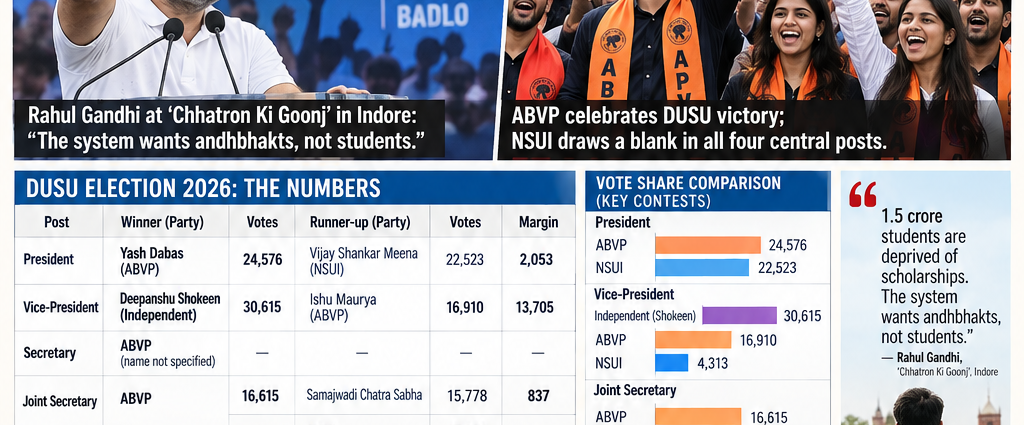
SEPTEMBER 20, 2026: One side of the political picture was unfolding in Indore on Saturday: Rahul Gandhi stood before students at “Chhatron Ki Goonj”, speaking about paper leaks, unemployment, recruitment delays and what he described as a political “system” that does not want students to question it.
The other side was unfolding in Delhi. At Delhi University, the Congress-affiliated NSUI drew a blank in all four central-panel posts of the DUSU election. The ABVP won three.
And the fourth went to an independent candidate, Deepanshu Shokeen, a former NSUI aspirant who had not received the NSUI ticket.
It most be noted that the DUSU numbers do not announce a landslide or an ideological coronation. They announce a close, fractured contest in which organisation still beat raw discontent. The presidency was decided by about 2,000 votes and the joint secretary’s race by roughly 800; an independent then crushed both campus machines for vice-president and polled more than any other winner.
That undercuts the slogan that students simply love ABVP or simply hate Congress. It shows something colder: in a plurality system, split opposition votes decide elections. In the joint secretary contest the two non-ABVP candidates together took almost twice ABVP’s tally, and ABVP still won – ordinary first-past-the-post arithmetic, not proof of invincibility.
The sharpest warning is Deepanshu Shokeen: denied an NSUI ticket, he ran alone and won the highest vote of the night. Voters can punish a party organisation without handing the prize to its rival. Paper leaks, stalled recruitment and hostel safety after the Satya Niketan collapse were live issues on that campus. They still did not deliver NSUI a single central post. Issues were present. Conversion was not.
DUSU is not India. About 40 percent of roughly 1.51 lakh eligible students voted in a campus contest shaped by hostels, college units, caste blocs and ABVP’s long presence in Delhi University; it is a sharp illustration, not a national referendum. ABVP taking three of four posts is also continuity, not a sudden shock that “anger failed to convert” — it won the same tally the year before, then added one rebel upset. The article is right that Congress’s problem is conversion and candidate quality. It is incomplete when it treats that as the whole story. Welfare targeting, social-coalition management, narrative saturation and opposition fragmentation far beyond NSUI versus one independent also blunt anti-incumbency. “What happens if I vote against the BJP?” is a real question for some voters. Many others never ask it. They vote for a local face, a caste equation, a scheme, or habit.
It is paramount to note that Indian voting is multi-dimensional. A voter can be angry about jobs, inflation, exam leaks or a local collapse and still prefer the same party on welfare delivery, perceived stability, leadership, security or identity. Those are not mutually exclusive.
A question often rises among the people, “If not BJP, then whom?” and this is a real constraint when the main challenger looks organisationally weak, internally divided, or poorly ticketed.
BJP’s advantage is better described as an ecosystem (cadre + welfare architecture + national narrative + local booth work + opponents splitting) than as a single magic cause
EVMs are often blamed after an electoral loss, but raising EVMs after a loss, without evidence of systematic manipulation that explains this result, does not explain NSUI’s 0/4.
The 2024 Lok Sabha election itself complicates the “BJP always wins” narrative” where BJP won 240 seats, falling below the 272-seat majority mark on its own. Congress won 99 seats, the NDA won 293 seats and formed the government. The INDIA bloc won substantially more seats than Congress alone. So BJP is not electorally invincible. What makes the party remarkable is its ability to remain the central force in Indian electoral politics even when significant anti-incumbency exists.
The DUSU elections results reveal something colder: in a plurality system, split opposition votes decide elections and the independent candidate can be the kingpin, an unknown someone who did not even lift a finger towards reaching out to the people.
JANPATH NEWS NETWORK (JNN)
Independent. Fearless. On the People’s Path.