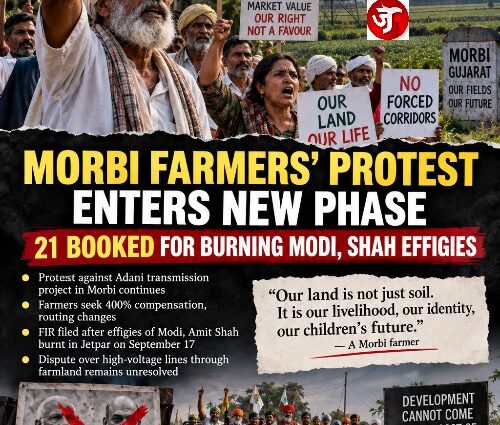
Unknown to most people, farmers in Morbi district Gujarat (Patidar-majority area) have been protesting since early June 2026 against Halvad Transmission Ltd, an SPV of Adani Energy Solutions Ltd (AESL)
September 20, 2026: What began in June as a local farmers’ agitation over compensation for high-voltage transmission infrastructure in Morbi has now entered its fourth month, with the confrontation taking a fresh turn after police registered an FIR against 21 people following the burning of effigies of Prime Minister Narendra Modi and Union Home Minister Amit Shah at Jetpar village on September 17, incidentally, on Narendra Modi’s birthday.
The farmers, who have been protesting against the installation of transmission lines by Halvad Transmission Limited, a special-purpose vehicle of Adani Energy Solutions Ltd (AESL), say the issue is not simply about money. Their central concern is the long-term impact of transmission towers and right-of-way corridors on agricultural land, including restrictions on cultivation and the effect on the value and usability of their farms.
The project forms part of a transmission system designed to evacuate renewable power from the Khavda Renewable Energy Park in Kutch. The authorised scheme includes the KPS2 (GIS)-Halvad 765 kV double-circuit line and a line involving Lakadia-Ahmedabad at Halvad. A September 2026 Ministry of Power notification corrected the tehsil classification of several affected villages, including Jetpar, Piludi, Rapar and Waghpar, while leaving the original authorisation otherwise unchanged and adding updated compliance requirements concerning the revised Great Indian Bustard area.
The dispute intensified in June when farmers began an indefinite hunger strike at the Upwas Chhavani in Jetpar. The fast involved a relatively small group of farmers, while the wider agitation drew support from villagers and farmer organisations. The protesters demanded substantially higher compensation, with their principal demand reported as compensation equivalent to 400 per cent of market value, along with a formal government resolution and, in some cases, changes to the transmission route.
The Gujarat government responded in early July by changing the basis on which compensation would be calculated. Instead of relying on the government-set Jantri rate, the revised framework uses market value, with the government agreeing to compensation at twice the market value for the relevant tower-base component. The policy also created a Market Rate Committee and provided for advance payment mechanisms.
But the change did not end the dispute. Farmers argued that the revised compensation framework still did not adequately address the economic consequences of having high-voltage infrastructure over or across agricultural holdings. They continued to demand a substantially higher multiplier and other changes to the policy. In July, the agitation expanded dramatically, with a march in Morbi involving farmers and women from hundreds of villages. Representatives of 365 gram panchayats submitted a memorandum seeking amendments to the July 4 resolution.
The Morbi agitation subsequently became part of a wider Gujarat debate over compensation for transmission corridors. By August, reporting indicated that farmers in other parts of Gujarat were also objecting to transmission projects and questioning whether compensation adequately reflected the restrictions placed on agricultural land.
The latest confrontation came on September 17, when protesters at Jetpar burned effigies representing Prime Minister Modi and Home Minister Amit Shah. The following day, Morbi police registered an FIR against 21 identified people and others not yet identified, citing offences including unlawful assembly and criminal conspiracy. The case followed a complaint filed by a police inspector after a video of the incident came to the authorities’ attention.
The FIR has added a new dimension to an already prolonged dispute. What began as a question of compensation for transmission infrastructure has increasingly become a broader confrontation involving farmers’ demands, government policy, infrastructure development and political accountability.
Yet the fundamental issue remains unresolved: how should the economic burden of major power infrastructure be distributed when privately owned or operated transmission projects cross productive agricultural land?
The government has moved from a Jantri-based formula toward a market-linked compensation system and has established a valuation mechanism. Farmers, however, continue to argue that compensation alone does not fully address the loss of agricultural utility and the long-term consequences for their land.
The dispute is therefore no longer the hunger strike of June or the compensation announcement of July. As of September 20, the protest at Jetpar remains an active farmers’ movement, and the latest FIR has brought the confrontation back into the headlines.
The competing positions are clear: the authorities and project proponents have to balance the construction of transmission infrastructure needed to move renewable power from Khavda, while affected farmers are demanding that the costs imposed on their land and livelihoods be properly recognised. The question of where that balance should be drawn remains at the heart of the Morbi struggle.
JANPATH NEWS NETWORK (JNN)
Independent. Fearless. On the People’s Path.