The United Nations has rarely felt more like a courtroom!
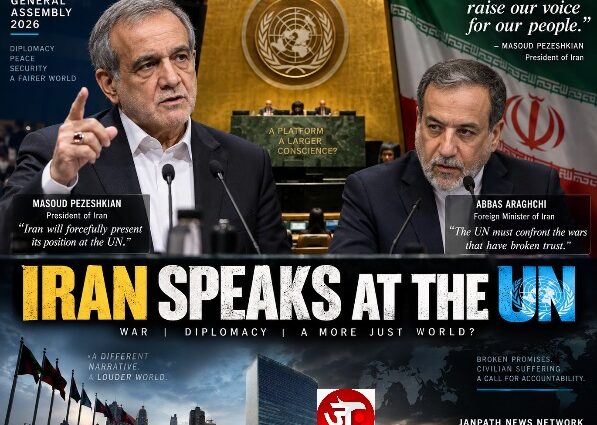
September 23, 2026: On one side stands the United States, whose president Donald Trump has defended his war against Iran from the very podium meant to represent international diplomacy. On the other stands Iran, whose President Masoud Pezeshkian and Foreign Minister Abbas Araghchi have arrived in New York carrying a very different message: that Tehran intends to put its version of the war, its grievances and its demand for accountability before the world.
Pezeshkian arrived in New York on Tuesday to attend the 81st United Nations General Assembly, becoming the highest-ranking Iranian official to enter the United States since the war with Washington and Israel began on February 28. He is scheduled to address the General Assembly on Wednesday, September 23.
But the confrontation had already begun before Pezeshkian stepped onto the UN stage. Before leaving Tehran, Pezeshkian made clear that Iran would not travel to New York merely to participate in diplomatic ceremony.
He said Iran would “forcefully” present its position at international forums and would raise what he described as the suffering of the Iranian people, alleged crimes committed against Iran and the deep distrust created by the collapse of previous diplomatic commitments. He argued that Iran had repeatedly entered negotiations and signed agreements, only to see commitments subsequently broken.
Pezeshkian also said Iran intended to raise the deaths of children in Minab and Lamerd and to draw international attention to what Tehran describes as the consequences of the war.
His message, therefore, is not expected to be simply about Iran’s nuclear programme or its confrontation with Washington. It was about war, sovereignty, civilian suffering, broken trust and the credibility of international diplomacy.
Iran’s Foreign Minister Abbas Araghchi has framed the confrontation in broader terms.
Speaking ahead of the UN meetings, Araghchi argued that the United Nations itself has suffered a crisis of credibility because, in Iran’s view, powerful states have repeatedly acted without sufficient regard for international institutions or international law.
The theme of this year’s General Assembly is “Restoring Trust, Managing Transformation: A United Nations That Delivers for All.” Araghchi has seized upon that theme. His argument was straightforward: if the world is genuinely discussing the restoration of trust, then the UN must also confront the wars and alleged violations that have produced the loss of that trust.
Iran intends to use the General Assembly as the place to make that argument. Araghchi has said Iran’s immediate objective is to defend the rights and interests of the Iranian people, while also discussing the war, civilian deaths and the future of diplomacy. For Tehran, the UN is therefore not simply a diplomatic gathering, but a global microphone.
The timing could hardly be more dramatic.
Trump addressed the General Assembly on September 22, defending the American war against Iran and warning that Washington could “annihilate” Iran if Tehran did not agree to a deal. At the same time, Trump disclosed that American and Iranian representatives had held several hours of discussions on the sidelines of the UN meetings.
That contradiction tells its own story, one moment the language is war, the next moment it is negotiation, one side threatens escalation, while the other side talks about diplomacy.
And somewhere in between sits the United Nations, which was created precisely because humanity apparently decided that shouting across battlefields was not an adequate system of international relations.
Iranian representatives were not present in the General Assembly hall for Trump’s speech. Reports said members of the Iranian delegation left after Trump began discussing the war and threatening Iran. Pezeshkian and Araghchi were in New York but were not in the hall at the time.
Iran’s most powerful argument may be the question of diplomacy
Whatever position governments take on the wider conflict, one issue is difficult to ignore: Washington and Tehran are simultaneously threatening one another and exploring diplomacy. That makes Pezeshkian’s appearance particularly significant. Iran says it wants its grievances heard, while Washington puts pressure on Iran to accept new terms.
Both sides have demonstrated that military pressure has not eliminated the possibility of negotiations.
Indeed, reports indicate that American and Iranian representatives held lengthy indirect discussions through mediators in New York, with US special envoy Steve Witkoff describing the talks as potentially “constructive and promising.” The diplomatic door, therefore, is not completely closed. It is simply surrounded by an astonishing amount of smoke.
The Iranian message to the world
Pezeshkian’s UN appearance comes at a moment when Iran wants to project two messages simultaneously. The first is defiance. Tehran wants the world to see an Iran that says it will not surrender its sovereignty or accept what it considers coercion, and the second is diplomacy.
Despite the rhetoric of war, Iran continues to use the United Nations, regional mediators and diplomatic channels to put forward its demands and defend its position.
A stage bigger than Iran and America
The significance of the Iranian delegation extends beyond the United States and Iran. The war has already affected shipping and energy markets, particularly around the Strait of Hormuz, while the wider Middle East remains caught in overlapping conflicts and diplomatic crises. That means the audience listening to Pezeshkian is not simply Washington, but the entire international community.
When Pezeshkian finally takes the UN podium, the symbolism will be enormous: An Iranian president will stand in New York, inside the United Nations headquarters, after months of war with the country hosting him, his foreign minister will already have spent days arguing that the world body must regain credibility, Trump will have used the same international stage to defend the American position and threaten further action, and and diplomats will be attempting, quietly and sometimes indirectly, to find a way out of the crisis.
This is therefore not merely another UN speech. It is a confrontation over whose version of events the world will believe, whether diplomacy still has meaning, and whether the United Nations can remain more than a magnificent building in which nations arrive carrying their grievances.
Now, the world is waiting for the Voice of America!
JANPATH NEWS NETWORK (JNN)
Independent. Fearless. On the People’s Path.