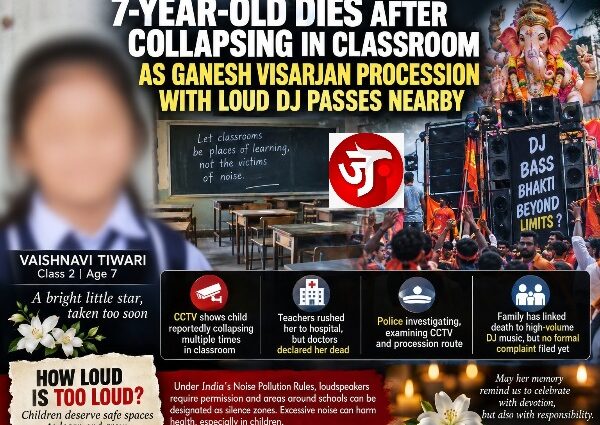
A seven-year-old Class 2 student, Vaishnavi Tiwari, died on September 21 after she reportedly collapsed inside her classroom at Divine Public School in Balrampur, Uttar Pradesh, while a Ganesh Visarjan procession carrying high-volume DJ music was passing nearby.
The circumstances surrounding the child’s sudden death have triggered questions about the use of extremely loud sound systems during religious processions, particularly when such processions pass close to schools, hospitals and residential areas.
According to reports, Vaishnavi was sitting inside her classroom when she appeared to become uncomfortable and subsequently collapsed. CCTV footage from the school reportedly shows the child collapsing more than once while seated. Some reports have said that she collapsed three times.
Teachers reportedly rushed her to a hospital, where doctors declared her dead. The child’s family has linked her sudden collapse to the extremely loud bass and music coming from the procession outside the school. However, police have not yet established that the sound was the medical cause of her death. The exact cause remains subject to investigation and medical findings.
Police have taken cognisance of the incident and are examining CCTV footage from the school and the surrounding area. Investigators are also looking into the route taken by the Ganesh Visarjan procession and the circumstances in which the DJ and sound system were being operated.
As of the latest reports, the family had not submitted a formal complaint to police. Some reports have said that the family does not wish to pursue further legal action. Police have indicated that further action would depend on what emerges from the investigation, including whether any noise-related rules were violated.
Vaishnavi’s last rites were performed in her ancestral village in Siddharthnagar district.
The tragedy has also renewed concerns about the growing use of powerful DJ systems and amplified bass during religious and festive processions across India. Religious celebrations are protected and deeply embedded in India’s social life, but the use of amplified sound is subject to regulations intended to protect people from excessive noise.
Under India’s Noise Pollution (Regulation and Control) Rules, 2000, the use of loudspeakers and public-address systems requires permission from the appropriate authority. The rules also restrict the use of loudspeakers during night hours, subject to specified exemptions. Areas around educational institutions, hospitals and courts can also be designated as silence zones.
The rules prescribe limits for noise from loudspeakers and public-address systems. Excessive noise is not simply an issue of inconvenience. Public-health authorities have long recognised that prolonged exposure to high levels of environmental noise can contribute to stress, sleep disturbance, impaired concentration and cardiovascular effects. Children can be particularly affected because schools require an environment in which students can concentrate and learn.
This does not, however, establish that the music played during the Balrampur procession caused Vaishnavi’s death.
The Balrampur incident comes amid continuing concern in different parts of India over extremely loud DJ systems during religious processions. Authorities have periodically taken action against organisers and DJ operators for alleged violations of noise regulations, particularly during festival and processions.
The larger question is therefore not whether religious processions should take place. It is whether celebrations involving powerful sound systems should be conducted in a manner that respects the health, safety and peace of people in surrounding areas, particularly children studying in schools, patients in hospitals and residents who may have no ability to escape the noise.
For now, the death of seven-year-old Vaishnavi Tiwari remains under investigation. Her family’s allegation about the DJ noise has drawn widespread attention, but until police and medical authorities establish the cause of death.
JANPATH NEWS NETWORK (JNN)
Independent. Fearless. On the People’s Path.