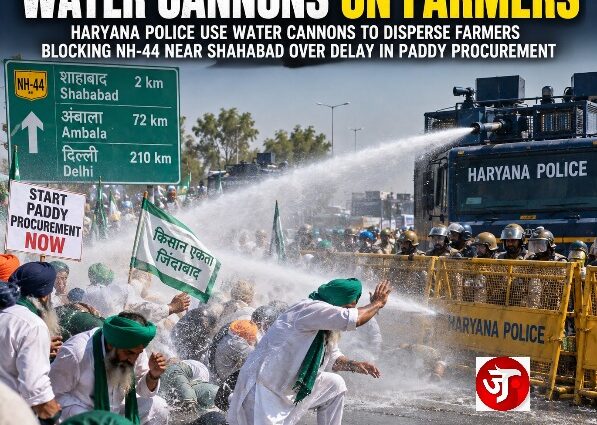
On the blistering asphalt of NH-44 near Shahabad, Haryana, the harvest collided with the state on Tuesday.
September 22, 2026: In Kurukshetra, Haryana, police use water cannons to disperse farmers who were trying to block NH-44 near Shahabad over delay in paddy procurement by the government.
Farmers who had spent months growing their paddy came onto the Delhi-Chandigarh highway demanding something brutally simple: start buying the crop. Instead, they were met with barricades, water cannons and tear gas.
Members of the Bharatiya Kisan Union (Charuni) attempted to block the Delhi-Ambala National Highway at Shahabad in Kurukshetra after the government’s procurement deadline demanded by farmers passed without the process being brought forward. Police used water cannons and tear gas to disperse the protesters, while several BKU leaders were reportedly detained.
The confrontation had been building for days. Paddy had begun arriving at mandis across Haryana earlier than the official procurement schedule. Farmers had initially demanded that procurement begin around September 15. The Haryana government subsequently wrote to the Centre seeking permission to advance procurement to September 20, citing early arrivals of paddy and difficulties farmers were already facing in disposing of their produce.
But September 20 came and went. The procurement schedule remained officially set for October 1 to November 15, according to reports, leaving farmers with a crop already reaching the markets but without the government procurement mechanism they were demanding.
For farmers, the problem is not theoretical. Once paddy reaches the mandi, it has to be stored, dried and eventually sold. Delay can mean waiting, additional handling and pressure to sell through other channels. Farmers’ organisations argued that early-maturing non-basmati varieties were already arriving and that waiting until October 1 could leave cultivators vulnerable to distress sales below the Minimum Support Price.
The MSP for the 2026-27 kharif season has been fixed at ₹2,441 per quintal for common paddy and ₹2,461 for Grade A paddy, according to the Indian Express report on Tuesday’s confrontation.
The Haryana government, for its part, had already taken the issue to the Centre. Officials told farmers that the state had requested an early start and relaxation of uniform specifications to facilitate procurement. But that communication did not put money into farmers’ hands or move the procurement machinery forward by the date demanded by the union.
So BKU (Charuni) carried out the threat it had issued earlier. At a meeting in Shahabad, farmers had warned that if procurement did not begin by September 20, they would block NH-44 on September 22. The warning was publicly reported days before the confrontation.
On Tuesday, they came. And the highway became the battleground. Water cannons blasted into the gathering. Tear gas was fired. Police barricades stood between the protesters and the highway as farmers tried to hold their ground. Images and videos from the scene showed streams of water cutting across the road while protesters scattered, regrouped and continued raising their demands.
The symbolism was difficult to miss: A farmer had brought his crop to the mandi, the government had not yet begun buying it, the farmers blocked the road, and the state turned the water cannons on them.
Behind the spectacle lies a dispute over something far more fundamental than traffic on NH-44: who bears the cost when nature moves faster than the administrative calendar? If the crop is already in the mandi, how long can the farmer afford to wait? And when the government feels overwhelmed, they spring up with water cannons on the farmers, instead of instead of talking with them.
JANPATH NEWS NETWORK (JNN)
Independent. Fearless. On the People’s Path.