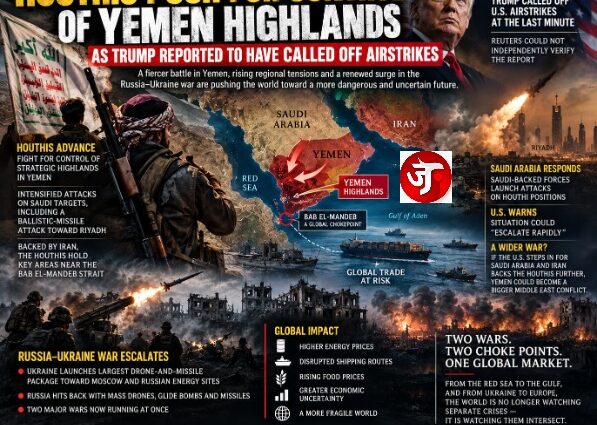
A new front is opening in Yemen, and the consequences could reach far beyond the Arabian Peninsula.
Iran-aligned Houthi fighters are pushing to seize strategic highlands in Yemen, seeking to cut the Red Sea coast off from remaining territory held by Saudi-backed forces. The Houthis are particularly trying to capture the Kahboub Mountains, strategic high ground in Taiz and Lahij provinces. These mountains sit between the Red Sea coast,
The rapid Houthi expansion this month, including the capture of much of Yemen’s Red Sea coast and strategically important territory around the Bab el-Mandeb Strait, one of the world’s critical maritime chokepoints has cost the death of about 700 people and more than 120,000 displaced in the latest fighting, according to the United Nations.
The development has also placed Washington in an increasingly uncomfortable position. The New York Times reported that President Donald Trump had called off planned U.S. airstrikes against the Houthis at the last minute, despite Saudi appeals for American intervention. Reuters said it could not independently verify the report and that U.S. Central Command had not immediately responded to requests for comment.
The timing is critical. On September 19, Saudi Arabia said its air defences intercepted a Houthi ballistic missile launched toward Riyadh, while the Houthis claimed attacks against Saudi infrastructure. Saudi-backed forces have meanwhile continued fighting the Houthis inside Yemen. The confrontation is no longer confined to Yemen’s battlefields: it is moving closer to Saudi territory and directly threatening one of the world’s most important energy-producing regions.
And the danger does not end at the Saudi-Yemeni border. The Houthis’ position around the Bab el-Mandeb Strait, connecting the Red Sea with the Gulf of Aden, gives a relatively resource-poor armed movement the ability to threaten a maritime artery used by global commerce. Any prolonged disruption could affect shipping routes, insurance costs, energy supplies and eventually consumer prices around the world. Saudi Arabia has already faced pressure on its oil-export routes, while the wider regional conflict has disrupted energy flows through both the Red Sea and Gulf.
This is where the mathematics of asymmetric warfare becomes particularly ugly. The Houthis do not possess Saudi Arabia’s wealth, air force, fleet or vast financial reserves. Yemen itself has been devastated by years of civil war, poverty, political fragmentation, attacks on infrastructure and a humanitarian catastrophe that has left millions dependent on assistance. Yet the Houthis have something that conventional military calculations often struggle to price: geography, experience, missiles, drones, organisation and a willingness to sustain enormous losses.
They have learned to fight from mountains and difficult terrain, and they have survived years of vastly superior military pressure. That does not make their attacks acceptable, nor does it make civilians safer. It demonstrates something more uncomfortable: military superiority does not automatically translate into political control.
For years, the United States supported the Saudi-led war effort in Yemen through weapons sales, intelligence and logistical assistance, including aerial refuelling during part of the conflict. Washington’s current reluctance to launch another campaign therefore carries significance beyond this week’s battlefield calculations.
Because if the United States eventually enters the confrontation directly on Saudi Arabia’s side, and Iran substantially deepens its military support for the Houthis, Yemen could become another direct arena in the wider confrontation between Washington and Tehran. That remains a possibility, not an established outcome. But the risk is precisely what makes the present moment so dangerous.
And then there is Ukraine. At almost the same moment that Yemen is becoming another major flashpoint, the Russia-Ukraine war has entered another period of intense long-range attacks. Ukraine launched what the Institute for the Study of War described as its largest combined missile-and-drone strike package against strategic targets in Moscow Oblast, while Russian forces continued their own extensive strikes. Moscow’s mayor said more than 1,600 Ukrainian drones had been downed since September 19, including around 450 approaching the capital.
Two wars. Two regions. One increasingly interconnected global economy. From the mountains of Yemen to the waters of the Red Sea, and from Moscow to Ukraine, the question is no longer how many conflicts the world can contain. It is how many can escalate at the same time before the consequences reach everyone.
JANPATH NEWS NETWORK (JNN)
Independent. Fearless. On the People’s Path.