Peace, Power And Threats: A Box of Contradictions In Trump’s UN Speech
September 23, 2026
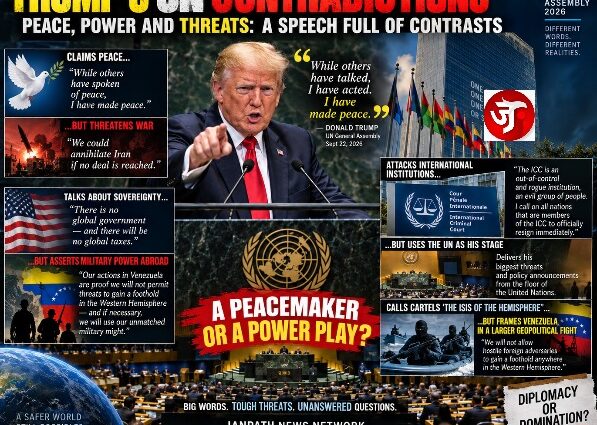
Donald Trump went to the United Nations declaring that America had become stronger, that he had acted where others had merely talked, and, most strikingly, that “while others have spoken of peace, I have made peace.”
But beneath that declaration was a speech filled with contradictions.
A president presenting himself as a peacemaker threatened to “annihilate” Iran if no agreement was reached. A leader speaking at an institution created to facilitate international cooperation attacked international bodies as instruments of global control. A president defending American sovereignty demanded that other sovereign countries abandon the International Criminal Court. And a government describing its military actions as necessary for security simultaneously celebrated the expansion of American power across the Western Hemisphere.
The contradictions were difficult to miss.
“I have made peace” while threatening to annihilate Iran
Trump told the General Assembly that he had confronted dangers rather than allowing them to grow and claimed that America had settled conflicts that others had failed to resolve.
Yet in the same address, he warned Iran that the United States could “annihilate” the country if a peace agreement was not reached. Reuters reported that Trump also said he believed a settlement could eventually be reached, and that negotiations between Washington and Tehran were continuing.
That creates one of the central tensions of the speech: Peace through negotiation, backed by the threat of overwhelming military force.
The White House presents this as strength producing peace. Critics can reasonably point to the language of annihilation and see a different model of diplomacy.
Trump declared:
“There is no global government — and while I am President, there will be no global taxes.”
Yet he chose the United Nations General Assembly as the platform from which to deliver that message. That is not technically a contradiction: a national leader can reject supranational authority while still using an international forum. But symbolically, it was striking.
The UN exists precisely as a forum in which sovereign states attempt to deal collectively with problems that cross borders. Trump used that forum to argue for a sharply sovereignty-first vision of international relations.
In effect, the message was: “Sovereignty” for America, military intervention abroad!
While invoking the American sovereignty, his speech also defended the use of American military power outside U.S. territory. He declared that the United States would no longer permit perceived threats to gain a foothold anywhere in the Western Hemisphere and said Washington would use its “unmatched military might” when necessary to protect U.S. national interests.
The White House has openly described the administration’s Venezuela policy in terms of reasserting American power in the region. It has also said the administration has “re-established the Monroe Doctrine” and sought to remove Russian and Chinese influence from Venezuela’s energy sector.
The tension is therefore between two principles: Non-interference in America’s sovereignty while active American intervention when Washington believes its interests are threatened elsewhere.
Trump’s supporters describe the latter as the legitimate exercise of national power to protect U.S. interests. Critics have historically described such policies as the assertion of a sphere of influence.
The underlying contradiction is not hidden. The White House itself now openly uses the language of American dominance in the hemisphere.
“The ICC is rogue” – but international accountability remains the issue. His attack on the International Criminal Court was perhaps the most explosive part of the speech.
He called the ICC an “out-of-control institution,” described its officials as “an evil group of people,” and accused it of operating as an anti-American tribunal.
Then he issued his extraordinary appeal:
“I call on all nations that are members of the ICC to officially resign from this rogue institution immediately.”
The administration’s position is that the ICC threatens U.S. sovereignty because America is not a member of the Rome Statute and has not accepted the court’s jurisdiction in the manner its member states have.
But the larger contradiction is this:
Trump’s administration simultaneously speaks about confronting terrorism, atrocities and threats to civilians while seeking to weaken an international institution whose stated mandate includes prosecuting genocide, war crimes, crimes against humanity and aggression when the relevant legal conditions are met.
“The drug war” – and the geopolitical war underneath it
Trump also defended U.S. military operations against drug cartels. He described cartels as “the ISIS of the Western Hemisphere” and said U.S. forces had carried out strikes against cartel drug boats. The White House says those operations are part of its campaign against foreign terrorist organizations and illicit drug trafficking.
But Trump simultaneously framed Venezuela in much broader geopolitical terms. He said the United States would not allow threats to gain a foothold anywhere in the Western Hemisphere and invoked American military power to protect U.S. national interests.
That matters because the viral claim circulating online suggested Trump had admitted that drugs were not the real reason for U.S. action in Venezuela. He did not say that. What he actually did was add a second justification: preventing hostile foreign powers from gaining influence in America’s hemisphere.
The speech therefore did not erase the counternarcotics argument. It placed that argument alongside a much larger doctrine of geopolitical control.
“While others have talked, I have acted” The title chosen by the White House for its account of the speech says it all:
“While Others Have Talked, I Have Acted.”
Trump repeatedly contrasted diplomacy with action, but diplomacy itself remained present throughout the speech. Washington was simultaneously threatening Iran and negotiating with Iran.
It was attacking international institutions while using the United Nations as its diplomatic stage
It was defending national sovereignty while asserting a sphere of influence in the Western Hemisphere.
It was speaking about peace while emphasizing military supremacy.
And it was telling the world that America would act alone when necessary while also seeking other nations’ support for its campaigns.
The contradiction at the heart of Trump’s UN message
Perhaps the most revealing way to understand the speech is not as a declaration of war against the United Nations.
Trump did not declare war on the UN.
He did something more complicated.
He used the UN to announce a foreign-policy vision that places American sovereignty and American power above international institutional constraints.
The United States will negotiate, but from a position of overwhelming military strength.
It will cooperate internationally, but reject what it considers supranational control.
It will defend sovereignty, while asserting American interests beyond its borders.
It will speak of peace, while keeping military escalation on the table.
And it will condemn the ICC as illegitimate while insisting that America itself should retain the authority to determine the limits of international jurisdiction over Americans.
The irony is that he delivered that message from the very institution whose relevance his administration has spent years challenging.
JANPATH NEWS NETWORK (JNN)
Independent. Fearless. On the People’s Path.