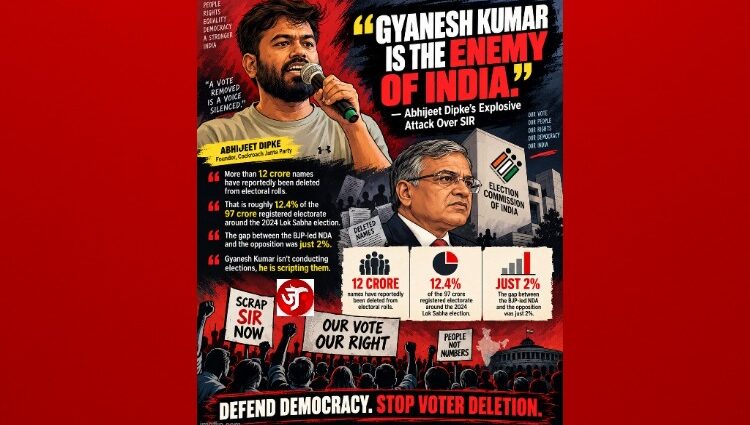
A fresh political storm has erupted over the Election Commission’s Special Intensive Revision (SIR) of electoral rolls, with Cockroach Janta Party founder Abhijeet Dipke launching a scathing attack on Chief Election Commissioner Gyanesh Kumar.
September 23, 2026: In a post on X on Wednesday, Dipke declared:
“Gyanesh Kumar is the enemy of India.”
He went on to claim that more than 12 crore names had reportedly been deleted from electoral rolls, arguing that the figure represented roughly 12.4% of the approximately 97 crore registered electors around the 2024 Lok Sabha election.
Dipke then connected the scale of the SIR exercise with the narrow difference between the two major electoral alliances in the 2024 general election.
“The gap between the BJP-led NDA and the opposition was just 2%.”
He concluded with his most pointed accusation:
“Gyanesh Kumar isn’t conducting elections, he is scripting them.”
The numbers behind the anger
The controversy comes amid reports that more than 13 crore names were left out of draft electoral rolls across 30 states and Union territories during the SIR process. The reported figure is therefore enormous, but it needs to be understood correctly: being absent from a draft roll does not automatically mean that a person has been permanently disenfranchised. The electoral process provides mechanisms for claims, objections and appeals.
The scale nevertheless has triggered intense political and legal scrutiny. In Uttar Pradesh alone, the Election Commission reported that 2.89 crore names were not found in the draft electoral roll following the enumeration phase. The Commission attributed the figure to several categories, including people who had died, migrated, could not be located, or otherwise did not submit the required enumeration forms.
Why the 2024 election matters
Dipke’s reference to the 2024 election is intended to underline how politically significant even a relatively small shift in the electorate can become. The 2024 Lok Sabha election produced a BJP tally of 240 seats, while the BJP-led NDA won enough seats to form the government with its allies. The NDA’s reported vote share was around 42.5%, compared with approximately 40.6% for the INDIA bloc, a difference of about 1.9 percentage points under that alliance calculation.
But the comparison does not itself establish that SIR benefits any particular party. That would require evidence showing where eligible voters were excluded, who was restored, who remained excluded, and how those changes affected particular constituencies.
And that is precisely where the controversy becomes more serious.
Questions inside the Election Commission
Dipke’s attack followed reporting that two Election Commissioners, Sukhbir Singh Sandhu and Vivek Joshi, had formally raised objections on multiple occasions concerning aspects of decisions and orders associated with the SIR process. The Indian Express reported at least 14 such objections over a 10-month period.
The Election Commission has disputed the implication of an institutional split. According to EC sources cited by Hindustan Times, all decisions taken by the Commission, including those concerning SIR, had the approval of all three Election Commissioners. That leaves an important question for the public: If the process is transparent and institutionally agreed upon, why are there such sharp disagreements over how it is being conducted?
The question bigger than Gyanesh Kumar
The controversy ultimately extends beyond one individual. The Election Commission has a constitutional responsibility to maintain accurate electoral rolls and remove ineligible entries. But an equally important democratic principle is that an eligible citizen should not lose access to the ballot because of an administrative error or an inaccessible appeals process.
That makes the scale and speed of the SIR appeals process crucial.
If millions of names are excluded from draft rolls, the credibility of the exercise will depend not merely on how many names are removed, but on how transparently the Commission establishes why they were removed and how quickly eligible voters can challenge those decisions.
Dipke has framed the issue in the strongest possible terms, accusing the CEC of “scripting” elections.
JANPATH NEWS NETWORK (JNN)
Independent. Fearless. On the People’s Path.