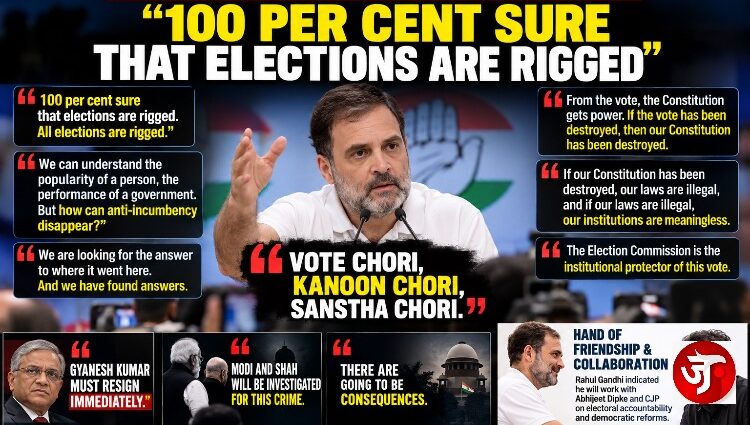
Rahul Gandhi walked into the room with a message that was blunt, sweeping and deliberately confrontational: he said he was “100 per cent sure” that elections in India were being rigged.
September 24, 2026: The atmosphere was tense as journalists gathered around a controversy that Gandhi has increasingly framed not simply as an electoral dispute, but as a question of whether India’s democratic and constitutional system itself is being undermined.
Gandhi left little room for ambiguity. “100 per cent sure that elections are rigged. All elections are rigged,” he said, referring to the 2024 Lok Sabha election and Assembly elections.
His argument centred on what he described as the disappearance of anti-incumbency. “We can understand the popularity of a person, understand the performance of a government. But can’t understand how anti-incumbency disappears.”
He asked where that anti-incumbency had gone. “We are looking for answer to where it went here. And we have found answers.”
The room had moved beyond the language of ordinary electoral contest. Gandhi was presenting his allegation as something much larger when he said, ““From the vote, the Constitution gets power” He repeatedly returned to the vote as the foundation of the constitutional system.
His argument was that the Election Commission’s responsibility to protect the vote was therefore inseparable from the protection of the Constitution itself. “If the vote has been destroyed, then our Constitution has been destroyed,” he said.
And he continued the chain: “If our Constitution has been destroyed, our laws are illegal, and if our laws are illegal, our institutions are meaningless.”
The words were delivered with the seriousness of someone deliberately moving the argument from electoral administration to constitutional survival.
“Vote chori, kanoon chori, sanstha chori” the phrase that may define the political language of the conference: Vote theft. Law theft. Institutional theft. The phrase condensed Gandhi’s argument into three words repeated three times.
He portrayed the issue not as an isolated dispute over electoral rolls, but as a chain in which the alleged destruction of the vote could ultimately weaken the law and the institutions built upon it.
Chief Election Commissioner Gyanesh Kumar was directly Gandhi’s target. Gandhi demanded that Kumar resign immediately, arguing that the person responsible for protecting the vote could not continue in office while the controversy remained unresolved.
His language was uncompromising. “This is not just some small rigging of an election. This is an attack on the Constitution of India.” He said the Election Commission was supposed to be the institutional protector of the vote.
The question hanging over the room was therefore stark: what happens when the institution entrusted with protecting the vote itself becomes the subject of such serious allegations?
The journalists push back
The questions from journalists repeatedly returned to one issue: evidence.
Could Gandhi substantiate his sweeping assertion that elections had been rigged?
Was the reported disagreement within the Election Commission itself proof of electoral manipulation?
What would he do if the Election Commission did not accept his allegations?
And, perhaps most importantly, what happens next?
Gandhi maintained that he was not speaking “in the air” and insisted that the Congress had evidence behind its claims. His answer remained emphatic: he said the material already available gave him “100 per cent” certainty.
He also framed the issue as one that could not simply be left to political parties. The people of India, he argued, would ultimately have to decide what they believed.
Another moment stood out amid the confrontation. A journalist questioned Gandhi about cooperating with CJP/Dipke on the electoral-roll issue around the wider issue of electoral accountability and democratic institutions. Gandhi answered he was open to this as he highlighted that the entire Opposition unanimously believed the elections were rigged.
The gesture was notable because CJP has been campaigning independently on questions surrounding electoral integrity and has itself demanded action against CEC Gyanesh Kumar.
Earlier on Thursday, Dipke and CJP had called for Kumar’s resignation and warned of nationwide agitation if he did not step down within 48 hours.
Gandhi then turned to what he said would happen next. “There are going to be consequences.” He said the matter would not disappear and that those responsible would ultimately face scrutiny. His warning extended to the highest levels of government.
Gandhi said that Narendra Modi and Amit Shah would be investigated, framing this as a commitment on behalf of the Opposition and the people of India. “No matter what happens, we are not going to let this crime go unanswered,” he said.
The room’s final question
The final questions repeatedly circled back to the same problem: if Gandhi believes the electoral system itself has been compromised, how can elections conducted through that system be trusted?
His response returned to the people. He argued that democracy ultimately could not be rescued by one politician. The people themselves, he said, would have to recognise what was happening and act.
That left the press conference on its most powerful theme.
Not merely who won an election, but whether the vote itself can still be trusted.
Rahul Gandhi’s message was therefore unmistakable:
“100 per cent sure that elections are rigged.”
“Vote chori, kanoon chori, sanstha chori.”
“From the vote, the Constitution gets power.”
And, as he warned repeatedly:
“There are going to be consequences.”
Reporting from the conference says Gandhi went beyond the electoral-roll issue and named Narendra Modi, Amit Shah, Gyanesh Kumar, RSS chief Mohan Bhagwat, NSA Ajit Doval and Adani while alleging a wider conspiracy. He also reportedly told Gyanesh Kumar that he should “turn approver”, arguing that the other two Election Commissioners had done the right thing by recording their objection
For a press conference, it was unusually stark. For Gandhi, it was clearly intended as something larger: a direct challenge over the credibility of India’s electoral system, delivered in front of a room of journalists and aimed squarely at the country’s political and constitutional institutions.
JANPATH NEWS NETWORK (JNN)
Independent. Fearless. On the People’s Path.