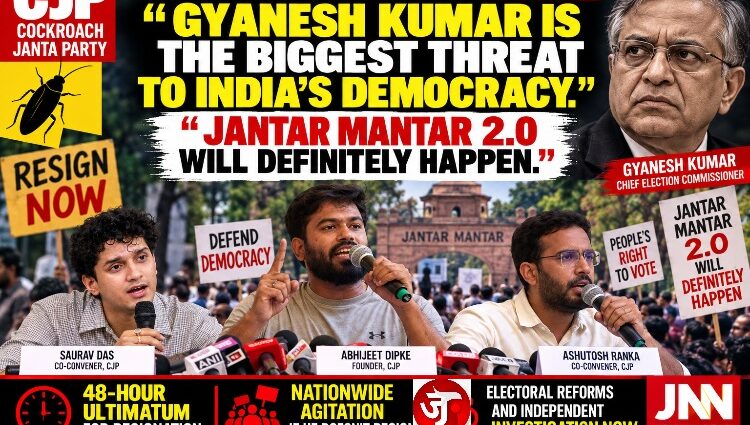
At its press conference in New Delhi on Thursday, the Cockroach Janta Party (CJP) turned its full attention to the Election Commission and Chief Election Commissioner Gyanesh Kumar, delivering a blunt ultimatum: He has to resign within 48 hours!
September 24, 2026: The tone was uncompromising. Resign within 48 hours, or face a nationwide agitation. At the centre of the press conference was CJP founder Abhijeet Dipke, flanked by co-conveners Saurav Das and Ashutosh Ranka.
Dipke did not soften his language. The strongest words came immediately.
“Chief Election Commissioner is the biggest anti-national. Gyanesh Kumar is the biggest anti-national of this country.”
Dipke went further:
“He should resign immediately because he is the biggest threat to India’s democracy.”
The accusation was presented not as a narrow disagreement over the Special Intensive Revision of electoral rolls, but as a fundamental question about who has the right to vote in India.
“What did democracy mean in our country?”
Dipke then turned the argument towards the meaning of democracy itself.
“What did democracy mean in our country? Democracy meant that the people would elect the government.”
He questioned whether that principle was being reversed.
“Since Gyanesh Kumar became the Chief Election Commissioner, the government has been deciding who will be allowed to vote and who will not. Is this democracy?”
And then came the sharper question:
“What kind of definition of democracy is this? You have turned the entire concept of democracy upside down.”
The language made clear that CJP was presenting the voter-roll controversy as something much larger than an administrative dispute.
“48 hours”
Then came the deadline.
“If within 48 hours Gyanesh Kumar doesn’t resign, the Cockroach Janta Party will start a nationwide agitation. We won’t step back till the time Gyanesh Kumar resigns.”
CJP warned that the protest would not remain confined to Delhi. The organisation said it would take the campaign across the country, with Dipke warning of a fresh nationwide mobilisation if the CEC refused to step down.
The threat was given a name. “Jantar Mantar 2.0.”
CJP said that if the 48-hour deadline expired without Kumar’s resignation, another major protest movement would follow.
Dipke had already signalled the confrontation the previous day, writing:
“Election Commission Thik Karo! Important PC tomorrow in Delhi. Gyanesh, it’s done bro.”
The phrase set the tone before the press conference even began.
CJP’s three demands
CJP did not stop at demanding Kumar’s resignation.
The organisation laid out three major demands.
First: Gyanesh Kumar must resign, followed by criminal proceedings against him and those who allegedly directed the disputed actions.
Second: The SIR process and upcoming elections should be put on hold, the electoral roll should be restored to the January 2025 position, and an independent investigation should examine the decision-making surrounding SIR.
Third: The 2023 law governing the appointment and service conditions of the Chief Election Commissioner and Election Commissioners should be repealed and replaced with a framework that CJP says would restore public confidence and involve civil society.
“The electoral process has been rigged”
CJP also alleged that the electoral process itself had been manipulated and that changes to voter rolls were depriving citizens of their right to vote.
Dipke questioned what he described as a pattern in which political forces opposing the BJP allegedly suffered electoral setbacks after the SIR process.
The Election Commission has rejected the broader interpretation of internal differences within the poll panel and has said its decisions, including those concerning SIR, were unanimous.
The press conference repeatedly returned to one fundamental question: Who decides who gets to vote?
CJP argued that a voter could be found eligible at the constituency level and yet remain outside the final electoral roll because of centralised systems governing the processing of electoral-roll decisions.
Saurav Das questioned the role of the Election Commission’s IT infrastructure, while CJP argued that the concentration of electoral-roll powers away from local officials required public scrutiny.
The controversy was therefore framed by CJP as a battle over the basic architecture of voting.
“We won’t back down”
As the press conference moved towards its conclusion, the message remained unchanged.
48 hours.
That was the deadline CJP placed before the Chief Election Commissioner.
And beyond the deadline, Dipke promised a movement that would travel beyond Delhi.
“We won’t back down until he steps down.”
For CJP, the press conference was not simply a demand for the resignation of one Election Commissioner.
It was a declaration that the organisation intends to make electoral reform, voter rights and the functioning of the Election Commission its next major national campaign.
The language was deliberately confrontational and the deadline was deliberately short.
And the final message was unmistakable: Jantar Mantar 2.0 will definitely happen!”
JANPATH NEWS NETWORK (JNN)
Independent. Fearless. On the People’s Path.